John Williams, Treasures of Nhill & District Facebook page, 4 June 2026, Nhill Free Press & Kaniva Times
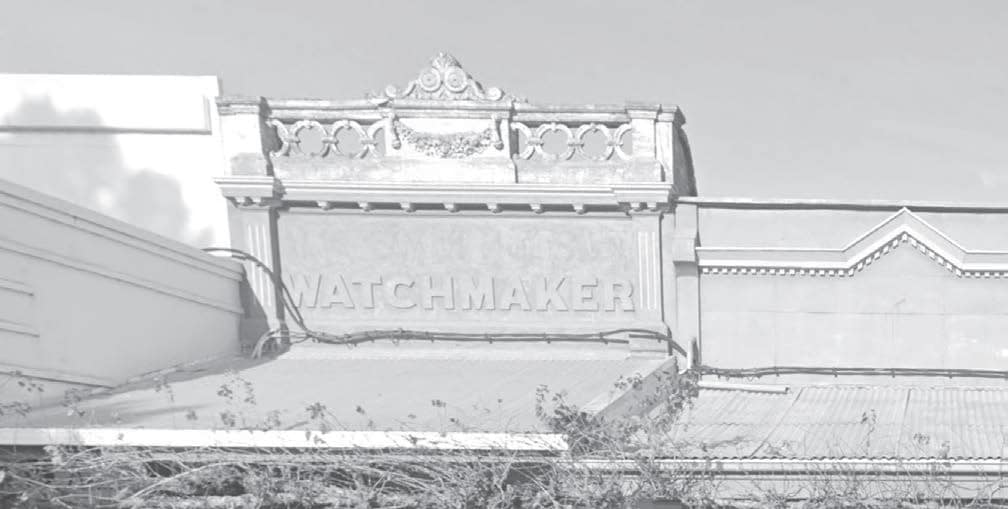
On Victoria Street Nhill, just above the awning of Amber’s café, a single word still rises in relief from the concrete façade: Watchmaker.
It’s a quiet survivor from an era when every town relied on a steady hand, a jeweller’s loupe, and a bench of tiny brass tools to keep the district’s clocks, fob watches, and wedding rings in working order.
For 80 years the shop was synonymous with the Smith family-two generations who polished, repaired, and engraved. But the story of this small building stretches further back, through a succession of earlier jewellers and watchmakers who each left their mark long before the Smiths made it their own.
What stands today as part of a quirky café that was once one of Nhill’s most meticulous workplaces: a place where time was literally taken apart and put back together.
Nhill managed to host not one, but two jewellers named Smith in different eras, leaving me to untangle which Smith was polishing which watch because they were not related.
The first Smith was Peter Cockburn Smith, P.C. Smith, who was an American-born watchmaker and jeweller from Charleston, South Carolina. He immigrated to Victoria in 1857. After operating businesses in Stawell and Ararat alongside his father, he relocated to the one-year-old Nhill and opened a shop In Victoria Street in 1881.
The second and unrelated Smith was John Robieson Smith (Jock) who was born in Scotland and came to Nhill to manage Walter McNee’s Jewellers in Victoria Street, the shop with “Watchmaker” stamped in concrete on the façade.
McNee had taken over the shop in 1911 from William Brooks, the first jeweller watchmaker to operate at that Victoria Street address after shifting his business from Macpherson Street in 1906.
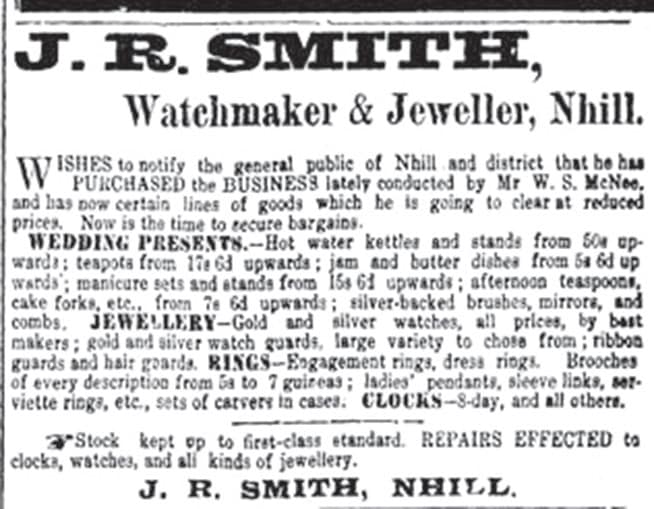
In 1914, “Jock” Smith purchased the business from McNee and began trading under the name J.R. Smith, later J.R. Smith & Son. Over the next decades he built a reputation for precision, reliability, and a shopfront that always had something worth stopping to look at.

During the First World War and throughout the 1920s, Smith regularly travelled to neighbouring towns – Kaniva among them – where he set up temporary window and counter displays in local hotels. His Nhill windows were equally well known: patriotic exhibits, casualty lists, and wartime memorabilia drew crowds, and in 1956 his displays featured specialised Omega timing instruments to mark the Melbourne Olympic Games.
Jock’s son, John David Smith, apprenticed under his father and continued the long standing pairing of watchmaking and jewellery – a practical combination, given the shared tools and the shared patience required. After Jock’s death in 1959, John carried on the business until 1994.
Away from the bench, John was a multi instrumentalist and Bandmaster of the Nhill Brass Band for 29 years. He was often called upon to play the Last Post at memorial services and gravesides.
After his retirementt he remembered the Victoria Street shop as relentlessly busy – often three weeks behind. Watches were the greatest challenge: with around 3,000 different types on the market, parts often had to be sourced from Melbourne, and in a typical year he repaired up to 1,500 watches and clocks. On one occasion he threw two troublesome clocks into the Nhill depot rubbish heap, only for a local to bring them back asking whether they could be fixed.
Engagement rings were not a strong seller – couples were too embarrassed to shop locally – but wedding rings sold steadily.
When asked to sum up a lifetime in the jeweller’s shop, John Smith offered a characteristically understated verdict:
“Not too bad at all.”
John died in Nhill in 1999 aged 70.
The Watchmaker shop became a florist shop in 1994 “Classic Blooms by Suz”.
See all the images in the issue.
This article appeared in the Nhill Free Press & Kaniva Times, 17 June 2026.