

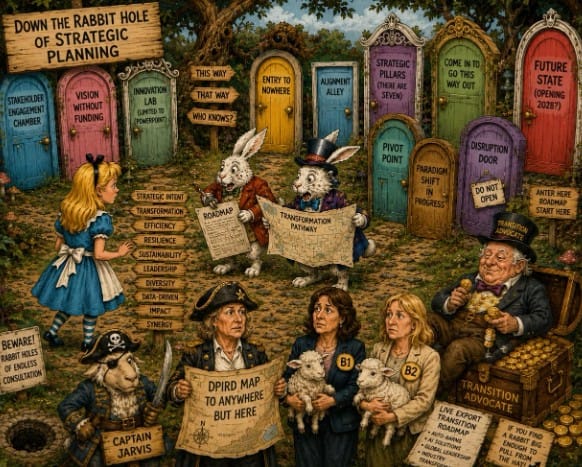
“Would you tell me, please, which way I ought to go from here?” asked Alice.
“That depends a good deal on where you want to get to,” replied the Cheshire Cat.
More than 150 years later, Lewis Carroll’s observation remains a useful test of strategic planning. Before an organisation decides how to get somewhere, it should first be clear about where it is going.
That sounds obvious. Apparently, it is not.
We are living through a golden age of strategic plans, roadmaps, frameworks, strategic intents, transformation agendas, pathways, pillars and vision statements. Governments have them. Industry bodies have them. Universities have them. Local councils have them. Sporting clubs have them. Corporations have them. The sheep industry is developing another one, while DPIRD is still working on replacing one that officially expired two years ago.
The irony is that the process of writing strategic plans has become almost as complicated as the problems they are supposed to solve.
Reality, unfortunately, has an irritating habit of ignoring strategic plans. Every plan looks impressive until it meets the real world. Yet many modern strategies seem to be written for a make-believe world not unlike the one Alice stumbled into in Wonderland.
Over the past 20 years, management language has steadily drifted away from clear objectives and towards documents labelled Strategic Intent, Strategic Frameworks, Roadmaps and Transformation Strategies. The words have become grander. The meaning has often become weaker.
A traditional strategy for the WA sheep industry might once have said:
“Lift returns from the Western Australian sheep industry to match those achieved by the grain industry.”
That is simple, measurable and brutal.
By contrast, the live export transition roadmap offers:
“A confident, adaptable WA sheep industry—supporting people across a profitable supply chain to meet changing markets, strengthened by innovation, science, and technology.”
One statement tells you what must be achieved. The other tells you how the authors would like the industry to feel if it ever arrives.
DPIRD offers a similar case study. Its website still links to the Primary Industries Plan 2020–2024, now well beyond its stated timeframe. In its place sits DPIRD Strategic Intent 2022–26, with the uplifting purpose statement:
“Enable enduring prosperity for all Western Australians through our work with regions and primary industries.”
It promises to Protect, Grow and Innovate, supported by values such as working together, acting with integrity, embracing curiosity and creativity, and aspiring for a better future.
Curiosity and creativity are admirable qualities, although they sound more like an arts festival than a department responsible for agriculture, biosecurity and fisheries.
The more important question is whether any of it can actually be delivered.
That is where so many modern strategies fail. When organisations lack the money, authority or practical levers to drive change, aspiration becomes a wish list disguised as strategy.
That is the weakness in the live export transition roadmap. It is also the risk with Sheep Producers Australia’s proposed Future Flock Strategy. It will almost certainly contain worthy ambitions about leadership, innovation, efficiency, sustainability, workforce attraction, artificial intelligence, data and environmental stewardship. Most of it will sound sensible because most of it will be.
The problem is not the ambition. The problem is the absence of any clear link between the ambition, the resources available and the organisation responsible for delivering it.
A strategy is not a strategy simply because it describes a desirable destination. At some point, someone still has to build the road, pay for it and convince people to travel down it.
I cannot see that either SPA or DPIRD has the funding or horsepower to drive the scale of transformation being implied. Certainly not the sort of grand industry reinvention sitting behind the live export transition roadmap.
If SPA and DPIRD continue down the rabbit hole of modern management planning, the result will resemble a guided tour through Wonderland. There will be doors leading nowhere and keys that fit no locks. There will be signs saying “Come In to Go This Way Out” and “Enter Here but Don’t Start Here”. Every pathway will promise progress and every turn will reveal another strategic direction.
By the end, readers may find themselves sympathising with Alice and seeking advice from the Cheshire Cat on where they are actually supposed to be going.
A proper strategy identifies objectives, allocates resources, assigns responsibility and sets priorities. Most importantly, it focuses on actions the organisation itself can reasonably influence.
The further strategic planning drifts from those principles, the more it starts to resemble literature rather than management.
Simple objectives are replaced with complexity. Clarity gives way to jargon. Common sense disappears beneath layers of stakeholder engagement, transformation pathways, capability frameworks and enabling themes.
This was my criticism of the live export roadmap. Not that the ideas were all wrong, but that the resources did not match the ambition. There is no way a few million dollars will transform an entire industry if the people expected to drive the transformation do not have the government funding to steer the industry out of the rabbit warren that the federal government has dumped them in.
Successful organisations tend to keep strategy simple, measurable and achievable.
In 1962, President John F. Kennedy challenged NASA to land a man on the moon before the decade was out. More recently, Elon Musk has set SpaceX the goal of establishing a settlement on Mars. Both are ambitious objectives, but they share three essential characteristics: a clear destination, measurable outcomes and organisations with the resources and credibility to pursue them.
When Jack Welch ran GE, his strategy for underperforming divisions was brutally simple: “Fix it, sell it or close it.”
When Steve Jobs returned to Apple, he cut dozens of products and focused the company on a handful that mattered. His philosophy was simple: focus.
Jeff Bezos built Amazon around three enduring customer promises: low prices, huge selection and fast delivery.
Now compare those examples with the average modern strategic plan. Too often it produces a vision statement nobody can remember, a plan nobody knows how to implement and an outcome nobody can measure.
The more successful an organisation becomes, the simpler its strategy often appears. The less successful it becomes, the more likely it is to commission another roadmap, framework or transformation agenda.
Of course, having a simple strategy is no guarantee of success. Lehman Brothers declared its vision was to create “superior value for clients, shareholders and employees through innovation, teamwork and excellence.” Enron aimed “to become the world’s leading company.”
We all know how those stories ended.
Which brings us back to DPIRD.
In its Primary Industries Plan 2024 Update, the department said it was developing a new plan based on short-to medium-term priorities with a 10-year outlook. That was in late 2024. Through 2025 we waited. In January this year, ACIL consultants contacted stakeholders seeking feedback on DPIRD’s next plan. Another six months have passed and we are still waiting.
That tells us plenty about why DPIRD appears stuck in the doldrums. One wonders how much management time is spent planning the plan. After more than two years, one assumes the final document will be thoroughly considered. The bigger question is whether it will be grounded in the reality of a department operating under severe budget constraints.
That reality is hard to avoid.
Over the forward estimates, DPIRD’s budget shows major reductions:
Biosecurity and integrity services fall from $143 million to $111 million.
Natural resource management falls from $110 million to $79 million.
Regional technical services fall from $108 million to $72 million.
Total cost of services falls from $727 million to $467 million.
There is no credible way this department can expand agriculture, protect agriculture, manage biosecurity, regulate fisheries, grow aquaculture, revitalise regional communities, drive innovation, increase exports, engage Indigenous communities, address climate change and transform the food sector with the budget Treasury has allocated.
That is not strategy. It is aspiration unconstrained by resources.
The next DPIRD plan does not need another consultant to discover more pillars. It needs to confront the obvious. The department is being asked to do too much with too little. It must decide what matters most and stop pretending it can do everything.
If I could offer one piece of advice to the Director General, it would be this: before signing off on the next strategic plan, feed the draft and the budget papers into ChatGPT and ask it to rewrite the document in plain English, remove every motherhood statement and put it against the budget over the next four years and identify what can actually be delivered with the money available.
The result could hardly be worse than another polished document heading towards the Minister’s desk promising enduring prosperity for all Western Australians.
Besides the words “Enduring prosperity for all Western Australians” should not sit in a departmental strategy. It is not a strategy. It is a political slogan, better left to political parties.
A useful DPIRD strategy would be less inspiring but more honest. It would say what the department will do, what it will stop doing, what it can no longer afford, and what risks government is choosing to accept.
The difficulty, as always, is not writing the aspiration. The difficulty is making choices.
That is ultimately the challenge facing both DPIRD and the sheep industry. Not finding another pillar, pathway or roadmap, but deciding what matters most and focusing available resources on delivering it.
As the Cheshire Cat reminded Alice, the road you take depends on where you want to get to.
The problem is not that strategic plans are useless. The problem is that too many modern plans confuse aspiration with strategy.
A strategy requires choices. It requires priorities. Most importantly, it requires saying no.
The next DPIRD plan and the proposed Future Flock Strategy will be worth reading for one reason. They will reveal whether their leadership is prepared to make those choices.
Because reality, unlike the Cheshire Cat, has little patience for imaginary destinations. Eventually every roadmap must leave Wonderland and face the real world.