

Rabobank, Media Release, 16 June 2026
Sentiment among Australia’s agricultural producers continued to track lower this quarter, with concerns about cost pressures in the wake of Middle Eastern tensions remaining top of mind for farmers across the country.
The quarter two Rabobank Rural Confidence Survey, released today, found national sentiment at its lowest point since November 2006 as it dropped to a net reading of – 48 per cent.
Concerns about the escalating cost and potential shortage of key farm inputs – such as fuel and fertiliser – contributed to more than half of the nation’s farmers expecting conditions in the agricultural economy to worsen in the coming 12 months (58 per cent, up from 28 per cent last quarter).
The latest survey, completed last month, found only one in 10 farmers reported having a positive outlook on the year ahead (at 10 per cent, down from 19 per cent in quarter one), while 28 per cent expected conditions would stay the same (down from 50 per cent with that view previously).
Rising input costs were by far the leading worry for Australian farmers, with 60 per cent citing this as a key concern (up from 36 per cent last quarter).
‘Energy security’ had also emerged as a notable concern for farmers for the first time this survey – cited by 26 per cent of respondents nationally.
Rabobank group executive for Country Banking Australia Marcel van Doremaele said across the country, farmers have been dealing with sustained pressure from higher input costs – particularly fuel, fertiliser and freight – and this was exacerbated by the impacts of the Middle East conflict and continued to be the dominant factor weighing on confidence this quarter,” he said.
“Many producers particularly faced challenges to their day-to-day operations through early- mid autumn, which aligned with winter crop planting. Not only did diesel prices surge to above $3 a litre, but supply chain disruptions created logistical challenges for many farmers accessing on-farm fuel deliveries. Fertiliser has been a major worry for many, with higher costs and availability concerns.
“Now, as we move into the middle of the year, the cost pressures are becoming more embedded in farming businesses and producers have been making strategic decisions about cropping programs, livestock management and capital expenditure as they work to protect margins.”
Mr van Doremaele said Australian farmers would be closely watching the latest developments regarding a potential resolution to the US/Iran war and the impacts on the opening of the Strait of Hormuz.
Mr van Doremaele said, while a third of farmers (33 per cent) reported being concerned about drought in the survey, this had eased somewhat since the previous quarter. In addition, 27 per cent reported expecting positive seasonal conditions to benefit the sector in the year ahead.
“And rain in a number of states in more recent weeks will have benefitted those farmers’ who received it,” he said. “In dry areas, such as the Central West of New South Wales, this rainfall will have been particularly welcomed.”
However, he noted, the long-range forecast shows rainfall is likely to be below average across parts of southern and eastern Australia for July to August, with an El Nino expected to be officially declared by the Bureau of Meteorology.
Favourable signals for key commodity markets were also helping to balance out farmer concerns about production costs, Mr van Doremaele said.
This quarter, 44 per cent of Australian farmers predicted rising commodity prices will have a positive impact on the agricultural economy over the next 12 months (similar to 42 per cent last quarter).
“Many farmers continue to see opportunities in commodity markets – both domestic and global,” he said. “Livestock markets remain a source of resilience, while signals are more complex for grain producers.”
States
Rural confidence was down in all states this quarter, with rising input costs the leading cause for concern in every region.
Victorian and Tasmanian farmers, though, shared the spot for the highest confidence among the states, both sitting at a net reading of -38 per cent.
“Victorian farmers overall are balancing cost pressures with expectations of good commodity prices, which has seen their investment intentions remain stable,” Mr van Doremaele said. “While in Tasmania, enterprise diversity has been providing farmers with flexibility to respond to high input prices by adjusting the area planted to high-input crops.”
New South Wales farmers were the least confident in the country this quarter, with the state’s net rural sentiment index dropping to -55 per cent on the back of elevated input costs coupled with dry weather conditions across parts of the state in much of autumn.
“However, nearly half of NSW farmers are hopeful rising commodity prices will deliver a positive impact over the year ahead and since the survey, spirits have been buoyed in regions where beneficial rain fell through late May,” Mr van Doremaele said.
Rural sentiment in Queensland continued a downward trend seen since late last year, falling to a net reading of -54 per cent this quarter.
“Despite confidence among Queensland producers sliding to what is the lowest point since tracking began in 2001, producers in the state continue to demonstrate a more positive longer-term outlook with more than half intending to maintain current investment levels and 17 per cent planning to increase investment,” Mr van Doremaele said.
In Western Australia, confidence dipped to a net reading of -49 per cent, with 71 per cent of farmers concerned rising input costs will have a negative impact on the economy.
“The shining light for WA producers is a solid start to the season, but growers will be keeping a close eye on global fertiliser markets and commodity market movements as the year progresses,” Mr van Doremaele said.
Likewise in South Australia, although confidence dipped to net -39 per cent, farmers have received a good start to the season post-survey and optimism on-the-ground appears to be building since the field work was conducted, he said.
Commodities
The quarter two survey found sentiment had tracked lower across all agricultural commodities this quarter.
Sheep producers remained the most optimistic commodity group, although confidence eased to net -27 per cent amid higher input costs and seasonal uncertainty.
“Although we did see a dip in lamb and mutton prices at the end of April, they corrected and remain at historically high levels and RaboResearch forecasts this will continue as we head towards the traditionally lower slaughter months of July to August,” Mr van Doremaele said. “Wool prices are also performing well, underpinning the confidence of producers despite elevated production costs.”
Beef producer confidence took a tumble this quarter, driven down to net -40 per cent with nearly half citing elevated input costs and seasonal conditions as their main concerns.
At the time of the survey, Mr van Doremaele said, cattle prices had also been tracked lower, albeit off a high base.
“Having now recovered these losses, cattle prices are expected to track close to current levels through early winter, with drought-related volumes of cattle being sold in northern NSW contracting and global markets for Australian beef remaining strong,” he said.
Grain grower confidence fell sharply to net -61 per cent reflecting the sector’s exposure to high farm input prices – especially fuel and fertiliser – paired with weaker price signals and concern about fertiliser shortage from global supply chain reductions.
“We are seeing some deliberate decisions around whether to apply or hold off urea in response to rain events as growers balance the risk-reward to yield and budgets,” Mr van Doremaele said.
Net sentiment dropped to a reading of net -60 per cent in the dairy industry – another sector exposed to movement in fuel, freight and fertiliser costs.
“Milk producers have been able to access temporary farmer support payments from several dairy companies in response to escalating supply chain and input cost pressures,” Mr van Doremaele said. “This has provided some margin relief, but dairy farmers will need to focus on careful cost control and operational resilience for the season ahead, with the announced new season milk prices coming in slightly below our expectation.”
Sugar cane and cotton growers – who are highly exposed to elevated input costs – recorded their lowest sentiment levels since the survey began in 2001.
Sugar cane growers had the lowest confidence among all commodities at net -86 per cent, with input cost concerns paired with worry about falling commodity prices. Cotton grower confidence dropped to net -84 per cent on the back of rising costs and drought concern, but they reported increased optimism about prices.
Investment intentions
Farmers’ investment appetite softened this quarter in line with overall sentiment, although the number who plan to maintain investment in their farm businesses at current levels in the year ahead still stood at 57 per cent (compared with 60 per cent last survey). There was a reduction in those farmers intending to increase investment (to 21 per cent, from 28 per cent last quarter). Media Release June 16, 2026 5 And those farmers intending to decrease their farm business investment doubled from the previous quarter (up to 19 per cent from 10 per cent).
“Capital expenditure remains a priority for Australian farmers, however they’ve pulled back spending plans as they navigate higher production costs,” Mr van Doremaele said.
Just over half of those surveyed (56 per cent), plan to invest in on-farm infrastructure, and around a quarter to adopt new technologies, increase livestock or purchase new plant/machinery – although intention to invest in all eased back on the previous quarter.
There was also a corresponding drop in planned purchase of farmland. Nationally, 10 per cent of farmers indicated they intended to buy land in the coming 12 months (down from 17 per cent last quarter). Victorian farmers were the most enthusiastic about growing their farming footprint.
Rabobank Rural Confidence Index
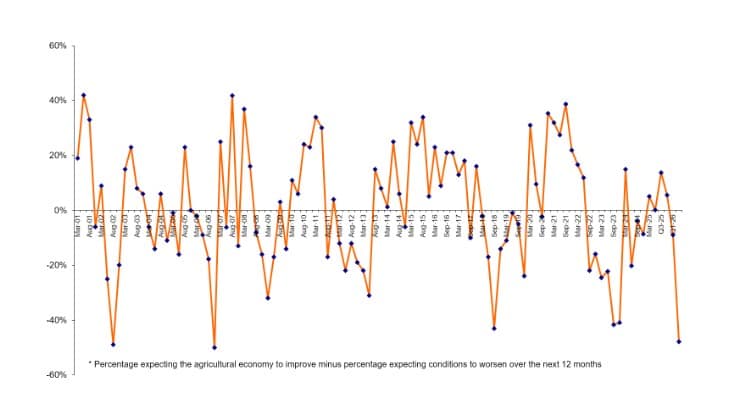
A comprehensive monitor of outlook and sentiment in Australian rural industries, the Rabobank Rural Confidence Survey questions an average of 700 primary producers across a wide range of commodities and geographical areas throughout Australia on a quarterly basis. The most robust study of its type in Australia, the Rabobank Rural Confidence Survey has been conducted since 2001 by an independent research organisation. The next results are scheduled for release in September 2026.