

The Hon. Beverley McArthur, Member for Western Victoria Region, Leader of the Opposition in the Legislative Council, Shadow Minister for Local Government, Shadow Minister for Small Business, Media Release, 28 April 2026
In October 2023, Victorians joined the rest of the country in rejecting the Voice to Parliament. It was a clear result, delivered by a clear majority, after months of national debate about whether race should have a formal place in the machinery of government. The answer was no.
And yet here in Victoria, the Allan Labor Government was already pursuing exactly that goal. Treaty negotiations had begun the previous year, and by September 2025 the Statewide Treaty Bill was before Parliament. It passed the Legislative Council on October 30 by 21 votes to 16, with the Liberals and Nationals opposed. Royal Assent followed two weeks later. The Act commences this month.
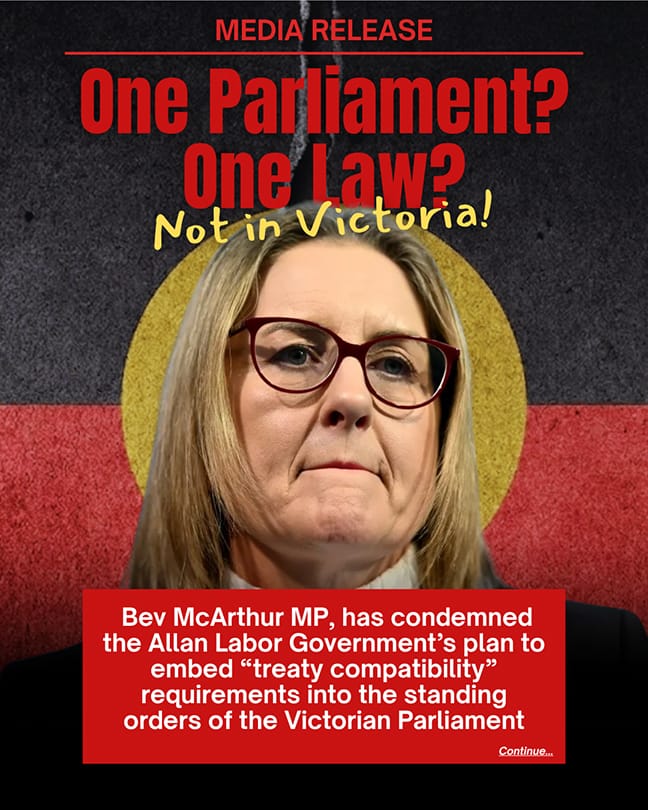
The pace since then has been striking. Gellung Warl, the statutory body at the heart of the treaty, held its first elections last month. Its 33 assembly members will be paid nearly $200,000 each, on par with state MPs, with the total wage bill alone running to $6.8 million a year. Annual funding starts at $24 million and will rise beyond $70 million by the end of the decade. And just last sitting week, the government moved to embed “treaty compatibility” requirements into the standing orders of the Parliament itself.
What that means, in practice, is that every future Bill will need to pass through a separate, identity-based approval process, equating the treaty framework with the Charter of Human Rights and Responsibilities. Yet I have to ask: can anyone clearly define what “treaty compatibility” means, what constitutes sufficient consultation, or where the limits fall? I don’t believe they can. The result will be delay, confusion, and constant argument, not better laws. This is presented as procedural and modest. I think it is neither.
Worse, each statement will require the sponsoring MP to assess whether the Bill is compatible with “addressing the disadvantage arising from the historical wrongs and ongoing injustices of colonisation.” That is not some neutral procedural test. It requires that every Member of Parliament adopt a single, legislated interpretation of history when proposing law. There are echoes of totalitarianism in this insistence on state-approved history.
The process creates what I can only describe as a second political gatekeeper in the passage of every law. Members of Parliament are elected by all Victorians and accountable to all Victorians. A body elected by only a small subset of Victorians should not have a privileged procedural role in the passage of every law. To embed one is to weaken our parliament’s sovereignty and dilute democratic accountability.
I believe reconciliation must be grounded in honesty, equality and shared purpose. Those are not abstract ideals but preconditions for a stable and confident democracy. When we depart from them, even with good intentions, we risk undermining the very cohesion we claim to advance.
Labor argues this is about inclusion. But inclusion that depends on differentiated structures of authority is, by definition, exclusionary. And the deeper problem, it seems to me, is what this says about citizenship and equality. Every Victorian lives under the laws passed by this Parliament. That means farmers, small business owners, migrants, the young and the old, even corporations and unions. None gets a special procedural pathway. None is offered a privileged veto point in the legislative process. Nor, I would argue, should they be. Equality before the law means one standard, applied to all.
I have always supported measures that address genuine disadvantage in Indigenous communities. But for me, help should be directed to people because they need it, not because of their ancestry. Outcomes are achieved through targeted and practical measures that address disadvantage directly. This proposal delivers none of that. It entrenches a new layer of lawyers, activists and bureaucrats living off consultation, interpretation and compliance, while the communities they claim to serve see no improvement in their daily lives.
I worry the government never took Victorians with it on this journey. Most have no idea what is contained in this framework. It has not been explained or offered for public scrutiny, and the principle has been pursued as though the Voice referendum result were entirely irrelevant.
We are told these measures are limited. That is, to say the least, questionable. What we have is not a definitive, specific, plan, but an enabling framework, drafted in deliberately open-ended language. Bureaucracies and political ideas alike rarely shrink within their boundaries. They grow, they evolve, they demand more. Nothing in this framework prevents any of that.
At its core, Victoria’s Treaty journey is fatally flawed, doomed by a contradiction it will never be able to resolve. It claims to promote unity while requiring division. It claims to strengthen democracy while diluting its authority. And it claims to advance reconciliation while embedding separation into the everyday machinery of government.
Governments are defined by their priorities, and at a time when Victorians are under real financial pressure, building an expensive new layer of governance and embedding identity-based processes into Parliament reflects, to my mind, a serious misjudgement.
I said at the outset that Victorians had answered the question of whether race should have a formal place in the machinery of government, and their answer was no. That answer should be honoured not sidestepped. Victoria has always drawn its strength from the simple and enduring idea that one Parliament, elected by all, makes one law that applies equally to every citizen. That is the Victorian Liberal government will defend, and we will begin by removing this treaty within 100 days of taking office.