


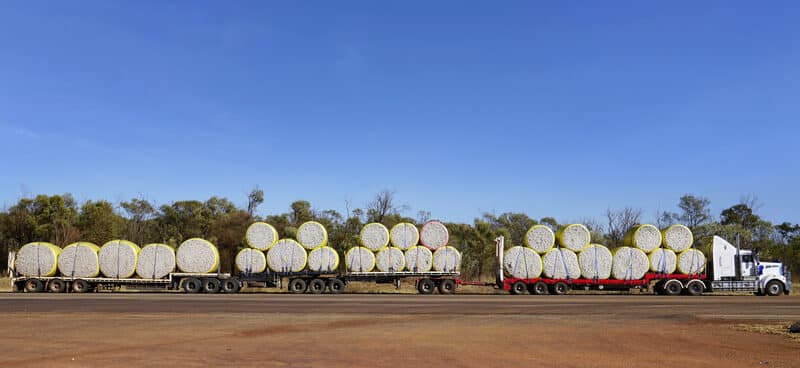
Photo: Ekays.
Matt Barrie, Executive Chairman of Loadshift and Chief Executive of Freelancer Limited (ASX:FLN), 13 May 2026
Australia burns through 160 million litres of liquid fuels every day. Diesel, petrol, aviation fuel – 160 million litres, gone, every 24 hours.

So when the Treasurer stood up last night and announced a billion litres of new fuel storage as part of an $11.9 billion security package, it probably sounded impressive to people watching at home. A billion litres. That’s a big number.
It’s less than a week’s supply.
We went into this crisis – a crisis triggered by a war in the Middle East that shut down the world’s most important oil chokepoint – with roughly 26 days of diesel reserves. The international benchmark set by the International Energy Agency is 90 days. Japan holds 220. We were at 26, for a country the size of a continent, where a single freight run from Sydney to Perth covers more than 4,000 kilometres and burns well over a thousand litres of diesel.
The Budget gets us to around 50 days for diesel. That’s better than 26. But it’s not even close to the 90-day minimum we’re supposed to be meeting, let alone what a country this dependent on trucked freight actually needs. A three-week blockade of Australia’s fuel supply and everything stops. Construction, farming, food, mining – all of it.
The excise cut that wasn’t extended
The single most important thing the government could have done for freight operators last night was extend the fuel excise cut beyond June 30. They didn’t. The Treasurer left the “door open” but made no commitment.
The cut worked. Since it came in on 1 April, diesel dropped from a peak of $2.76 a litre to around $2.00. That’s the proof. But it expires in seven weeks and the conflict that caused the crisis hasn’t been resolved. Operators who spent March and April watching their fuel bills double – and in some cases, being stranded at fuel stops in remote Australia – are now looking at a 26-cent-a-litre jump on July 1 with no clarity on whether the government will act.
At Loadshift, we’ve seen what the crisis has done to the industry first-hand. Job postings on our platform are up 18.5 per cent on last year, with more than 18,000 freight jobs posted in 2026 so far. That’s not a sign of booming business. It’s a sign that drivers who used to run empty between jobs can’t afford to anymore. They’re using Loadshift to pick up backloads – smaller jobs on the way home – because every litre counts.
Interest-free loans nobody wants
The Budget also announced $1 billion in interest-free loans for the logistics industry. We went to our driver network – the largest heavy haulage network in Australia – and asked what they thought.
Not a single operator was interested.
The feedback was blunt. If you’re already in negative cash flow because your fuel costs have doubled, why would the answer be to take on more debt? Even at zero interest, drivers don’t trust that the terms won’t change – and after watching this government reshape the tax system overnight, you can understand why.
What operators need isn’t loans. They need the cost of fuel to come down and stay down. Scrapping excise on diesel entirely – or at a minimum, permanently zeroing excise on diesel refined in Australia – would do more for the industry than any lending scheme. It would also give investors a reason to build domestic refining capacity, which is the only long-term fix for a country that imports more diesel by volume than anywhere else on earth and has just two refineries left.
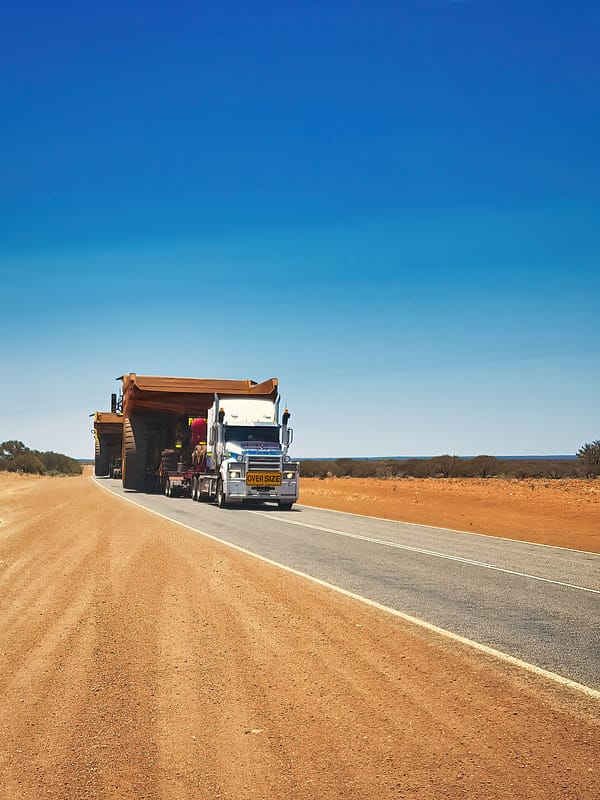
Photo: Hans Wismeijer.
The EV fantasy
There was talk in the Budget about heavy vehicle reform, which in practice means more capital expenditure for operators as the government tries to push the freight industry toward electric vehicles.
This is detached from reality.
The average distance a Loadshift job covers is 1,450 kilometres. Our drivers are moving heavy machinery in and out of mine sites, shifting building materials across state borders, hauling agricultural equipment through remote communities where the nearest town is three hours away. You can run an electric vehicle around a golf course or do a metro flower delivery. You cannot haul 40 tonnes of freight across the Nullarbor with a battery.
We surveyed 82 freight operators. Not one had considered transitioning to electric trucks. Two-thirds said a mandatory transition would threaten their survival. This country runs on diesel. The government’s policy settings need to reflect that, not some fantasy about an energy transition that the freight industry physically cannot make.
Capital gains and the bigger picture
Then there’s the damage the capital gains tax changes will do. The budget effectively doubled the tax on capital gains by replacing the 50 per cent CGT discount with an inflation-indexation model and a 30 per cent minimum rate. For transport operators trying to raise money – whether that’s to buy new trucks, expand a fleet, or just refinance during a crisis – capital just got twice as expensive.
This isn’t just a freight problem. Every small business in the country that needs to attract investment or sell assets is now worse off. But it hits particularly hard in an industry where the margins were already razor-thin before the fuel crisis started.
What should have been in the Budget
The freight industry needed three things from this budget.
First, extend the excise cut – or better yet, scrap diesel excise altogether and permanently zero-rate domestically refined fuel to incentivise investment in Australian refining capacity.
Second, build serious fuel reserves. Not 50 days. Not 90. We’re the world’s biggest diesel importer with a country the size of a continent. We should be holding reserves that reflect that – closer to a year’s supply, not a few weeks.
Third, stop trying to electrify an industry that can’t be electrified. Every dollar spent on heavy vehicle “reform” that assumes electric trucks are viable for long-haul freight is a dollar wasted. Put that money into roads, into fuel infrastructure, into actually supporting the men and women who keep this country’s supply chain moving.
The freight industry doesn’t ask for much attention on Budget night. But when the shelves are stocked, the construction sites are running, and the mines are operating – a truck driver made that happen. Last night’s budget should have done more for them.
Related stories: Federal Budget 2026-27

