


The first major project unveiled by the Australasian Space Innovation Institute, the National Digital Twin for Australian Agriculture holds immense potential for the agricultural industry to harness existing national datasets and observation systems to model scenarios, test options and inform discussions and decisions, including at scale.
Australian Rural & Regional News found out a good deal through an in depth interview with Andrew Beveridge, Director of the National Digital Twin for Australian Agriculture (set out below the ASII announcement).
Australasian Space Innovation Institute unveils National Digital Twin for Australian Agriculture as its first major project
The ASII commits $15 million to develop a sovereign, AI-enabled geospatial national digital twin to boost productivity, sustainability and resilience across the sector
Australasian Space Innovation Institute, Media Release, 17 February 2026
The Australasian Space Innovation Institute (ASII), an independent, not-for-profit organisation translating world-class research into space-enabled solutions, has launched a $15 million National Digital Twin for Australian Agriculture to establish a capability for coordinated decision-making and innovation across the agriculture, forestry and fisheries system at a national scale.
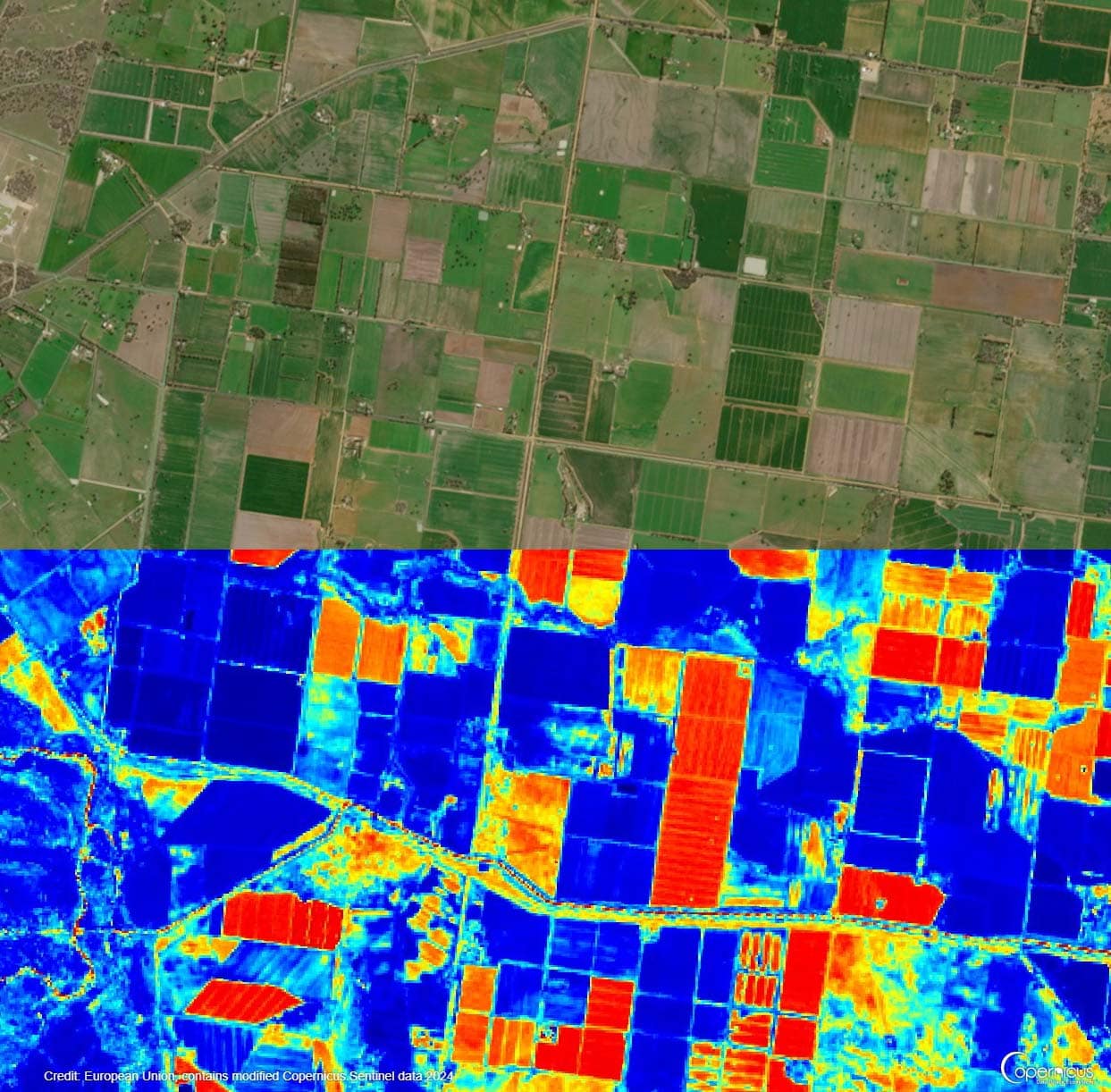
This flagship initiative will deliver a sovereign, AI-enabled geospatial digital twin that integrates satellite Earth Observation, IoT and sensor data, climate data and agronomic models into a shared digital environment to create a dynamic, virtual replica of Australia’s agricultural landscapes, designed as a whole-of-agriculture capability.
Supported by Elders, Meat & Livestock Australia and Charles Sturt University (CSU), the digital twin will serve as a living R&D engine for faster, lower-risk innovation, empowering industry stakeholders to lift productivity, strengthen resilience and accelerate growth across the entire sector. Its AI-enabled capabilities support predictive scenario modelling across climate resilience, biosecurity, water management and productivity, enabling decision-makers to test options, anticipate risks and optimise actions before implementation.
Professor Andy Koronios, founding CEO and Managing Director of ASII, said: “Australia has world-class agricultural, forestry and fisheries capability, but we lack a shared national capability to turn that strength into decision-ready insight at scale.
“The National Digital Twin provides that missing layer: a sovereign, AI-enabled environment where Australia can model scenarios, test outcomes, and make better decisions across productivity, resilience and policy. It is a national infrastructure for public good, best stewarded by an independent, not-for-profit institute like the ASII, for the benefit of the nation.”
Mick Crowley, Managing Director, Meat & Livestock Australia, said: “The Digital Twin creates the foundation for a new virtual R&D capability: scenario modelling and hypothesis testing inside a replica of agricultural environments. That means we can test livestock management options and research questions faster, refine trials before we invest in large scale field trials, adoption or commercialisation. Done well, this approach can save millions of dollars and years of research time compared with traditional methods, while lifting confidence in what we deploy at scale.”
Professor Renée Leon, Vice Chancellor, CSU, said, “The National Digital Twin for Australian Agriculture initiative is an important step forward for the whole sector. The Australian Agricultural Data Exchange at Charles Sturt University is already proving essential in bringing together relevant agricultural data. Now working with the National Digital Twin, they will jointly operate to transform Australia’s fragmented datasets into scalable, trusted outcomes for research, industry, and policy. This will equip our experts with the necessary information and linked data they need to carry out more effective experimentation, test hypotheses, and refine trials.”
Mark Allison, Managing Director and CEO of Elders and board member of the ASII, said, “Elders’ strength has always been our people and our relationships with farmers. The National Digital Twin builds on that by giving agronomists, advisors and agtech providers access to trusted, nationally consistent intelligence and a powerful environment to test and refine ideas before they reach the paddock. It aims to strengthen the advice that can be provided, while keeping relationships and judgement firmly with the advisor.”
Questions from Australian Rural & Regional News, answered by
Andrew Beveridge, Director of the National Digital Twin for Australian Agriculture,
Australasian Space Innovation Institute
ARR.News: It is described as the first national-scale sovereign, AI-enabled virtual copy of Australia’s agricultural landscape.” Can you explain what is meant by “sovereign” in this context?
Andrew Beveridge: In this context, “sovereign” means that Australia retains control over the critical data, infrastructure, and decision-support capability that underpins its agricultural system.
Today, much of the data used to understand Australia’s land, water and production systems (particularly satellite Earth observation) is sourced from overseas platforms and processed offshore. While these services are valuable, they create a level of dependency in increasingly strategic areas.
The National Digital Twin is about reducing that dependency over time, by ensuring that:
- core datasets relevant to Australian agriculture can be accessed, integrated and governed within Australia;
- the modelling capability, how data is turned into insights, is developed and maintained domestically; and
- Australia retains decision-making independence in how its agricultural systems are analysed, managed and optimised.
Importantly, “sovereign” does not mean isolation. Australia will continue to work with international partners and utilise global data sources.
Rather, it means that Australia is not solely reliant on external systems for critical insights about its own land, food production and environmental systems.
Given Australia’s role as a major global food exporter, and the increasing pressures from climate variability, biosecurity risks and supply chain disruption, having this level of sovereign capability is about resilience, security and long-term national interest – not just technology.
ARR.News: This “dynamic virtual replica of Australia’s agricultural, forestry and fisheries systems” – is it derived from real analysis of all land and water across Australia? Ie has there been an examination of all properties, land and waterways to develop it?
Andrew Beveridge: No. The National Digital Twin is not created by surveying every individual property or farm in Australia.
Instead, it integrates existing national datasets and observation systems, such as satellite Earth observation, weather systems, water monitoring, soil maps, and agricultural production statistics. These datasets already provide extensive coverage of Australia’s landscapes.
The Digital Twin seeks to bring these data sources together into a shared modelling environment that allows researchers, industry and government to analyse agricultural systems at multiple scales – from regional landscapes to national production systems.
Importantly, the system is progressively refined over time. As new data sources become available – including improved satellite data, sensor networks, and validated research models – the digital twin becomes more detailed and accurate.
The aim is not to monitor every individual farm, but to provide the capability to understand trends, risks and opportunities across Australian agriculture.
ARR.News: What level of detail does it include? For instance, does it count stock, crops, measure dam levels, trees, tree coverage and health, soil quality, wildlife (eg koalas), fish, weeds, invasive species and feral animals, fencing, roads?
Andrew Beveridge: The National Digital Twin is designed to provide insights at multiple scales, rather than act as a system that directly monitors every individual asset on every farm.
At a national and regional level, it can integrate data to understand patterns such as:
- crop performance and seasonal variability;
- soil moisture and water availability trends;
- vegetation condition and land use change;
- biosecurity risks, including weeds and invasive species; and
- environmental indicators such as ground cover, tree health and biodiversity.
As more data sources are integrated over time, the resolution and usefulness of these insights will continue to improve.
However, a key principle of the Digital Twin is that it does not replace the role of farmers, agronomists, or AgTech providers. Companies like CropX and others in the AgTech ecosystem already have direct relationships with producers and provide trusted, paddock-level advice based on sensors, farm data and agronomic expertise.
The role of the Digital Twin is to sit behind and alongside these services, by:
- providing a validated, national-scale context;
- improving the quality and consistency of underlying data and models; and
- enabling service providers to enhance their existing tools and advice.
In practice, this means a farmer is far more likely to experience the Digital Twin through the platforms and advisors they already trust, rather than interacting with it directly.
This approach ensures that insights are not only technically robust, but also relevant, practical and grounded in real-world farming decisions.
ARR.News: Are permissions from any landholders or other bodies required to conduct the surveys needed to gather this information?
Andrew Beveridge: The National Digital Twin will primarily rely on existing datasets that are already collected and used for scientific, environmental or agricultural purposes.
This includes information from sources such as:
- Satellite Earth observation data;
- weather and climate monitoring systems;
- water and soil databases; and
- agricultural statistics and research datasets.
The Digital Twin does not involve surveillance of individual farms or the collection of private farm data without consent. Where industry or farm-level data is incorporated in the future (for example, through partnerships with agribusiness platforms or research trials), this would occur with appropriate permissions, data agreements and privacy protections in place.
Respecting landholder rights and data privacy will be a core principle of the system’s governance.
ARR.News: How often is the information underpinning the National Digital Twin refreshed; How often are new surveys conducted?
Andrew Beveridge: New data will continually feed into the National Digital Twin, strengthening its modelling capabilities and predictive performance. The Digital Twin will serve as a Living R&D engine, continuously improving as new data and insights are validated and incorporated.
Ultimately, the Digital Twin is not a destination with a fixed finish line. It is a living engine designed for continuous progress and evolution. The system is built to learn and improve as we progress.
ARR.News: Who is able to access this information?
Andrew Beveridge: Access will be delivered through integration with the services industry. Rather than acting as a direct-to-farmer application, the Digital Twin will primarily deliver capability through existing industry and AgTech platforms, advisors, and trusted service networks.
This is why Elders have come on board – it will add to their already comprehensive agronomic services, supporting farmers with expertise in broadacre cropping, horticulture and pasture management. They see that it can further enhance the advice they provide to their clients to optimise crop yields, soil health and pest management.
It’s important to recognise that the National Digital Twin is not positioned as a competitor to commercial AgTech platforms. It is not just another farm app or dashboard. It exists to connect, validate and amplify the value of existing investments across RDCs, government and industry, taking a much more macro, holistic view.
This will ultimately enable farmers to test livestock management options and research questions faster, refine trials before deploying in the real world and reduce reliance on lengthy, expensive field programs. It will complement the existing systems they use, enable the government to redirect policy in ways that will benefit farmers, and ensure environmental sustainability.
ARR.News: Do you have any good examples of the application of the National Digital Twin so far?
Andrew Beveridge: The National Digital Twin is not yet in operation. The program is structured in phases. Early 2026 will see the formalisation of the Steering Committee and program structures, with initial workstreams commencing.
The priority is to design, build, and test the core platform and validate initial use cases with partners. From there, the platform will transition from pilot deployments to operational services, adding national layers over time.
ARR.News: Can you give some specific examples of the uses envisaged?
Andrew Beveridge: Key use cases include predictive capability and scenario modelling across climate resilience, biosecurity, water management and productivity.
For example, if an exotic pest is detected in one region, the digital twin can use data on transport corridors, wind patterns, and livestock movements to simulate likely pathways of spread, impacts across communities, and potential trade disruptions. Biosecurity containment strategies can then be tested virtually before enforcement, which limits both economic loss and policy overreach.
Another possible application would be to test a shift from water-intensive crops to mixed horticulture and carbon farming. The digital twin could model long-term soil health, biodiversity impact, farm income volatility and regional employment effects. Decisions are then evaluated on productivity, environmental, and social metrics, rather than on a commodity-by-commodity basis.
ARR.News: Wouldn’t modelling outcomes depend upon the actions of individual landholders on the ground? So, for instance, if a landholder alters their practices that would throw out a result based on things continuing as they had been? So for large scale planning for large scale results, many people will need to agree and take the same course?
Andrew Beveridge: Yes, that is exactly why modelling tools like a Digital Twin can be useful. Agricultural systems are influenced by many factors, including:
- farmer management decisions;
- climate conditions;
- markets;
- pests and diseases; and
- water availability.
Because of this complexity, the Digital Twin is designed to test multiple scenarios, rather than assuming everyone will act in the same way.
For example, models might examine:
- what happens if some farmers adopt a new practice and others do not;
- how regional productivity changes under different climate scenarios; and
- how pest outbreaks spread depending on management responses.
In this way, the Digital Twin helps stakeholders understand potential outcomes before decisions are made, rather than assuming one fixed future.
ARR.News: If this is so, a modelled course that achieves a good result for one party may disadvantage another party. Is there a risk that such large scale modelling will throw up conflicts?
Andrew Beveridge: Agriculture, water management and land use often involve complex trade-offs, so differing perspectives are inevitable.
The purpose of the Digital Twin is not to dictate decisions, but to provide transparent evidence that helps stakeholders understand those trade-offs more clearly.
By modelling multiple scenarios, the Digital Twin can show:
- potential economic impacts;
- environmental outcomes;
- regional employment implications; and
- infrastructure requirements.
This allows decision-makers, farmers, industry groups and governments to evaluate options with better information.
In many cases, the goal is to identify solutions that deliver both productivity and environmental outcomes, rather than framing them as competing objectives.
ARR.News: We are in a time when many Australian farmers feel their interests and productivity are threatened and even sacrificed for a supposed “greater good”. Transmission lines marching across prime agricultural land, refusal to build new public dams, Murray-Darling water buybacks, to name a few. How do you view the risk that such large-scale modelling could be manipulated by government to justify a political policy at the expense of individual producers and landholders and agricultural productivity?
Andrew Beveridge: The Digital Twin is being designed as a transparent research and innovation platform, not a policy tool controlled by any single organisation.
A key principle of the program is that the underlying models and datasets will be scientifically validated and developed collaboratively with:
- research institutions;
- industry organisations;
- agricultural bodies; and
- Government agencies.
This multi-stakeholder approach is intended to ensure that the system reflects real agricultural systems and is subject to scrutiny and validation.
Importantly, the Digital Twin does not make decisions or implement policy. It simply provides evidence-based analysis that can inform discussions.
Ultimately, decisions about land use, water, or infrastructure will always remain the responsibility of governments, communities and industry stakeholders.
ARR.News: How robust is the AI backing the National Digital Twin? For instance, can you be sure it will not hallucinate? That it will use all and only the relevant information?
Andrew Beveridge: The Digital Twin is not a generative AI system producing answers on its own, so the concept of “hallucination” does not apply in the same way it does with chatbots.
Instead, it relies primarily on:
- scientific models;
- validated datasets;
- statistical and simulation techniques; and
- machine learning tools trained on real environmental data.
Where AI techniques are used, they will be applied in controlled analytical contexts, such as detecting patterns in satellite imagery or improving forecasting models.
All models incorporated into the system will undergo scientific validation and benchmarking, ensuring that outputs can be tested and reproduced. The aim is to build a rigorous modelling platform grounded in data and research, rather than relying on speculative AI outputs.
ARR.News: Can you see how the National Digital Twin might be helpful in the context of the Murray-Darling Basin review, to model how farmers could get more water while achieving environmental outcomes?
Andrew Beveridge: Yes, this is a good example of the type of challenge the Digital Twin is designed to help analyse.
Water management in systems like the Murray–Darling Basin involves balancing:
- agricultural production;
- environmental outcomes;
- community livelihoods; and
- long-term sustainability.
A Digital Twin could allow researchers and policymakers to test different water management scenarios, such as:
- alternative water allocation strategies;
- infrastructure upgrades;
- changes in crop systems; and
- environmental flow requirements.
By modelling these scenarios, the system could help stakeholders see the potential impacts of different policy options before they are implemented.
This could support more informed and transparent discussions about how to achieve both productive agriculture and environmental outcomes.
ARR.News: Could the National Digital Twin be used to show where energy infrastructure should not go?
Andrew Beveridge: The National Digital Twin will be able to help answer questions like these by taking into account a variety of factors, such as location suitability, potential environmental impact, and areas with the highest need for energy delivery.

