


Dr Siri Gamage, Regional Rail Advocate; Former Vice President, Trains North Inc.
We keep hearing about regional growth. We hear about decentralisation, productivity, housing pressures in capital cities and the promise of thriving regional communities.
But here is the uncomfortable truth: growth without proper public transport is not a strategy. It is rhetoric.
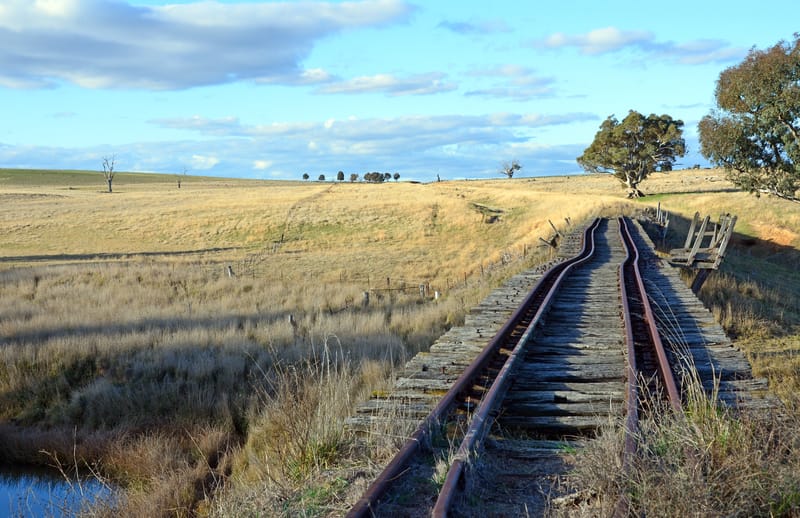
Photo: Karen Black.
Across regional NSW — including New England — public transport has been steadily reduced over decades. Rail lines have been suspended. Services have not returned. Investment has flowed overwhelmingly to metropolitan Sydney while regional corridors sit idle.
Governments speak of opportunity. Yet opportunity depends on connectivity.
Around the world, nations are investing in modern rail — not retreating from it. High-speed and fast rail networks are expanding across Asia and Europe, connecting regional centres to capital cities, strengthening supply chains and cutting emissions. Rail is seen as nation-building infrastructure.
In Australia, we are still debating whether regional rail is “economic”.
If freight must move from road to rail to meet net zero targets — as governments repeatedly state — why are so many regional rail corridors in NSW non-operational? Why are publicly owned rail assets left dormant while heavy trucks dominate highways, increasing road maintenance costs, emissions and accident risks?
In regional NSW, kilometres of unused rail line exceed those in operation. That is not efficiency. It is policy failure.
In New England, more than 10,700 residents signed a petition in 2024 and submitted to NSW parliament seeking restoration of rail services from Armidale to Jennings/Wallangarra near the Queensland border. The response was predictable: provide a business case. NSW government showed no responsibility to undertake at least a feasibility study with a faction of money it spends on Sydney Metro.
A full business case can cost hundreds of thousands of dollars. Expecting community volunteers to fund complex transport modelling is unrealistic and unfair. Feasibility studies for metropolitan projects are commissioned as a matter of course. Regional communities should not be required to crowd-fund their right to be heard.
The northern rail line from Armidale to Queensland is not a trivial branch line. It is a strategic corridor. Earlier infrastructure decisions excluded it from Inland Rail planning. Since then, Inland Rail costs have escalated dramatically. At the very least, alternative or complementary freight pathways deserve serious reassessment.
Meanwhile, freight continues to rely heavily on the New England and Pacific Highways. Road repair bills grow. Heavy vehicle movements increase. Accidents are reported regularly. The public pays twice — through taxes and through safety risks.
The human impact is equally serious.
Residents north of Armidale — Guyra, Glen Innes, Tenterfield and surrounding communities — face real transport hardship. There is no direct public transport link to Toowoomba, Warwick or Brisbane. Travel south to Sydney by train takes more than eight hours from Armidale alone, longer for those who must first travel by coach. Medical appointments often require overnight stays, adding accommodation costs to already significant burdens.
For elderly residents, people with disability, students and those without access to private vehicles, limited transport is not inconvenient — it is isolating.
Yet metropolitan NSW enjoys frequent rail services, integrated ticketing and large-scale transport investment. Regional taxpayers contribute to those projects but receive a fraction of comparable service.
Transport inequality is widening.
Regional rail should not be assessed solely through narrow short-term financial returns. Broader economic, environmental and social benefits matter:
- Reduced road maintenance costs
- Lower freight emissions
- Improved regional productivity
- Better health and education access
- Cross-border economic integration
- Greater resilience during natural disasters
If we are serious about regional development, rail must be part of the equation.
A practical starting point is straightforward: commission an independent feasibility study into reinstating the northern rail corridor. Examine freight potential, passenger demand, cross-border connectivity and long-term cost savings. Put the evidence on the table.
Doing nothing is also a decision — one that entrenches disadvantage and locks regional NSW into long-term road dependence.
Regional growth without rail is not bold policy. It is managed decline.
If Australia truly believes in balanced national development, it must invest in the infrastructure that makes regional life viable. Rail is not nostalgia. It is strategy.


In transport budgets Sydney seems to always get the bells whistles and fireworks. Limited money goes to regional and it’s spent on roads that trucks continually damage in rain and heat. Now there’s a housing crisis people are flocking to the regional areas and strong growth is happening, now is the time to start making plans to both improve and revive regional rail lines, the needs to move people and freight are growing across the growing populations not only in regional areas but for state and country to.
Hopefully the strategic integrated transport plans and freight reforms will strongly provide for this moving into the future.
All exceptionally important points – however, in the world we find ourselves in today, the threat of war is everywhere. There is nothing to stop America from suddenly deciding that Australia is an easy target with many rare earth deposits – just ripe for the picking. Sparsely populated, scattered communities, we need more trains lines, but especially in the route from Sydney to Brisbane for military purposes; to keep Australia safe.
In complying with decarbonisation and reducing transports footprint unless every effort is made to switch it across to rail where possible the transport sector will not progress at the rate required of it.
The irony of the 1988 Greiner NSW Coalition misgovernment discontinuance of the railway services north of Armidale are that the newly elected NOtional$ MP allowed it to happen without a whimper of protest. Northern Tablelands electorate is foundation district of the Country Party the NOtional$ precursor.
So, the Sydney government re-allocated those funds to increasing subsidies on the Sydney metro railway network, presently at about 90+% of operating costs.
The rail service was only returned when Richard Torbay INDEPENDENT hosted a ”Return the Train” demonstration where the about 3,500 angry Northern Tablelands voters intimidated Michael Costa MP, the then LABOR Minister for Railways, to extend the slashed service from Tamworth back up to Armidale because of the numerous education facilities.
The last Coalition misgovernment initiated BILLIONS of dollars in Sydney based infrastructure development, $25 BILLION for the Bankstown Line rip-up the heavy rail to replace with light rail for the driverless trains; $25 BILLION for the Rozelle rolling Carpark that was destined for sale to a sympathetic bankers consortium to maximise profits at great expense to the voters, and many other such improvements in the Sydney Basin to increase over-crowding, pollution & driver traffic stress as they commute slowly through the diesel particulates and fossil fuel fumes from their high stacked sardine tin home units to their work places across the congested freeway system.
The Main North Line (MNL) is the historic public transport facility that runs down the centre of the NSW electorate, connecting these 216 km of regional voters to the world and distant government services. Renovating and restoring the MNL has an estimated cost of $100-150 MILLION in public infrastructure expenditure.
However, the majority No Name NOtional$ faction of Armidale Regional Council is planning to ”rip-up-the rails” to make ANOTHER rarely used ”fail rail trail” to nowhere, to see nothing ….. WITHOUT EVEN PRESENTING A COSTED BUSINESS PLAN TO GOVERNMENT.
An excellent Article making several very important points. The isolation of residents north of Armidale is completely dismissed by both State Government and Glen Innes & Armidale Councils. While an estimated $80 Billion is being spent on extra rail services in Sydney & a Fast Train is proposed for The Sydney-Newcastle connection quoted at costing $40 Billion (add at least 50% for costing blowouts) the elderly, disabled & youth on the Northern Tablelands are ignored. We keep getting told it’s “Not financially viable” – Sydney rail has NEVER been financially viable. If freight is added, then the whole equation changes. Take trucks off the road reducing carbon emissions, reducing road wear & tear & importantly reducing road deaths. Encourage Freight companies to use rail instead. Establish an Intermodal Depot in Glen Innes like the one in Tamworth that is a huge success. Governments continually preach about Climate Change & reducing emissions. Time to stop talking and start making some practical decisions that will benefit the Australian Taxpayers that live in rural NSW.
The people of Armidale,Guyra,Glen Innes need our trains back north of Armidale there have been many accidents between Armidale and Wallangarra. The highway between both Armidale and Wallangarra is very poorly maintained heavy vehicles on the highway make the road unsuitable for smaller vehicles. Causing significant damage to vehicles. Bringing the train service back north of Armidale would benefit the hole community it would all so take a lot of freight off the roads. Australia post could utealis this service Bringing the price of parcel price down. This would allso be grate for freight taking apx 90% of heavy vehicles off the roads meaning heavy trucks only have to travel short distances for delivery. To ports. Transport for nsw invested business from Armidale to Wallangarra this has been a fail. The service only runs once day. And is a big inconvenience to the disabled. I put this comment forward that a disabled person in a wheelchair if a paraplegic for instance if the person has little on no control over there boderly functions are thay forced to sit in there own excrement while on a bus. Where it is much more efficient to put a disabled toilet a small shower on a train for sutch accidents. This has not been take in to consideration buy the rail trail group that are small minded and self centred. The rail trail group have only one thing on there mind the rails must be removed. Asap or it will not be called a rail trail. Nsw rail corridors are 40m to 60m wide there is enough room for both service I all so made this point but was abused with abusive behaviour from the trail trail group. I am heaverly against the Armidale regional council and Guyra council for even deciding to put a push bike track in. Guyra council should know this Bring back the trains North of Armidale to Wallangarra and beyond in to Queensland.
This excellent article demonstrates the many reasons why regional railways need to be reinstated. Our local line in the Northern Rivers runs through Byron Bay where 2 million visitors congregate annually. They aren’t able to visit the rest of our region, without their own transport, to support the economies of other towns like Lismore, which is still suffering after the record breaking floods of 4 years ago. From local surveys, over 85% of residents and over 90% of businesses want train services to return to the Northern Rivers line. Not having adequate public transport is a major problem for this region and rather than pull up the tracks for a bike path, local railway company, Northern Rivers Rail Ltd, are advocating for having both regular rail services and a recreational bike/walking path within the 32 metre wide railway corridor. Working with another regional railway company, the application for a licence is moving forward to repair the rail infrastructure and extend services beyond the current 3kms of the privately funded ‘world’s first’ Byron Solar Train, to the rest of the 72kms of track that lies between Lismore and the top of Byron Shire at Yelgun. Private funding is being sought to provide this much needed service to support the future sustainability of the Northern Rivers region. For more information see http://www.northernriversrail.com.au
Thanks all for your comments. Whether we like or not,as glorious writes there must be huge vested interests behind transport infrastructure decisions that you and me are not privy to. While many writers from New England have shown the immense regional and national significance of Northern rail line connecting NSW and Queensland, we cannot understand the logic of two councils proposing a glorified rail trail instead of advocating better ground transport for the region? Partly NSW government is to blame for the community division that has been created by the Armidale and Glen Innes council highly biased advocacy of a rail trail. It is because of the attempt of the government”s lack of a clear position regarding regional rail revival. Minns government is spending the current term to prepare regional transport plans for the 9 regions in NSW without spending a single dollar to restore a single regional rail line. Instead it is happy to spend many millions on road repairs and bypasses eg 700 million for Singleton. This story of neglect deserves national attention. Victoria is moving ahead compared to NSW. It is spending 4 billion to upgrade regional rail.
Such a sane, logical article! And so well expressed. Mind you– there IS one point that Siri has overlooked… What about the swelling tide of ever-growing-older citizens who are simply LONGING to heave themselves out of their wheelchairs and leap onto bikes for that thrilling ride up the mountain bike-track?? There are possibly millions of us!! Personally…umm… I can hardly wait…
Wonderful to see our Glen Innes Railway Station today, indeed another important & historical link on the Main North Line north of Armidale, Guyra & Ben Lomond, presently undergoing a large maintenance project by a heritage construction company!