

The state government has no plans to restore 24-hour police station operations in Naracoorte or other Limestone Coast towns, despite growing frustration from regional communities over slow response times and reduced police visibility.
Police minister Blair Boyer told The [Naracoorte] News that reopening stations around the clock would “mean someone has to be at the station at all times in case someone attends,” arguing the current model kept officers on the road rather than behind a counter.
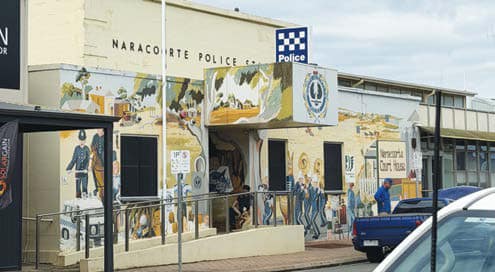
He said the existing hours ensured “local police [can] attend frontline duties and respond to the community’s needs as they happened.”
The issue has been thrust into the spotlight with towns including Naracoorte, Lucindale, Keith, and Penola reporting fewer patrols and shorter counter hours raising questions about how SA Police plans to address ongoing shortages across regional and rural areas.
Frontline focus, not front desks
State Operations Service Assistant Commissioner Ian Parrott said recent changes were designed to free up officers for operational work.
“Regional police officers [will] return to frontline duties,” he said.
Face-to-face services will continue during standardised hours: Monday to Friday, 9am 5pm, and for those open on weekends, 9am 3.30pm. SAPOL also pointed residents to its expanding suite of online services.
“SAPOL’s priority is to provide a highly visible police presence on our streets and to place police officers where they are needed most,” Assistant Commissioner Parrott said.
“Police stations are often staffed by taking officers from other operational or frontline positions… Standardising hours across the 14 stations will not affect how the police presence or response in these towns will continue to be provided.”
He added that “the primary method of contact from the public to South Australia Police is by phone not front counter attendance,” and that officers working at station counters “do not have the ability to respond to crime.”
“People are familiar with calling Triple Zero or 131 444, and a large portion of the community now have mobile phones always with them.”
Recruitment surge but retention challenges remain
On whether the government is offering incentives to attract officers to regional towns, the minister said a range of benefits were already in place, including housing or rental assistance, penalty rates, and career development opportunities.
The government also pointed to what it described as a major uplift in interest in policing careers. Last financial year, 3,050 people applied to join SA Police the highest on record.
This surge has led to additional courses at the Police Academy and double the number of graduating cadets.
In 2024 25, 264 officers graduated, compared with 111 in 2021 22 under the former Liberal government.
The government has invested $12.2 million over three years to accelerate recruitment and the 2025 26 state budget included the largest police funding boost in the state’s history, with $172 million over six years to lift sworn numbers to 5000 officers by 2031.
Data provided shows:
Applications vs Sworn Officers
| Year | Applications | Sworn in |
| 2018-19 | 922 | 181 |
| 2019-20 | 996 | 129 |
| 2020-21 | 1451 | 136 |
| 2021-22 | 1825 | 111 |
| 2022-23 | 2250 | 167 |
| 2023-24 | 2394 | 242 |
| 2024-25 | 3050 | 264 |
From 2018-19 to 2021-22, an average of 1291 applications were received each year, with 139 sworn in. Under the Malinauskas government (2022-23 to 2024-25), the averages rose to 2564 applications and 224 sworn in annually — “a huge increase,” the government says.
Mental health support for officers
The Police minister acknowledged the pressures facing police, particularly those in isolated postings.
“Policing is a rewarding career but obviously very demanding as officers can be exposed to traumatic events, violence, and high-stress situations,” a spokesperson said.
Support services include social workers, psychologists, and medical officers who are on call for staff.
Opposition: Regions ‘paying the price’
Shadow minister for Police Jack Batty criticised the government’s handling of police resourcing, saying regional communities are being forced to choose between patrols and open stations.
“Labor has so hopelessly under-resourced South Australian Police that in our regional areas we now need to choose between either having cops out on patrol or keeping police stations open,” he said.
“If we had enough police across South Australia this wouldn’t be an either-or proposition… Police stations are critical to ensuring community safety in our regions, but with a shortfall of more than 100 cops across the state, it seems our regions are paying the price.”
Mr Batty also warned that without genuine incentives, South East officers could relocate interstate.
“Without incentives on the table, what is to stop police officers in the South East from moving to the Gold Coast where they will receive an instant cash boost.”
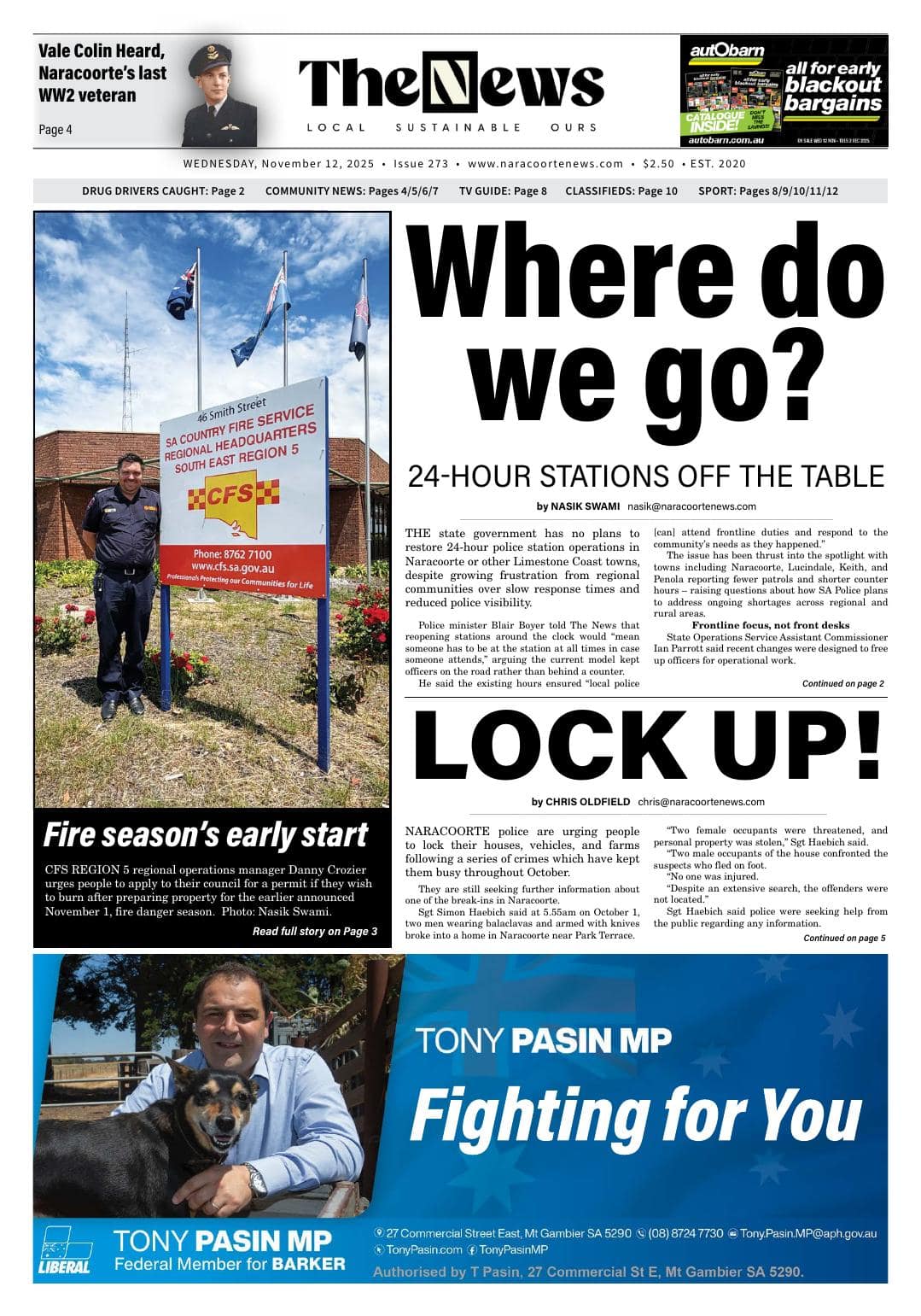
This article appeared in The Naracoorte News, 12 November 2025.

