Grafton based intensive care paramedic Peter Maxwell clocked off from his last shift on Sunday after a rewarding 44-year long career with NSW Ambulance which also saw him meet his wife.
But Mr Maxwell said he never had a burning ambition to join NSW Ambulance, his career came about by circumstance.
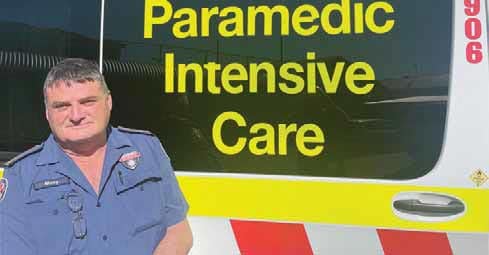
After growing up in northern Sydney and completing his schooling, Mr Maxwell got his first job.
“I started a plumbing apprenticeship, and I was earning about $65 a week, where I was doing all of the hard work, all of the shovelling and stuff,” he said.
“Then this opportunity with NSW Ambulance came up earning $200 a week with no shovelling s..t, so I thought I would have a crack at it.”
His parents had friends who worked for Ambulance NSW.
“I knew a bit about the job because of that, but it wasn’t like when I left school and I wanted to be a paramedic, it just fell into place,” Mr Maxwell said.
So, the career transition happened, and Mr Maxwell started training.
“Back then it was four weeks training at the NSW Ambulance training school, then you did a year’s probation where you worked with someone else who taught you the ropes,” he said.
“Then you were either a paramedic or an ambulance officer, and a paramedic was the equivalent of today’s intensive care paramedic.
“Within the first three years I did what they called then ‘advanced life support’.”
With several years on the job under his belt, Mr Maxwell moved into the NSW Ambulance operations centre where he worked in operations and dispatching.
“I was in the radio room and dispatch, then I went back on the road as a paramedic,” he said.
“Then they were offering upgrades to an intensive care paramedic if you had an advanced life support qualification, so I went and did that training to become an intensive care paramedic about 15 years ago.”
Intensive care paramedics are specialised emergency medical professionals who are highly trained to perform advanced clinical procedures and require high levels of clinical exposure and a strong professional community of practice.
These specialist skills include advanced airway management, such as endotracheal intubation, and treatment of life-threatening chest injuries.
They also handle complex cases like severe head injuries and cardiac conditions with more advanced interventions.
Working in the NSW Ambulance Service led to Mr Maxwell meeting his second wife, Rachel.
“I was working in Newcastle in 2005 2006 and we got together when we were both working in the Ambulance operations centre,” he said.
“We’d been friends for years.”
Mr Maxwell said his wife is now retired after a 35-year career with NSW Ambulance as a paramedic.
While he tries to put traumatic situations behind him, Mr Maxwell said the first big incident he attended was the Cowan train disaster on May 6, 1990, when the 3801 Limited special steam passenger train returning from the Morpeth Jazz Festival was struck in the rear by the following CityRail inter-urban passenger service.
“There were six fatalities and 100 injuries,” he said.
“In its infancy there was only myself, two police officers and one other paramedic there for the first hour or so.
“It was 4wd access only and was halfway between Brooklyn and Cowan.
“I was too busy at the time to think about the enormity of the situation.”
Over the 44-years, Mr Maxwell said there had been incredible advancements in technology and procedures for paramedics.
“The most important thing then you had was your hat, and if you didn’t wear it you go into trouble…now I can basically do what an Emergency Department does and I don’t have to wear a hat,” he said.
“When I started, basically you had a first aid kit with some bandages and you used to have to be able to do some splints and use oxygen, and that was basically it.
“I think the biggest thing we do now would probably be pre-hospital thrombolysis.
“That’s when people have a heart attack and they have a big clot in their coronary artery, I have a chat with the cardiologist at which ever hospital we are going to go to, send them the ECG of the patient I’ve got in the ambulance, and if we’re all on the same page I use a thromboliser on the spot to try and dissolve the clot.
“It’s saved truckloads of lives.”
Mr Maxwell said he has made life-long friends and many memories working for NSW Ambulance.
“It has been a very rewarding career,” he said.
“With in the job I have made lots of friends over the years…I’ve got lots of patients who are acquaintances, who I say g’day to if I see them in the street.”
Now that he is retired, Mr Maxwell said he and Rachel plan to ‘take it easy’ and do some travelling both around Australia and internationally.
This article appeared in the Clarence Valley Independent, 17 September 2025.