


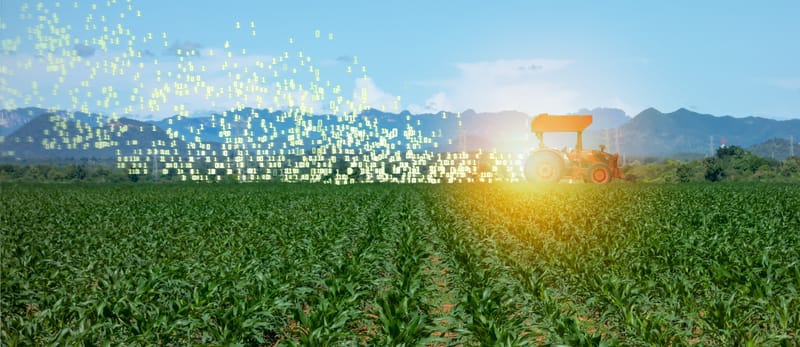
Whether you like it or not, the era of AI is beginning in global agriculture.
The reasons for this event are divided into obvious and secret.
These reasons predetermine the prospects for using AI.
Obvious reasons and trends of AI development
This article is the first in a series of articles about AI in agriculture by Pavel Kuliuk for Australian Rural & Regional News.
The main and obvious reason for the development of artificial intelligence (AI) is the need to improve the efficiency of agriculture. This is necessary to reduce greenhouse emissions, though the main thing is that improving the efficiency of agriculture is necessary to feed the ever-growing population of the planet. Because of this, by 2050 humanity must produce 60 per cent more food than in 2012.1
According to official data, productivity in Australia’s agriculture must increase by 1-5 per cent each year in order for this sector of the economy to remain competitive in the domestic and foreign markets.2 This is a real race for survival. And the natural assistant in this competition is AI. To win, agricultural producers must focus on solving three main problems. These global problems determine global trends in the development of AI.
1. Pest control. Worldwide, pests destroy about 40 per cent of crops every year. This causes losses of at least US$70b.3
2. Improve soil quality and irrigation. Almost 33 per cent of the Earth’s surface suffers from soil degradation. This reduces agricultural opportunities and causes losses of US$400b.4 Agriculture uses 70 per cent of available fresh water. But 60 per cent of the water used is lost during delivery.5 This reduces the efficiency of agriculture.
3. Weed control. There are about 1,800 species of weeds on Earth. These weeds reduce crop yields by about 31.5 per cent. This results in losses of $US32b annually.6
In addition to these general problems, each country has additional national challenges. For example, in Australia, this is the agricultural labour shortage. In 2023, the country was short 172,000 workers in the food supply chain.7 Ten years earlier, in 2013, the labour shortage was only 100,000 people.8 According to the government, this crisis cannot be solved by market measures.9 AI can optimise the agricultural labour market in Australia. We will discuss this in detail in a future article “How will AI change the agricultural labour market in Australia?”.
As of September 2025, AI has become a real commodity. Artificial intelligence is already being used by tens of millions of farmers around the world to solve obvious global and local agricultural problems. And the demand for AI is growing rapidly. The use of AI in agriculture is projected to increase from US$1.7b in 2023 to US$4.7b by 2028.10
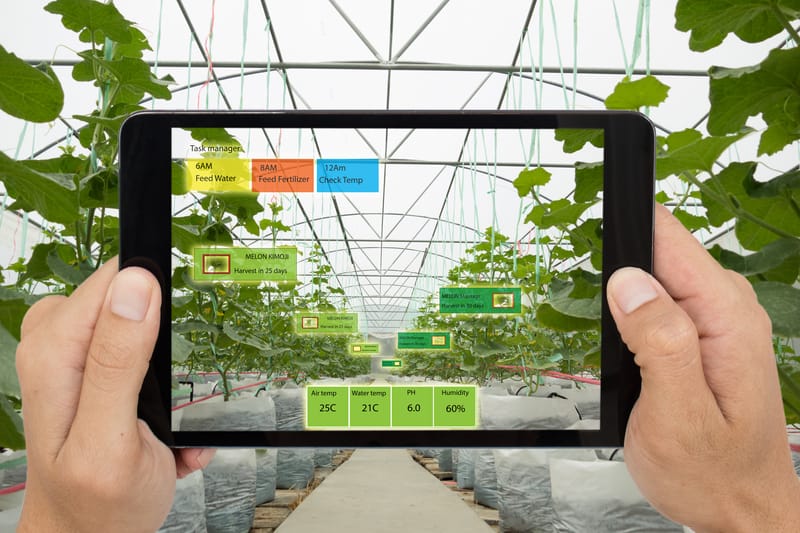
Machine vision and learning technologies are the basis of AI. These technologies predict and improve crop yields. This is done by detecting plant diseases and consulting on how to treat these diseases, giving advice on fertilising and watering, calculating the NDVI index, etc. All this help is included in the functions of so-called computer applications for “precision farming”. These programs occupy the largest market share of almost 50 per cent.
AI developers are starting to move away from using clouds for computing. Instead, edge computing in real time is starting to be used. This makes it possible to use AI in remote fields where there is no internet connection. This feature is in great demand among farmers. Since it allows them to process data in real time and make decisions quickly.
But the increasing convenience of AI does not yet affect the cost of this service. Although AI is already included in the standard equipment, the price of implementing artificial intelligence is $US 50,000 – $ US200,000. This price depends on the complexity of the software and the size of the agricultural company.
Due to the high cost, large agricultural enterprises remain the main consumers of AI. These companies form about 70 per cent of AI clients. American farmers are the leaders in terms of AI usage. These entrepreneurs make up about 40 per cent of all consumers of artificial intelligence. European farmers are in second place. Moreover, Ukraine is one of the leaders in the state implementation of AI in agriculture. In August 2025, a Ukraine state service with AI support for obtaining a veterinary licence began operating in the country!11 For a country at war, this is a great achievement.
But agricultural businessmen from the Asia-Pacific region in general and Australia in particular represent the fastest growing consumer segment; it is here that demand for AI is growing fastest.12
This creates an unexpected challenge for Australian farmers. By starting to use AI, Australian farmers are creating a culture of AI consumption based on their own experience. We will talk about what can help on this path in the article “What occupation has AI created for Australian farmers?”.
Hidden causes and trends in the development of AI
The main and perhaps the secret reason for the development of AI is the following. AI is a weapon of business and political expansion. Your fate depends on which side of this weapon you are on. If you hold the hilt of the sword, you can become a winner. But if you stand facing the tip of the sword, you will most likely become a victim. In the future, this will be discussed in detail in our article “Redistribution of property rights in agriculture due to AI”.
Soon, skilled agricultural businessmen will offer AI to other businessmen, but not use this AI for their own needs. In other words, if you want to achieve great success in agriculture, then develop AI for farmers, but do not be the farmer who uses AI.
Because artificial intelligence is becoming a promising means of collecting information about agricultural producers, this makes it possible to predict production volumes, prices, bankruptcies and other transactions in the agricultural market. And this gives significantly greater opportunities than simply increasing the productivity of your farm due to AI.
We will not name specific companies. This is a delicate topic. But if you carefully study the sites of the most popular AIs with tens of millions of downloads, you will discover an amazing detail: these AIs are developed in technologically advanced countries, the USA and the EU, but most of the reviews about the use of these AIs are written by farmers from Africa, Asia, and South America.
That is, most of the economic expansion will be international in nature and vertical from top to bottom. Business representatives from technologically advanced countries will gain control over agriculture in countries where technology is poorly developed. Of course, this does not mean that horizontal expansion is impossible in the markets of technologically advanced countries, but there this expansion will be limited and will be complicated by legislative norms. However, in technologically underdeveloped countries, AI can become a real Excalibur for its owners.
Thanks to AI, for the first time in the history of agriculture, the focus of investment may change. Instead of buying a new tractor, farmers may find it more profitable to invest in a startup promoting a popular AI application for agriculture or develop their own artificial intelligence for these purposes. Virtual agriculture may be more profitable than physical agriculture. Agricultural AI is a great diversification of assets and an opportunity for enrichment. This is what is causing the rapid spread of AI across planet Earth.
But in the pursuit of profit, one should not forget about the “Achilles heel” of AI. Otherwise, artificial intelligence will bankrupt not only clients but also its creator. We will tell you in detail why this can happen in the article “When is AI not effective?”.
What’s the bottom line?
Some people will become AI clients. And some people will become AI developers. But many of us will be neither. However, we will all become dependent on AI, since artificial intelligence will change agriculture and even rural life. We will tell you how this might look in 20-30 years in the article “How will AI change farming and rural life?”.
As a general note, by publishing a series of articles about AI in agriculture, we do not claim absolute truth, but offer a discussion. So your comments after reading the articles are a very important part of the examination of AI in agriculture. Write what you think. As long as we think, we are alive. And this means that AI is not alone on the planet.
References
1. https://www.un.org/en/chronicle/article/feeding-world-sustainably
2. https://www.aph.gov.au/parliamentary_business/committees/senate/education_employment_and_workplace_relations/Completed%20inquiries/2010-13/agribuisness/report/~/media/wopapub/senate/committee/eet_ctte/completed_inquiries/2010-13/agribuisness/report/c02.ashx
3. https://www.fao.org/plant-production-protection/about/en#:~:text=Every%20year%2C%20up%20to%2040,at%20least%20USD%2070%20billion.
4. https://www.mdpi.com/2073-445X/11/2/179
5. https://www.worldwildlife.org/threats/water-scarcity#:~:text=Agriculture%20uses%2070%25%20of%20the,in%20which%20they%20are%20grown
6. https://www.mdpi.com/2073-4395/12/8/1808#:~:text=Globally%2C%20approximately%201800%20weed%20species,per%20year%20in%20economic%20losses
7. https://nff.org.au/media-release/significant-labour-shortages-across-food-supply-chain-weighing-on-growth-cost-of-living/
8. https://www.deloitte.com/au/en/Industries/consumer-products/perspectives/farming-verge-workforce-crisis.html
9. https://www.aph.gov.au/parliamentary_business/committees/senate/education_employment_and_workplace_relations/Completed%20inquiries/2010-13/agribuisness/report/
10. https://www.marketsandmarkets.com/Market-Reports/ai-in-agriculture-market-159957009.html
11. https://www.rbc.ua/ukr/news/ukrayini-z-yavilas-persha-derzhposluga-pidtrimkoyu-1755656087.html
12. https://www.researchgate.net/publication/390694604_Artificial_Intelligence_in_Agriculture_Market_2025_Trends

