


Specimen Hill Wind Farm: the view of the forest scientist, the environmentalists
and the energy company
Foresters and environmentalists in Australia may not have seen eye to eye of late, but on the subject of forest clearances for large scale renewable energy developments, there are increasing instances where their objections to the consequential impact on the forest make them de facto allies.
So it is that former forest scientist and occasional contributor to Australian Rural & Regional News, Dr Gary Bacon AM, has found some common ground with the environmental group, Rainforest Reserves, over the native forest destruction they expect to be caused by a network of connected wind towers along the East coast ranges making up the Specimen Hill Wind Farm.
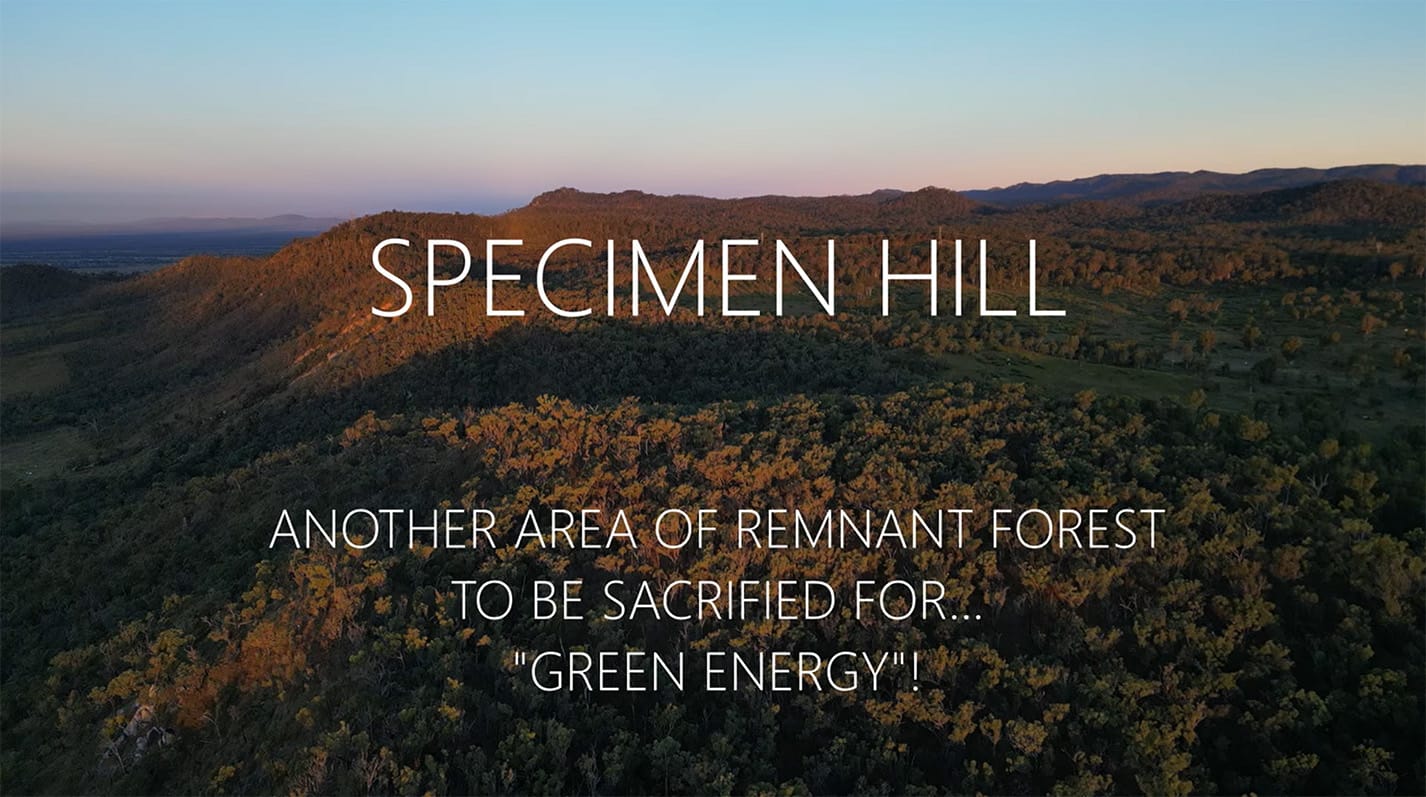
Australian Rural & Regional News found out more from Gary, sought and received a detailed response to the film from the energy company, Ark Energy, and was pointed to more upcoming films and action by Rainforest Reserves.
Perhaps it is the points of emphasis that demonstrate key differences between the parties. Gary highlights the fact that the native forests around Specimen Hill were once harvested and evidently sustainably managed Queensland State Forests. Rainforest Reserves describes the forest as remnant eucalypt forest, with critical koala and Greater Glider habitat which will be “decimated” by the wind farm, together with extensive other damage to ecosystems and the environment. Ark Energy points to the years of onsite studies by specialist ecologists and survey teams, the priority to avoid and minimise adverse impacts, that the project does not impact on any protected areas and that many of the ridgelines have sparse open ironbark woodland of different ages and conditions.
Keep reading and watch the video below for the fuller views of Gary, Rainforest Reserves and Ark Energy.
Where does the reality lie? Is there truth in all these views? If so, how much? Is it possible to know what that is before the forests are cleared and the Specimen Hill wind farm goes into operation? Is there any win/win outcome possible? Share your views below.
The view of Dr Gary Bacon AM, as described to Australian Rural & Regional News:
“As a professional forester my operating thesis was the maintenance of the forest ecosystems in perpetuity utilising procedures, standards and practices based on continuous research, development and assessment. It still is, and so operations that impact negatively on the composition, structure and viability of these forest ecosystems must be called out. Hence my support for those who think and act in alignment with that thesis.
Harvesting native hardwood timber products within the majority of Queensland State Forests has been progressively reduced over the past three decades to a trickle of yesteryear removals with concomitant loss in dependent rural employment. The lock up and get out mantra of ultra preservation groups has been, unfortunately from my perspective, successful.
This has been the fate of the native forests around Specimen Hill (Maxwelton State Forest, Calliope Range State Forest and Kroombit Tops transferred from State Forest to National Park). The fact that many National Parks had previously been managed for multiple use including timber harvesting and still met the criteria for Park gazettal (national and international) provides clear evidence that the forests were managed sustainably by the State Forest Service. The North Queensland rain forest National Parks, Fraser Island, Cooloola and Kroombit Tops Parks are prime examples.”
The environmental group, Rainforest Reserves, campaigns against particular large scale renewable energy developments on the grounds of their impact upon the environment. They released a film on 14 July 2025 damning the approval of the Specimen Hill Wind Farm. Rainforest Reserves introduces the film by saying:
“Specimen Hill wind farm, now approved, will be located in Central QLD adjacent to Kroombit Tops National Park. Koalas are set to lose over 700 hectares of habitat, and other threatened species will also lose critical habitat. This wind farm should never have been approved.”
Australian Rural & Regional News sought a response to Rainforest Reserves’ film and about Specimen Hill Wind Farm from Ark Energy.
Damian Verney, Head of Development for Ark Energy, responded:
“The project involves a group of properties west of the Dawson Highway in Dumgree, about 25 km north-east of the town of Biloela. They are currently used for cattle grazing and hosting a wind farm is a complementary land use for graziers that can provide a reliable supplementary income, as well as provide significant economic opportunities for Traditional Owners and the region.
Avoiding and minimising impacts to the natural environment and fauna species that might utilise a project area is a priority for all Ark Energy’s projects. Rigorous and comprehensive assessment of the potential environmental impacts, and how unavoidable impacts will be mitigated and managed, was required for the development application by both the Queensland and Australian Governments.
The ecology work was done in accordance with state and federal guidelines and involved multiple years of onsite studies by specialist ecologists and survey teams. The host properties contain mostly ironbark woodland. Many of the ridgelines where the wind turbines would be located have previously been logged or thinned and have sparse open woodlands of varying age and condition, and the lower lying areas include land that has historically been cleared for grazing. The project does not involve or impact on any protected areas.
Environmental assessment takes a conservative approach to potential habitat although utilisation by species may be low. Surveys sought to identify areas of higher quality habitat and ecological value, and as findings from the work became available the project’s design was refined and modified to avoid these areas as much as possible. As an example, the project design underwent numerous iterations to avoid areas of higher quality habitat for Greater Gliders and most records of the species found within the host properties are outside of the proposed project footprint.
The development application was assessed by the Queensland Government and consent granted in December 2021. Potential impacts on matters protected under the Commonwealth Environment Protection and Biodiversity Conservation Act 1999 (EPBC Act) was also assessed by the Australian Department of Climate Change, Energy, the Environment and Water (DCCEEW), and the proposal approved by DCCEEW in September 2022.
An offset strategy was required for the assessment and approved by the regulators. A detailed offset area management plan outlining how these areas will be delivered, managed and monitored is one of several management plans required as conditions of the approval. This is yet to be completed and must be approved by the regulators before construction can commence. Various secondary approvals must also be obtained.
The project team is committed to collaborating with ecology stakeholders and host landowners to implement responsible strategies to mitigate impacts and a key aim of the project will be to achieve a net gain for biodiversity in the area over the longer term. This might include additional initiatives such as rehabilitation of the initial construction disturbance and more rigorous management regimes for feral pests and weeds.”
Update, 19 August 2025. Ark Energy responded further:
“The story seems to suggest the project area may involve state forest, but to clarify, this is not the case. There are state forests nearby but the project area is entirely within privately owned cattle grazing properties. The video appears to contain images and information that is not directly related to this project and similarly, Dr Bacon’s view seems to be a comment on the nearby state forests, rather than the project area?
“For further clarification, environmental assessment under the EPBC Act takes a precautionary approach and considers habitat regardless of whether a species is seen. However, no individual koalas were observed in the project area over multiple years of field surveys, including targeted surveys for koalas. Possibly due to several pest species which threaten them and were recorded, including wild dogs, pigs and feral cats. Environmental management plans associated with renewable energy projects can actually offer the opportunity to improve an area’s habitat values through better management of feral pests and invasive weeds.
“To also note, all the study findings were detailed in the environmental assessment reports (which amounted to thousands of pages) prepared for the Department of Climate Change, Energy, the Environment and Water (DCCEEW) and these were placed on public exhibition for comments in 2022. Following exhibition, as mentioned, the proposal was approved by DCCEEW with a suite of strict conditions later the same year.”

