


Australian Rural & Regional News asked a few further questions of Vic Jurskis, answered below. Find many more articles about koalas at Open for Debate: Koalas.
Greens environment spokeswoman Sue Higginson was right to say that “translocation of koalas is fraught with risk and failure”.1 For example, over 10 years, more than 3,000 koalas from Kangaroo Island were sterilised and released in mainland South Australia. Thirty eight per cent of them (that’s more than 1,100 koalas) died within a year of translocation.2
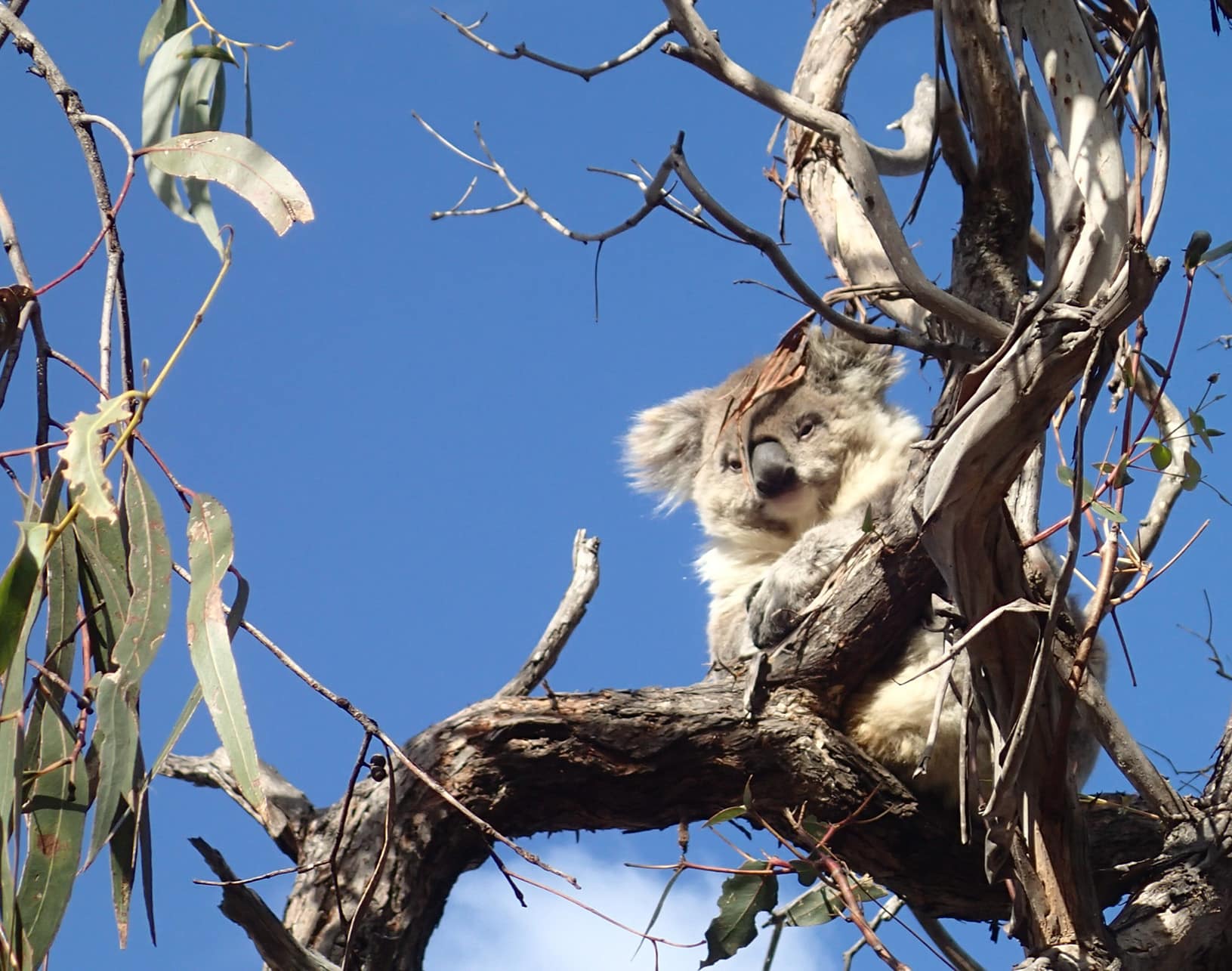
But the New South Wales Government’s secrecy is intended to hide the fact that there are too many koalas. Promising to create a Great Koala Park was a vote-winner.
Higginson says that koalas must be protected from dogs, vehicles and disease to keep them from “their current dire trajectory of extinction”.1 However, increasing disease, dog attacks and collisions are signs of increasing numbers invading suburbia. It is an animal welfare issue not a conservation problem. Surely people have noticed road warning signs popping up everywhere, if not live koalas.
There were widespread irruptions of koalas in the late 19th Century. Consequently, they suffered malnutrition and disease. The humane and economic response was to shoot them and export their skins. Millions were shot. Now they are usually either treated and released back into overcrowded forests or euthanised by injection. Some were recently shot from helicopters after a wildfire in Victoria.
Koalas continued to increase whilst they were being shot in the late 1800s. As more adults were shot, more young survived to breed. When leaves frizzled in the Federation Drought, koala numbers crashed.
Numbers remain stable in healthy mature forests because most young koalas die. They can’t find enough food. Koalas eat soft young shoots which are a rare commodity. So each koala travels around a large home range, including thousands of trees, feeding on fresh new growth and returning after it has resprouted. In stable sub-populations, females produce young each year but few survive to maturity – only those that find food where an old koala with worn out teeth can no longer hold its home range. So recruitment matches mortality.
A second irruption of koalas has occurred in the Sydney catchments since a major wildfire in 1977 produced an abundance of soft young regrowth. Numbers are increasing from the Upper Nepean through to Campbelltown and Lucas Heights and through Blue Mountains National Park to the northwest. NSW Koala Inquiry was informed of this irruption by Science for Wildlife but chose to ignore it in their preordained finding that koalas are heading for extinction.
It’s not the first time that koalas have been secretly translocated from this irrupting sub-population. Around 2006, some young adults were moved 100 km south to Tarlo National Park where koalas were supposedly extinct. One of the translocated females had a joey by a local male, but there were only two sightings of the ‘extinct’ local koalas in seven years.3
Healthy, stable low-density subpopulations of koalas are invisible. Visible koala populations are unhealthy and unstable. But the Koala Industry depends on visible koalas, so animals must suffer malnutrition, disease, dog attacks, collisions with vehicles and/or incineration. ‘Lock It Up and Let It Burn’ conservation is good for the species but not for the animals. We could restore healthy and safe forests for people and animals, with low and stable koala numbers and viable numbers of the truly endangered ground species that depend on open grassy conditions. If only there was the will.
Questions from Australian Rural & Regional News
ARR.News: What do you yourself know of the current koala population (or lack thereof) in the area to which the koalas were recently, unsuccessfully translocated, the South East Forest National Park?
Vic Jurskis: We don’t know where the koalas were released, but our playback and listening survey revealed that koalas were present across the region. They were mostly at low densities. Our radio tracked koalas lived at an average density of six koalas per thousand hectares. Densities were much higher in logging and fire regrowth forests in the northeast of the region where recent sound recording surveys by Law et al have revealed densities comparable to highest densities on the north coast.
Jurskis, V., Douch, A., McCray, K., Shields, J. 2001 A playback survey of the koala, Phascolarctos cinereus, and a review of its distribution in the Eden region of south-eastern New South Wales. Australian Forestry 64,226-31. doi:10.1080/00049158.2001.10676193
ARR.News: So if, as you say, koalas in low and stable numbers are effectively invisible, and if koalas in declining numbers or if there no koalas at all in an area are also invisible, how can we can be sure which is the case in a particular area?
Vic Jurskis: The most efficient and effective way is to use sound recording surveys in spring to confirm koala presence (and estimate density) as has recently been done at Kosciuszko where there were previously only eight records in the best part of a century. Best estimate of densities in sparse populations is by radiotracking every koala that can be found as we did until NPWS stopped us.
ARR.News: Can’t dog attacks and collisions also indicate that koalas have been driven to move (from their home range) because it has been cleared or made inaccessible or lacks the right trees?
Vic Jurskis: No. Koalas are moving out of National Parks, State Forests, water supply catchments etc. where there is no clearing.
Vic Jurskis is the author of The great koala scam : green propaganda, junk science, government waste & cruelty to animals, Connor Court Publishing, 2020.
References
1. The Greens NSW, Clandestine koala translocation program results in koala deaths – labelled animal cruelty and calls on minister and premier to explain, 14 July 2025; Lisa Cox, More than half of koalas relocated to NSW forest died in failed government attempt at reintroduction, The Guardian, 14 July 2025.
2. Whisson, D.A., Holland, G.J., Carlyon, K. 2012 Translocation of overabundant species: Implications for translocated individuals. Journal of Wildlife Management 76, 1661-9; https://doi.org/10.1002/jwmg.401
3. Close, R., Ward, S., Phelan, D. 2015 A dangerous idea: that Koala densities can be low without the populations being in danger. Australian Zoologist 38, 1-8; https://doi.org/10.7882/AZ.2015.001

