Rachel Hagan, Yorke Peninsula Country Times
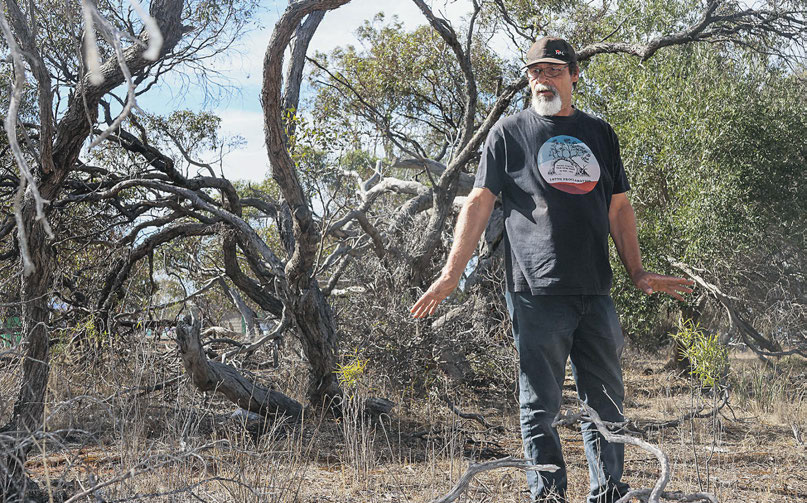
Despite recent weather bringing a small amount of some much-needed rain, Nharangga fire practitioner Peter Turner says it’s not just water the trees on Yorke Peninsula need to thrive.
Two years of drought has had a huge effect on YP’s trees, with many already dead and the rest struggling to stay alive with limited water.
During the past two days, several of these vulnerable trees have been taken down by the strong winds, but Mr Turner said drought is also causing the trees to drop high amounts of foliage, which is building up at the base of the trunks.
“One year without enough rain is rough, but two, it’s going to be dropping limbs because it just can’t support it — there’s no moisture,” Mr Turner said.
“Our trees are the elders of Country, they have been looking after Country for a long time because it’s them, the grasses and the life in the soil that takes care of it.”
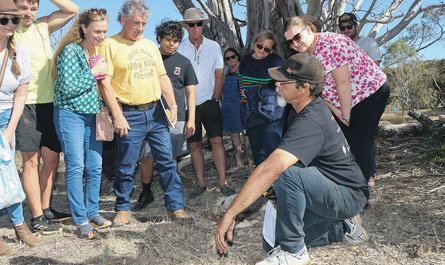
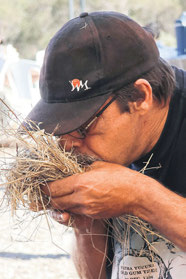
Cool burning fires have been used for tens of thousands of years by First Nations people to manage vegetation and reduce risks of devastating bushfires.
These fires burn at a lower intensity, and help encourage new growth on many native species.
However, since colonisation, First Nations peoples have lost access to the majority of their land, and large amounts of fuel, especially around the base of trees, have built up across the Country.
“Dogs used to dig down under trees in the dirt for that cool earth during the summer-time to keep cool, but you can dig two metres now and it’s just dust,” he said.
“It was an annual clean up every year and certain people in our mob would be allocated to go run fire and burn a massive area over 20, 40 to 50 kilometres.
“Australia was like a manicured garden with each nation looking after their area of Country, and they maintained it in a harmoni-ous way with nature.
“And now most of our native grasses are not here — they are gone and most of this stuff is introduced.
“(It) doesn’t belong here, it belongs in Africa, it’s elephant food.”
Though the CFS does protect communities with prescribed burns, Mr Turner said this was not helping Country, and they were killing the environment with the hot fire being used.
“That’s not looking after Country, that’s looking after an asset or a town,” he said.
“If they want to look after the asset and Country, they need to listen to us and understand how to get the balance right.”
Millions of dollars are spent every year on prescribed burns, but Mr Turner said he would like to see that funding given to First Nations, so they could take care of their Country properly.
“And it wouldn’t cost $28 million — I can tell you that,” he said.
The Australian Government Department of Climate Change, Energy, the Environment and Water has predicted, with very high confidence, winter and spring rainfall over YP will continue to decrease.
Projections show, by 2030, under all emission scenarios winter rainfall will decrease by 15 per cent, and later in the century by 25 per cent, creating a harsher fire climate.
It said the decreases for autumn and summer are less clear, but the results suggest a continuation of the observed autumn decline.
This article appeared in Yorke Peninsula Country Times, 27 May 2025.