



Once every three or so years at the federal level, peak bodies in agriculture line up to present their election wish lists to the major political parties, in the hope of getting them embedded in their campaign platforms.
These lists are typically accompanied by a barrage of questions demanding clarity on how the parties—if handed power—intend to view, regulate, and support the sector. In response, political operatives roll out carefully crafted answers.
Unfortunately, these answers are usually banal, vague, or artfully non-committal. Over the course of the campaign, a piecemeal stream of promises is drip-fed into the media cycle. Finally, as polling day looms, a grand policy document is unveiled—complete with glowing headlines about bold investments and bright futures, and buried in the fine print, the less palatable costs of doing business if they stagger over the line into power.
This last-minute flourish is rarely designed to inform—it is instead aimed at swaying the small pool of undecided voters still paying attention, or worse, at delaying the answering of difficult questions until it’s too late for rebuttal.
The whole process has become a ritualised dance around the issues. Both parties go through the motions—generating promises that sound impressive but lack the substance or machinery to ever be realised. For those of us deeply invested in agriculture, this performance has long since lost its audience—and, more importantly, its effectiveness.
Too often, the policy platforms pushed by industry groups are more about appeasing their own membership than shaping government strategy. The loud and opinionated are well-practised in getting their pet projects funded—be they the train tragics, road ragers, or comms complainers.
But the truth is this: the loudest voices should no longer be indulged with sprawling lists of demands—regional hospitals, better schools, roads, rail, ports, power, comms, or water. Everyone knows that unless a project serves a marginal seat, the dance card stays empty.
Instead, it’s time to change the tune.
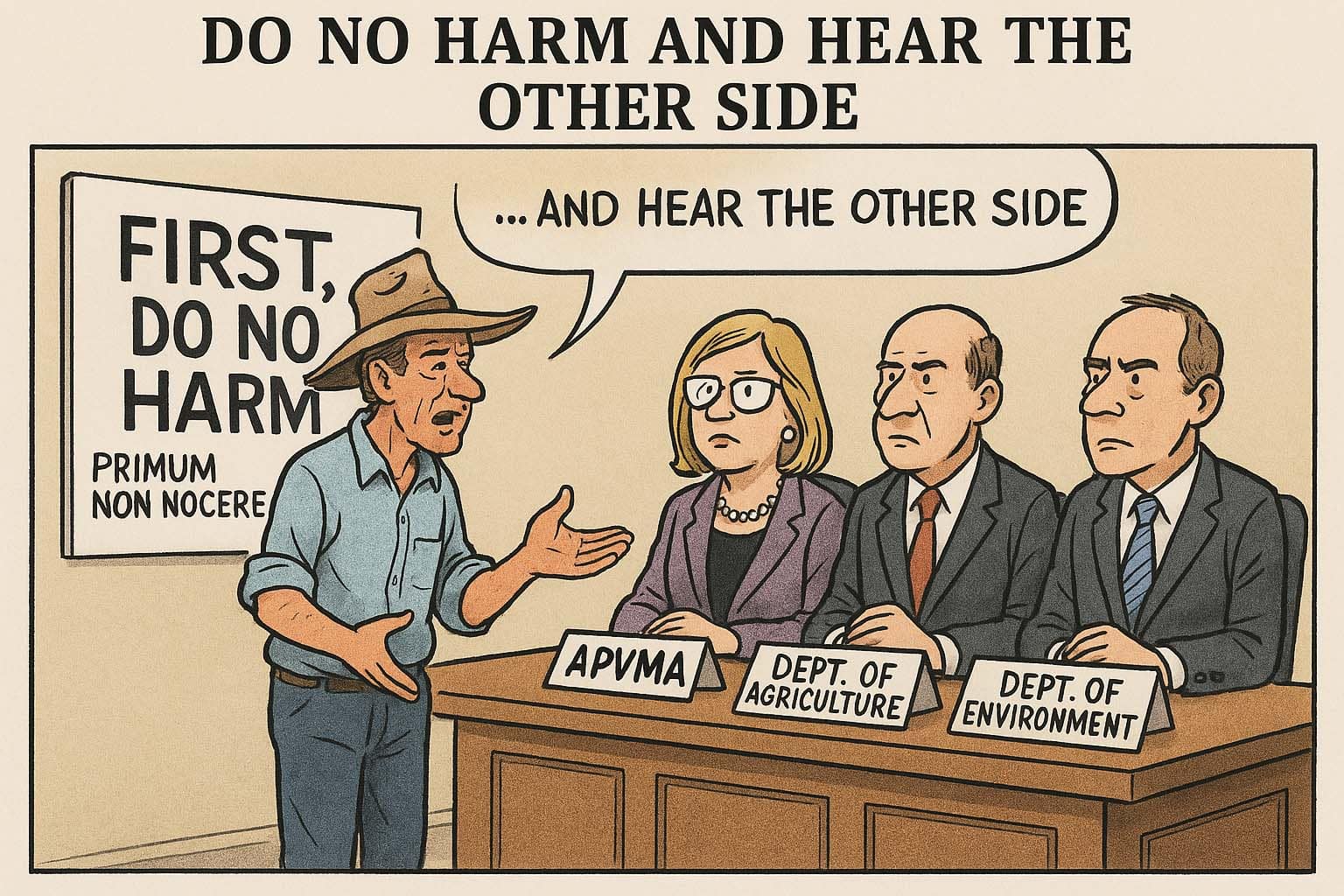
Let us propose a new approach: one borrowed from the guiding principle of medical ethics—Primum non nocere—“First, do no harm.”
We ask that the federal government approach agriculture with the view that every new regulation and every new law should be examined as a potential regulatory burden and rigorously assessed for its impact on agriculture.
Each Cabinet decision, each of the 60 to 100 Acts passed annually, and the swathe of regulations pushed through—often with minimal scrutiny—should be reviewed for their cumulative impact on the sector. More often than not, these documents contain well-concealed burdens buried deep within their clauses.
Before legislating on taxation, chemical regulation, industrial relations, animal welfare, biosecurity, telecommunications, or climate policy, each proposal should undergo proper cost–benefit analysis with agriculture in mind.
To oversee this, the Department of Prime Minister and Cabinet should house a dedicated team tasked with monitoring and assessing the effect of new legislation on agriculture to prevent rogue departments or mad Ministers from unleashing poorly thought-out policies without due consideration.
This would spare Prime Ministers from having to personally step in at the eleventh hour on issues like “Nature Positive” environmental reforms or a stealth carbon tax on utes.
We are asking for this change in approach because the ag sector has long since recognised that the few policies governments tout during an election campaign are often far outweighed by the stealthy creep of hidden regulatory costs.
Worse, the most heavily sold commitments—from renewable energy to Indigenous recognition—are frequently pitched as transformational, when they have little real chance of delivering meaningful, measurable change.
The farming community has grown weary and sceptical of governments’ glossy pledges to support agriculture, only to watch as ministers chase agendas that might as well have been drafted by activist organisations, be they bans on live exports or crackdowns on agricultural chemicals.
Hence, the call: change the tune. Drop the dance.
What we’re asking for is simple: a “less is best” approach—one that removes politics from policy and begins to rebuild trust in the process.
We ask that the next federal government refrain from treating agriculture as a convenient vehicle for advancing progressive policy agendas built on spurious, untested community sentiment—read: inner-city green–teal–red–leftist ideology—and instead commit to a policy framework grounded in science and economics.
This means a genuine commitment to do no harm:
- That the APVMA remain a science-based regulator, not one captured by environmental activist agendas.
- That the Department of Agriculture retains its focus as an industry agency, not a proxy for ideological causes.
- That the Department of Environment resists becoming a pipeline for policies dreamt up in activist circles and dressed up as stakeholder engagement.
- That the cost of production for Australian farmers is not quietly undermined through hidden carbon taxes and climate-linked compliance burdens.
We understand that legislation must evolve, and old frameworks must sometimes be retired. But when essential change is proposed, the industry must be engaged in meaningful discussion, not token consultation disguised as stakeholder meetings followed by predetermined press releases.
Farmers can accept government decisions—provided we’re given time to read the drafts, respond with feedback, and are treated with the respect of being heard. That has become increasingly rare, as governments seek to control the narrative at the expense of actual dialogue.
So here is the ask: that Labor and the Coalition each take just two simple, serious policy commitments to the 2025 election on agriculture:
Audi alteram partem and Primum non nocere.
Hear the other side, and do no harm.

