


Mine Free Glenaladale, Media Release, April 2026
Groundswell against Gippsland Critical Minerals Fingerboards mineral sands mine 25 kilometres from Bairnsdale continues to gain momentum, as many in the community are now aware the probable negative impacts of the mine will not be confined to the Glenaladale area.
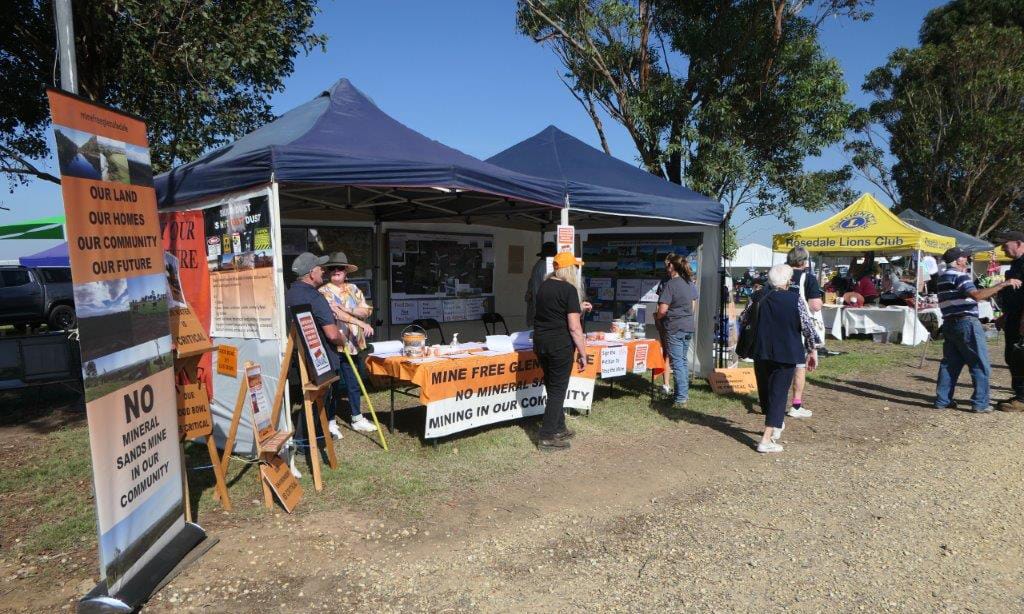
Photo: Mine Free Glenaladale.
At the recent East Gippsland Field Days the many hundreds of people spoken to and attending the Mine Free Glenaladale stand expressed their frustration that the Government had given the former Kalbar Resources, now rebranded as Gippsland Critical Minerals, the opportunity to rescope the failed Kalbar project.
Ms Grant from Mine Free Glenaladale said, “Many expressed their opposition to the mine citing reasons including contamination issues relating to mine runoff into the Mitchell and Perry Rivers and downstream to the Gippsland Lakes. This was a real concern for fishing enthusiasts and recreational users of these waterways. Contamination would come from mine runoff, in-pit tailings disposal and the use of flocculants and chemicals used in the processing. Contamination of irrigation water for the agricultural and horticultural industries was seen as an important issue.
“Dust blowing from the mine site has many in the community worried as the silica and radioactive particles are known carcinogens. The 1.5 kilometre buffer zone east of the mine site would do nothing to protect the agricultural and horticultural industries and people in rural communities including the City of Bairnsdale and other towns in East Gippsland. At least GCM, seeing the need for a buffer zone, confirms there will be dust. Attendees at the Field Days did not believe GCM could control the dust at the two open pits, which would cover an area of 2 kilometres by 600 metres. The Fingerboards elevated location and the strong winds which persist in this area would make dust suppression impossible.
“Water was seen by many as a precious commodity and a finite resource necessary for food security and domestic supply and should not be used for a mining operation and in particular for dust suppression for the mine.”
Ms Grant added “Information contained in GCM’s referral which was recently submitted to the Federal Government regarding the effect of the mine on Matters of National Significance (MNES), under the Environment Protection and Biodiversity Conservation Act, surprised many with the revelation that some areas to be mined will now be at a maximum depth of 58 metres this is in contrast to the 40 metres GCM originally planned.
“Community members questioned the long term viability of the mine, as the increased depth will be more costly to excavate and more water will be required for dust suppression on the increased size of the overburden heaps.
“In the same document the community now learns that the project site will cover an area of 6140.63 hectares which includes a large bore field south of the highway, over the red gum plains. This will tap into the Latrobe aquifer that supplies water for irrigation, domestic supply and the City of Sale water supply. The project area will include pipelines, a power supply corridor, a solar farm, haul roads and a large rail siding between Lindenow South and Fernbank. Impacts of mine infrastructure will be felt many kilometres from the mine site.
“There was scepticism amongst those attending the MFG stand that the test pit would provide all the answers in relation to impacts of the mine on the environment, over a 22 year time frame and would not show the success of mine rehabilitation over a large mining site. People felt this was another flawed process of this proposal. The test pit is proposed to be only .6 of a hectare in size and only 20 metres deep with a disturbed area of 4 hectares and it would not resemble the final footprint of the mine. This will be a smaller area to show dust suppression and containment of mine water runoff. There is also no guarantee monitoring of in-pit tailings storage will prevent contamination of the aquifers and the waterways.”
Ms Grant concluded, “That feedback from the community is that the risks to the environment and community wellbeing are too great for a mine development in this location. There was no confidence in the Government regulators to ensure the mine would not pose problems to the East Gippsland community. This attitude was based on people’s experience of other mining ventures in the State, including the local Benambra mine.”
Test pit concerns
The rescoping of the Fingerboards mineral sands mine project at Glenaladale 25 kilometres west of Bairnsdale, by Gippsland Critical Minerals formerly Kalbar Resources, will include a demonstration mining pit.
Construction of this mini mine has the community very concerned, as it is situated amidst First Nations’ Cultural Heritage and between two gully systems that flow into the Mitchell River. It also has the potential for dust to be blown off the site leading to contamination issues.
Gippsland Critical Minerals claims the test pit will test its proposed approach to noise, dust management, surface water runoff, Cultural Heritage, geotechnical, soil reinstatement and rehabilitation.
The community questions the authenticity of these claims, as the proposed test pit will only be dug to 20 metres and be a fraction of the size of a proposed mining void, which will be up to 58 metres deep and 900 metres long and 350 metres wide. Two of these mining voids will be in operation simultaneously.
Robyn Grant from Mine Free Glenaladale said “It will not give a true indication of any impacts large scale mining will have in the Fingerboards location. The test pit location is in an area known for its dispersive soils, when disturbed these highly erodible soils form large tunnels which can be many metres deep.”
She also added “In the past Governments have spent many millions of dollars in the Glenaladale and surrounding areas attempting to rectify tunnel erosion. This has not been successful as tunnels have reformed after attempts at stabilization. I am concerned the mitigation measures Gippsland Critical Minerals are proposing will not counteract tunneling of the soil and that rehabilitation outcomes will be unsuccessful.”
“Excavation for the test pit will interfere with the shallow aquifers; we don’t know how this will affect the hydrology in the area. These aquifers are important as they provide clean filtered water to the Mitchell River, as they flow through the gravel and sand layers. Disturbing these aquifers will also affect ground water dependent ecosystems and permanent spring fed dams which drought proof farms.”
“Infrastructure will include road construction, site buildings and a processing plant, this will cause considerable disturbance to the area being likely to affect critically endangered vegetation and Cultural Heritage.”
Ms Grant said “Flocculants and acids used in the processing plant at the test pit site have a potential to runoff into the gullies. These chemicals are toxic to aquatic life and could spell a disaster for fish and other species in the Mitchell River and the Gippsland Lakes.”
“Tailings from the processing are to be pumped back into the test pit, I am afraid chemicals will leach into the ground polluting rivers and streams.”
“Gippsland Critical Minerals test pit is the start of a water grab and competition for water from existing industries and domestic supplies. With dry times predicted in the coming year the 10 megalitres which has been allocated for the test pit may not be enough for dust suppression, processing and rehabilitation. If water is not available for dust suppression flocculants will be needed to control the dust coming off roadways, the overburden pile and any other site disturbance, adding to a toxic burden to both soil and water.”
“The community is questioning whether base line studies have been completed prior to the excavation of the test pit.”
Ms Grant reiterated “the community believes this is another attempt at marketing spin by the company, it will prove little and not show the destruction and long term consequences of large scale mining in this inappropriate location at Glenaladale.”
Find the series of stories relating to the Fingerboards Project including statements by Gippsland Critical Minerals and the community action group opposing the project, Mine Free Glenaladale here: Fingerboards Mineral Sands


Mineral sand mining for what are now considered to be critical minerals has been happening around Capel in SW WA since the 1950s. None of the ‘issues’ outlined in the above article – water pollution, dust, etc – have ever occurred. I therefore have to conclude that the anti-mining people are NIMBYs who have not bothered to find out how these ‘issues’ are managed and resolved elsewhere in Australia.
Perhaps you’ve had your head in the sands for too long Bernard?
“Yes, mineral sands mining around Capel, Western Australia, has had significant negative environmental effects, particularly regarding groundwater contamination, residue storage, and vegetation management over decades of operations. Key environmental impacts and issues identified include: Groundwater Contamination: Historical storage of mineral sands residue (by-products) in old dams has caused contamination of local shallow groundwater with manganese and sulphates. These materials were stored, not disposed of, but seepage occurred over time.
Contaminant Cleanup: Iluka Resources is conducting a major remediation project to move roughly \(70,000\text{m}^3\) of residue from old storage dams at the Capel dry plant and \(410,000\text{m}^3\) from South Capel to a new purpose-built facility to allow shallow groundwater to recover.
Groundwater Drawdown: Mining operations require dewatering (removing water from the ground), which can impact surrounding vegetation health. Vegetation and Fauna Impact: Mining activities necessitate clearing native vegetation, impacting ecosystems.
Historical reports indicate some sites were already affected by jarrah dieback disease, though rare fauna was not initially found on specific sites.
Air and Noise Pollution: Mining and processing operations have historically produced sulfur dioxide emissions, dust, and noise.
Residue Management: The process produces fine solids that require careful management (settlement dams) and return to mined-out pits, with some potential for nutrients to be released.
Perhaps you’ve had your head in the sand for too long Bernard?
Yes, mineral sands mining around Capel, Western Australia, has had significant negative environmental effects, particularly regarding groundwater contamination, residue storage, and vegetation management over decades of operations.
Key environmental impacts and issues identified include:
Groundwater Contamination: Historical storage of mineral sands residue (by-products) in old dams has caused contamination of local shallow groundwater with manganese and sulphates. These materials were stored, not disposed of, but seepage occurred over time.
Contaminant Cleanup: Iluka Resources is conducting a major remediation project to move roughly \(70,000\text{m}^3\) of residue from old storage dams at the Capel dry plant and \(410,000\text{m}^3\) from South Capel to a new purpose-built facility to allow shallow groundwater to recover.
Bernard Masters […] You have no idea on what you are saying; where is the evidence that you have that is not a subjective report from the mining company with biased and incompetent research and stats. And as far as dust blowing everywhere, you have no idea. At Kanagulk in Victoria, a report from the CFA Tower called a fire at our Iluka mine site, but what it was, was a very thick dust storm of all the radioactive dust. And my husband got a rare cancer which is not genetic, as for 24 years this radioactive dust has blown over our property, and an employee from Iluka has come down with cancer as well. And as far as water pollution goes, the water from the mine site was not supposed to leave the site. Well we had a very wet year which meant that their dam, third flow down the chain from the mine site, overflowed and went all the way to one of the most pristine rivers in Victoria, the Glenelg, winning many environmental awards, and contaminated the water with this radioactive contaminated dirt. There were Platypus in that river as well. Let me go on, and let’s debate. You are so wrong. And our Health Department have no longitudinal studies to say that there is no risk to people’s health or environment.