


According to Forestry Australia’s Dr Freeman, National Parks don’t guarantee biodiversity. But the soon to be ‘Great Koala National Park’ is supposedly a unique opportunity to balance the establishment of protected koala habitats against maintaining an area of state forests.
Freeman says:
- science-based active forest management will be crucial to conserving koala habitat;
- recent research shows that koala numbers remain high and stable in NSW state forest;
- in the Pilliga Forest the thriving population of koalas declined following conversion of state forest to conservation reserves;
- increasing the plantation estate needs to start today; and
- managing the threat of bushfires is another key consideration.
FA previously supported the National Forest Policy Statement including the Wilderness Myth and its inherent denial of Aboriginal management. Regional Forest Agreements were supposed to strike a balance. But every new claim from anti-logging activists brings a new answer to balancing new reserves against shrinking multiple use state forests. Green ideology wins every time. New South Wales is long past a balance point and well on the way to having no multiple use timber production forests, just like Victoria and Western Australia.
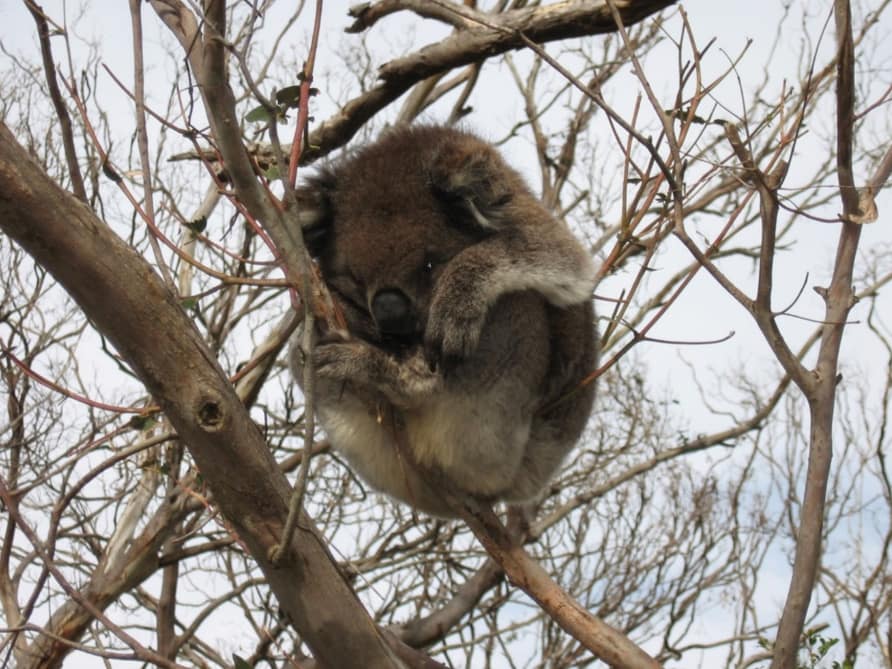
The Endangered listing of koalas north of the Victorian border and the idea of a Great Koala National Park are farcical. The koala is an irruptive species. High numbers indicate an irruption, not a stable population. Where numbers are very high, they typically crash during severe droughts, as happened widely during the Federation Drought and in the Pilliga as well as the Koala Coast during the Millennium Drought.*
The first irruption of koalas was reported by Surveyor Govett in the 1830s after Aboriginal burning was disrupted in the foothills of the Blue Mountains. Another irruption occurred there after the 2013 State Mine fire. It was reported to NSW Koala Inquiry by Dr. Leigh of Science for Wildlife: “What we are finding is large, growing populations … Everywhere we look we find a lot of koalas”.
Strzelecki’s party of exploration lived on koala meat for nearly four weeks in 1840 as they struggled through dense 20-year-old fire regrowth with thick understorey in South Gippsland. There was no diverse grassy understorey supporting game and foodplants on the ground. High numbers of koalas were still there in 2020 despite Black Thursday 1851, Red Tuesday 1898, Black Friday 1939, Black Saturday 2009 and 15 other high intensity wildfires in 200 years. Koalas as a species respond positively to high intensity fire regrowth, though many animals suffer a cruel death. The well-known irruption on Sydney’s outskirts near Campbelltown commenced after wildfire in the Sydney Water catchments in 1977.
Under Aboriginal management, koalas were a rare species living solitary lives in healthy and safe mature forests with diverse grassy understoreys and small game. Male koalas occupied large home ranges of around 100 hectares, moving around to exploit fresh growth on individual trees amongst the thousands in their range. Females had smaller ranges generally with more nutritious species. They were attracted by male bellows in the spring breeding season.
Active, scientific management, including frequent mild burning, would also produce healthy and safe forests with diverse grassy understoreys and fauna. There would be low numbers of koalas in mature forests and higher numbers in younger forests, including plantations. Excess joeys in timber plantations would be exported to zoos and wildlife parks where they could be fed from koala food plantations managed by coppicing.
References
– Vic Jurskis, Ecological history of the koala and implications for management, CSIRO Publishing, Wildlife Research, December 2017, https://doi.org/10.1071/WR17032
– Vic Jurskis, The great koala scam : green propaganda, junk science, government waste & cruelty to animals, Connor Court Publishing, 2020.


I agree with some points and not on others.
– science-based active forest management will be crucial to conserving koala habitat;
Yes, science should inform the forest management. Independent science aiming to preserve biodiversity, carbon, water quality and other valuable resources. In state forests, the aim has been to maximise log volumes and quality. This has led to major conflicts over these other factors. “multiple use” has tended to sacrifice nature for economics.
– recent research shows that koala numbers remain high and stable in NSW state forest;
Koalas remain listed as endangered in NSW. Fortunately, there has been more research and surveys done for Koalas in NSW. The song meters used do report if males are traveling through an area and do give some indication of distribution, but not much information on the health of the population. In any case, not enough evidence has been put forward to change the status from endangered. Such a change would require an independent scientific assessment. We would all welcome good news.
– in the Pilliga Forest the thriving population of koalas declined following conversion of state forest to conservation reserves;
A 2012 study found that Koala declines were likely caused by heatwaves (climate factors) and logging of native softwoods was probably not a big factor here (as they are not feed trees). Ending logging in that area may have stopped the removal of non-feed trees. But it can’t be said that changing the management to conservation was as big as a factor as climate. As often, it’s not easy to see exactly what is going on.
– increasing the plantation estate needs to start today; and
– managing the threat of bushfires is another key consideration.
Yes, we must do both of these and resource them both well and base them both on sound, independent science.
We currently export a lot of our hardwood plantation timbers for pulp; this is a waste. Regional towns could be using this material to make engineered wood products. But this would take forethought and investment, which seems scarce in Australian industry.
Plantations cover around 1.3% of Australia’s forests estate but supply around 90% of the wood products and is profitable. This efficiency needs to be expanded. Native forest logging is losing money and costing us in species (Greater Glider, Swift Parrot….etc), carbon, water quality and should end.
Plantations, done well, are the answer. Let’s end the conflict and move onto a secure future for nature and regional communities.
The points of agreement between the Koala Industry and Forestry Australia help to explain the unnecessary chronic decline in sustainable native forestry. Scientific forest management would remove all the additional onerous prescriptions relating to koalas. Research by Dr. Law has shown conclusively that koalas are unaffected by logging, irrespective of its intensity or extent in the landscape.
Existing eucalypt plantations cannot supply the high-quality timber that comes from native forests. Most of the wood products come from softwood plantations. The contribution of native forests is very much reduced because Victoria and Western Australia have ordered a stop in sustainable forest management.
Native forest logging has never extinguished a single species of plant or animal.
The endangered listing of koalas is risible. It relied on ‘expert’ guesses based on ineffective surveys.
The crash of koala numbers in the Pilliga was inevitable due to the irruption of koalas into unsustainably high numbers. Koalas living at low densities in semi-arid areas in Queensland were not affected by the Millennium Drought.
Mr Ryan of the Koala Industry claims that native forestry is losing money. He is incorrect. Native forestry is saving money because it delivers conservation of soil, water, clean air and wildlife more cheaply than National Parks whilst delivering a beautiful renewable resource in timber, that feeds a substantial value-adding industry.
The Koala Industry, on the other hand, is funded by tax-deductible donations from well-meaning people deluded by green propaganda. There are more koalas over a much wider area than there were when Europeans came to Australia. They are suffering disease, dog attacks and vehicle injuries due to overcrowding and dispersal from forests into suburbia. Meanwhile the Koala Industry spends heaps of money trying to exacerbate the problem.
They got a boost from John Williamson on TV this morning. He was advertising the upcoming release of his book of propaganda aimed at young children, called “Koala Koala”. The chorus of his song of the same name is “gunna send in some money today”.
Mr Ryan, Some of the points you have made are deserving of a response.
Your claim that State Forests are primarily about timber production is one. I can only talk about the Victorian experience where timber production was always only undertaken on a portion of State Forests, for example, for many years prior to the 2019 political decision to end Victorian timber harvesting there was around 2 million hectares of State Forest, but less than a quarter was available and suitable for long-term management for timber supply, after taking account of unsuitable or economically- inaccessible forests, as well as various management and operational reserves specifically applied to protect or minimise impacts to other non-wood values, such as biodiversity and water. Indeed, the whole point of the Code of Forest Practices (which every state has had for almost 40 years), is to minimise impacts on water and conservation values, which thereby significantly reduces the capability to maximise timber output. In addition, as far back as the 1970s and 80s Victoria’s Forests Commission was employing ecologists and landscape architects to guide the protection of important values in State Forests, including in logging zones.
It must also be remembered that until the mid-1990s, Australia’s native forests provided the majority of the nation’s timber needs as the plantation estate was growing towards maturity. Despite all this, there has never been a documented extinction of any species associated with the periodic harvesting and regeneration of Australia’s native forests.
Your claim that “native forest logging is losing money” is also highly questionable. The state government agencies run at a loss in some years because they perform other functions and cannot always sell logs (for their income) because of external factors such as fires or dealing with incessant protests and associated court injunctions; but the balance sheet of the government forestry agency is only a small part of the overall socio-economic activity generated by the broader timber industry that processes logs and makes them into usable products. There has never been a question of the broader timber industry losing money as a result of logging, but critics tend only to look at the balance sheet of the government agency that sells logs.
Plantations — it does make some sense to grow export pulpwood plantations for longer to produce sawn wood products for local use, but the extent to which this is possible is dependent on plantation ownership, contractual obligations, and site productivity. If sufficient plantations could be grown longer, it would take capital investment in regional towns to utilise them for local use. Whether or not this happens is less dependent on “the lack of foresight of local timber industries”, then on the confidence to invest given the history of incessant anti-forestry activism. Why would the industry invest hugely, when the next election could see them closed down by some Greens-inspired political decision. Hardwood plantations are only marginally less susceptible to this than native forests, especially because koalas find then attractive, as in SW Victoria where an estimated 43,000 live in Blue Gum pulpwood plantations.