

Australia’s largest water reform project, the Murray Darling Basin Plan, appears to be joining a growing list of abject failures driven by politicians and bureaucrats who have little to no wisdom, ethics or skin in the game. Unless of course, that skin is water trading.
Section 100 of the Australian Constitution states: “The Commonwealth shall not, by any law or regulation of trade or commerce, abridge the right of a State or of the residents therein to the reasonable use of the waters of rivers for conservation or irrigation.”
Despite constitutional protections, the Australian Federal Government’s $13 billion has fuelled a 50 per cent reduction in NSW and Victorian irrigation water use since 1997-98. South Australia saw a 22 per cent reduction, while Queensland bucked the trend increasing extraction by roughly 58 per cent.
The hardest hit areas of NSW and Victoria are the food bowl regions of Southern NSW and Northern Victoria. Despite the Federal Government’s claim that the basin plan had a triple bottom line, communities, staple food industries and our local environment have borne the brunt of this political plan. Despite a plan to “save the environment”, the federal government appears unable to produce a single environmental impact study completed prior to the removal of irrigation water from local floodplains. The same floodplains supported ecosystems and endangered species, such as the Southern Bell Frog, Australasian Bittern and Murray Darling Python. Along with the blanket removal of water modernisation projects, the Northern Victoria Irrigation Renewal Project (NVIRP), has also come under fire as the once earthen channels, which were not 100 per cent water efficient, but did provide some of the richest wildlife corridors and refuge belts in the region, and delivered water by the wonders of gravity!
Independent Member for Murray Helen Dalton this week accused the NSW Government of taking “Hush Money” from the Federal Government to sell out Murray-Darling Basin communities. Dalton slammed the NSW Government for accepting a $15 million payment from the Federal Government which is designed to compensate for damage done by Commonwealth Water Buybacks.
“This money is hush money,” Helen said. “And by taking this money, the NSW Government is selling out the regions and legitimising the devastating buybacks.”
The $15 million payment is part of $160 million the Federal Government has offered as compensation to Murray-Darling Basin communities which will be devastated by 450 gigalitres worth of Commonwealth water buybacks.
“The Commonwealth does not need this water, rural communities do.” Helen said. “It’s not compensation. It’s a bribe. It’s hush money and we don’t want it.”
Ms Dalton is calling on the NSW Government to send the $15 million payment back to the Commonwealth and fight against the buybacks.
“Right now, the Minns’ Government is selling out rural NSW. They just need to stop the Commonwealth buybacks before they cause even more devastation.”
With an election in the air, federal member for Farrer Sussan Ley, who has held the seat since the coalition’s initial implementation of the Basin Plan, attacked the Albanese Government for greenlighting new water buybacks from the southern Murray Darling Basin just weeks out from a federal election.
“Water buybacks is a lazy, uncaring method of taking enormous amounts of water for the environment.
“If you want to divide farms, split communities, add to the nation’s debt level and stop growing Australian produce, then this is the way to go about it.
“And it’s only happening because Anthony Albanese collaborated with the Greens and crossbenchers in late 2023, legislating for the removal of more water from farmers over a shorter period of time.”
With the Basin Plan came a shift in the geographical use of water. Modelled on a spreadsheet from the comfort of Canberra, the true cost of moving water was never fully realised. Increases in conveyance losses, natural constraints of the system, and the systematic erosion of the very rivers the government claim to “save” have all featured heavily.
Now the Natural Resources Access Regulator (NRAR) will survey lower Murray River farmers as part of a pilot project to reduce the risk of water law breaches below the Barmah Choke. A plan to “restore the balance” enabled tens of thousands of hectares of new irrigation areas to be set up further from the water source and below the natural constraints of the system.
NRAR Manager Priority Programs, David Thomas, said increased permanent plantings in this region meant higher demand for irrigation water and this could exceed the volume of water able to pass through the choke point, especially during dry periods
“When you combine that water delivery issue with the likely high cost of traded water during dry periods, compliance problems could arise,” Mr Thomas said.
“The risk is that with all those pressures, people may not comply with the rules and that is exactly what NRAR hopes to prevent,” he said.
What should successful water reform look like?
- A decreased ability for everyday Australians to pursue a life in irrigated agriculture?
- Increased water charges and associated costs?
- Reduction in water reliability?
- Increased foreign water speculation competing with Aussie farmers?
- Net decrease in wildlife corridors, refuges, and feeding and breeding habitats?
- Conversion from a gravity-fed system to energy-intensive water delivery during a government-made energy crisis?
- Critical mass issues of irrigation delivery companies resulting in financial sustainability issues?
- Formation of new irrigation areas below constraints and atop ancient salt shelves?
- The corruption of science to maintain a freshwater estuary fallacy for the South Australian Lower Lakes?
- An active program to dilute the Southern Ocean with freshwater in a hot and variable climate like Australia?
Well, if so, we have success!
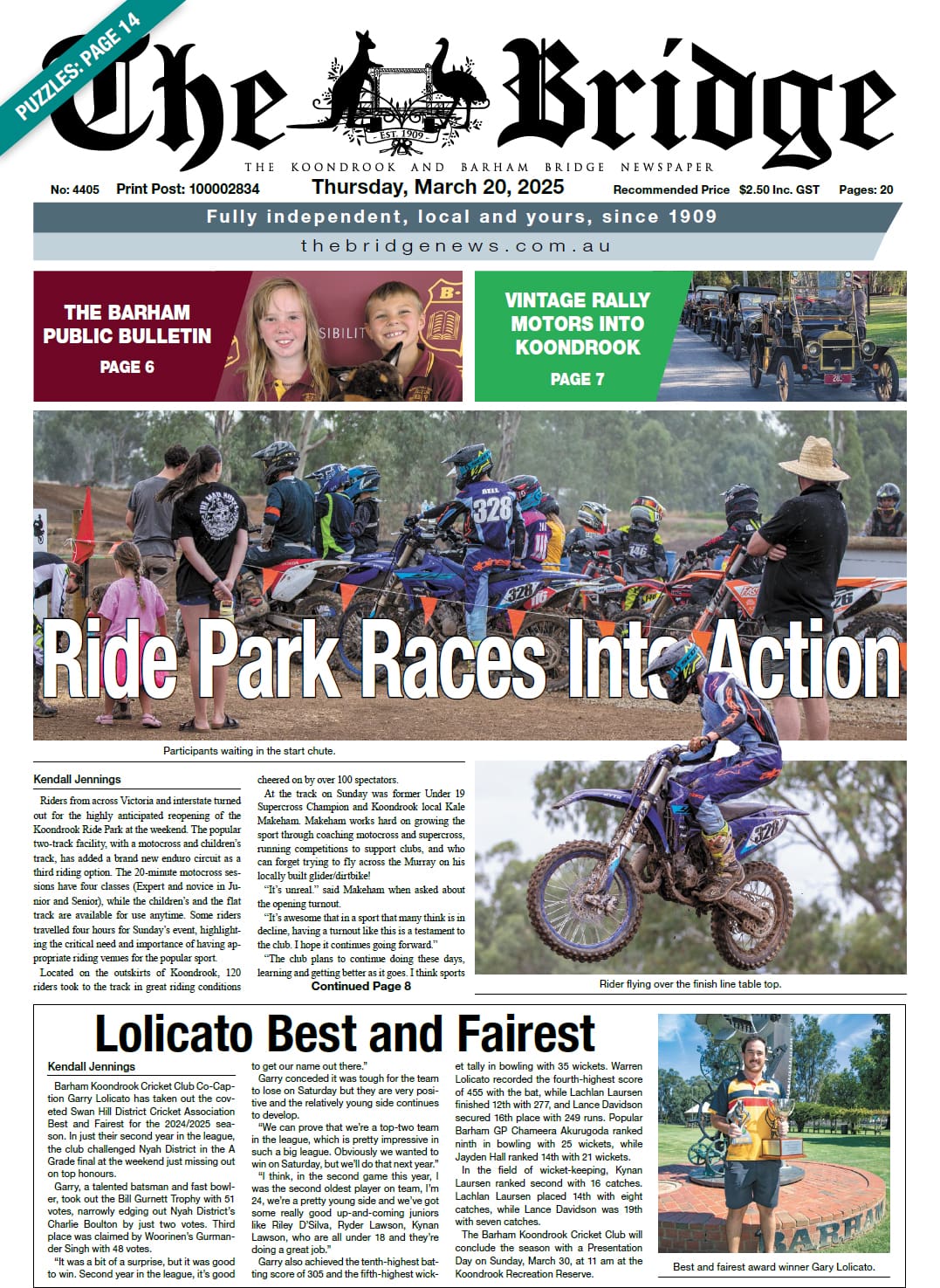
This article appeared in The Koondrook and Barham Bridge Newspaper, 20 March 2025.
