


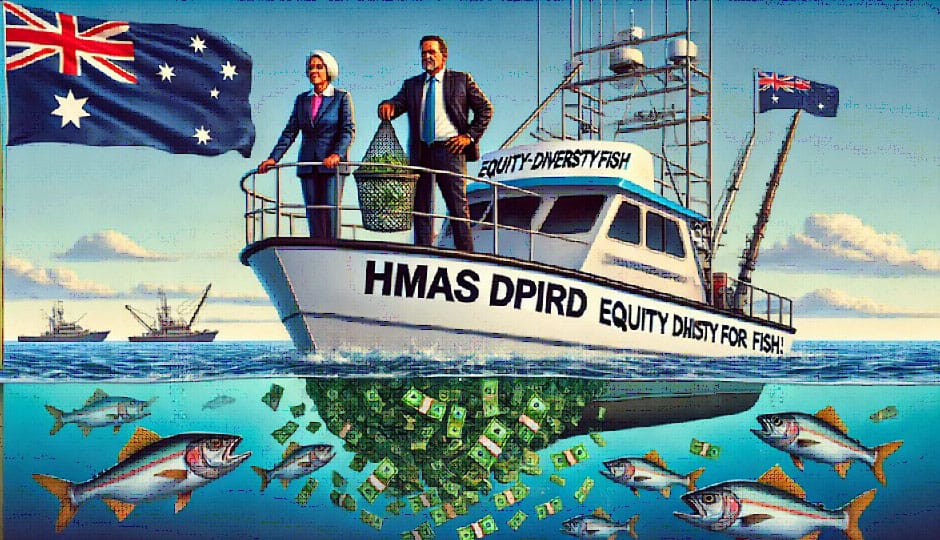
DPIRD, dated January 22, 2025, announces a $7 million splurge under the banner of “Building Climate Resilience on WA Farms.” Tucked neatly inside this generous handout is an eye-watering $1,071,770 for “future-proofing” Western Australia’s aquaculture industry. Future-proofing? Against what, exactly? Climate change? Cue the laughter.
Or perhaps it’s a hedge against Twiggy Forrest losing interest in his aquaculture venture, Harvest Road, which has poured tens of millions into mussel and oyster farming in Albany—with little to show for it. It’s about as successful as his foray into green hydrogen: a never-ending money pit that conveniently ignores the fact that without a market, these investments are nothing but financial sinkholes.
No wonder the Ministers for Fisheries and Food didn’t put their names to the press release, leaving it to some hapless bureaucrat to tell us the “exciting news” that the government is about to throw more good money after bad into the watery grave of aquaculture.
No doubt both ministers have wised up to the fact that someone (read: me) actually reads these announcements and will do the Opposition’s job for them—highlighting yet another waste of taxpayer money.
Now, I’ll admit to a passing acquaintance with aquaculture, courtesy of seven long years working in a former Minister for Fisheries’ office.
During that time, I suffered through no shortage of grand schemes to transform WA’s 18,000-kilometre coastline into a utopia of fish farms—a watery paradise stretching from the Kimberley to the Great Southern.
The logic, if one can call it that, is simple: we have lots of water, ergo, we should be able to produce lots of fish. Never mind the pesky details like markets, infrastructure, the lack of air freight capacity for a highly perishable product, or the high cost of labour—just minor inconveniences, apparently. (Note: These are the same challenges we face with processing sheep meat onshore versus walking live animals onto a boat.)
This magical thinking—that abundance equals profitability—isn’t limited to aquaculture. It’s the same delusion that drives the boxed mutton fiasco, where governments seem perpetually baffled by the concept that producing something doesn’t automatically guarantee a profit. À la green hydrogen—or, for that matter, green anything.
And yet, here we are, once again tossing millions at an industry that barely exists beyond a few marron farms and a barramundi operation up north—despite every independent economist pointing out that growing fish to sell fresh is unviable without either significant domestic demand or global supply chain infrastructure. But who cares about feasibility when there’s a shiny “holy grail” to chase?
Meanwhile, as aquaculture basks in its latest shower of taxpayer cash, the very departments forced to dole out the grants are busy slashing their own critical functions. Biosecurity? Essential staff? Regulatory oversight, sustainability of our wild caught fisheries? All taking a backseat to these political vanity projects—none of which have been stress-tested by independent economists.
How delightfully ironic that the same ministers extolling the virtues of this “investment” are the ones presiding over their department’s slow implosion.
The justification? “Creating jobs” and “stimulating investment,” they claim. But where are the economic studies to back these bold assertions? Where is the hard evidence that this money will do anything more than fund a few photo ops and glossy press releases, standing in front of yet another refurbished state-owned hatchery?
If government grants were the secret sauce to prosperity, Perth would be looking like Dubai. Instead, it feels like we’re hurtling back to the glory days of WA Inc., when ministers fancied themselves as titans of economic development but ended up achieving little beyond spectacular failures.
And let’s not forget the “drought resilience” angle. Perhaps they’re worried the oceans might dry up due to climate change? Who knows? The logic behind climate catastrophism has long eluded me.
It’s almost impressive how consistently the government manages to ignore common sense while throwing good money after bad. And yet, they keep at it—undaunted, unaccountable, and utterly predictable.

