

As bracket creep pushes more and more people into the top tax rate of 37 per cent for those earning over $120,000 (10–15 per cent of taxpayers) and 45 per cent plus the Medicare levy for those earning over $180,000 (3–5 per cent of taxpayers), it is only a matter of time before Australians who are mobile enough decide they don’t want to pour an ever-greater part of their annual income into funding Albanese’s political priorities.
For those who can pick up and leave the country to escape our high tax rates I thought I would give you a quick world tour of where you can park yourself between seeding and harvest every year to keep the tax man at bay.
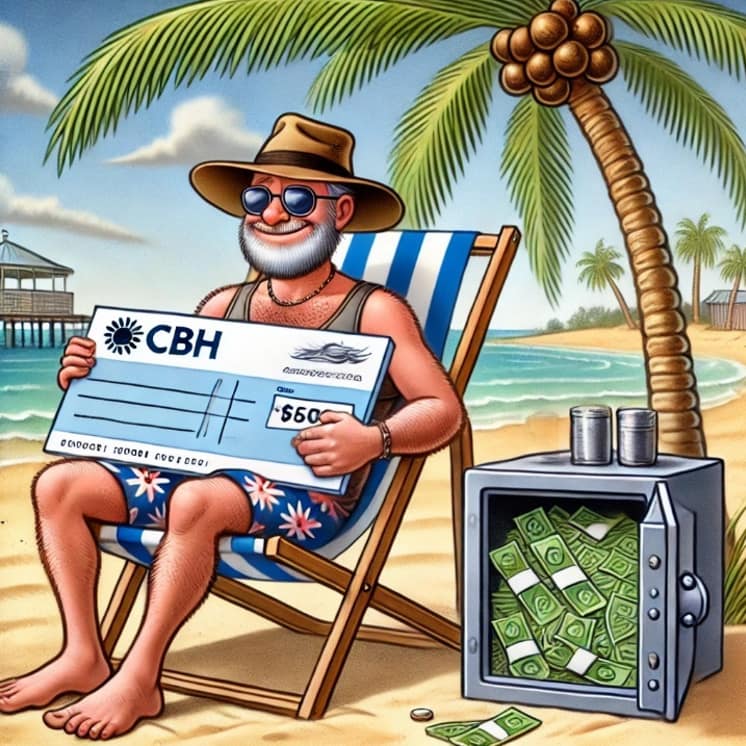
Let’s start with the Caribbean. The Cayman Islands offer 0 per cent income tax and 0 per cent GST, but import duties of 27 per cent push up the cost of living. Monaco is an attractive option with 0 per cent income tax but a high 20 per cent GST though the local talent is glamorous. The United Arab Emirates charges 0 per cent income tax up to $375,000, with 9 per cent on anything over, plus 5 per cent GST but it’s cranking hot in our winter. Singapore is closer to home and has an income tax capped at 22 per cent and a GST of 8 per cent but its housing costs have exploded with all the Chinese nationals bailing out of Hong Kong. Panama’s income tax is 25 per cent, with a 7 per cent GST but it’s three flights away, while Bulgaria boasts a flat 10 per cent income tax and a 20 per cent GST but watch out for any wayward drones which overfly Ukraine. My preferred option is Vanuatu, which offers 0 per cent income tax, 0 per cent corporate tax, 0 per cent capital gains tax, and a 15 per cent GST, the weather is good and the people speak English.
Take your pick. Depending on what food you like to eat, and the weather, there are lots of options out there for those eager to escape the taxman – Asia, Middle East, Europe, the Caribbean, Central America or the Pacific. There is indeed a place for you, and more people are seizing the opportunities to park themselves where they are not funding the dreams of progressive politicians.
Just how bad is it these days? Well, those with long memories will recall that Australia has a history of taxing people out of the country. In the 1970s, the highest marginal tax rate was as high as 67 per cent, kicking in at around three times the average income—thanks to Gough Whitlam’s economic policies. By the mid-1980s, economic reforms under the Hawke-Keating government saw the top rate cut to 49 per cent to stem the exodus of talent and encourage longer working hours.
Under Howard and Costello the trend of lowering tax rates continued, reaching 47 per cent in the early 2000s, and later Morrison reduced it to 45 per cent. If the Coalition had won at the last election their Stage 3 tax cuts would have dropped that rate to 37 per cent for incomes up to $200,000 but this promise, also matched by Labor, was abandoned this year by Albanese and his socialist Treasurer despite such promises as:
“We will deliver responsible economic management and ensure that Australians benefit from the tax relief already legislated. Our plan supports working families and creates a fairer tax system.”
So much for Albo’s credibility. Of course, we shouldn’t complain too much; some European countries, like Sweden, Denmark, Japan, Finland, and France, still have top marginal tax rates exceeding 55 per cent. Rates and economic models that Jim Chalmers seems to admire.
But dropping taxes is what all governments should aspire to as, let’s face it, it’s theft of our money. Margaret Thatcher famously dropped the UK’s top tax rate from 83 per cent, which included an additional investment income surcharge bringing it to a unbelievable 98 per cent, to 40 per cent by the time she left office. Mind you, we were not much better under Menzies, Holt, and McMahon who between the 1950s and 60s oversaw a top rate of between 67 per cent and 75 per cent. Though less than 1 per cent of the population were in this bracket vs 7.4 per cent today.
This is why great disruptors like Thatcher and Trump are important. Trump, during his presidency, lowered the top income tax rate from 39.6 per cent to 37 per cent while doubling standard deductions from $6,350 to $12,000 for singles and from $12,700 to $24,000 for couples. But his real triumph was reducing the corporate tax rate from 35 per cent to 21 per cent. This measure is part of why he remains popular, as the tax cuts are set to expire in 2025, and Kamala Harris’s proposal to increase taxes was not well received. Trump has promised to extend these cuts and introduce Tax Cuts 2.0, which includes eliminating payroll taxes and directing businesses to pay that money to workers, while he is promising to drop company tax to 15 per cent with the revenue loss being funded by tariffs on the rest of the world.
Talking about the rest of the world, let’s have a quick look at global corporate tax rates amongst the OEDC countries: United States at 21 per cent; United Kingdom recently raised to 25 per cent by the new Labour government; Canada at 26.5 per cent; Germany at 25 per cent, France at 25 per cent, Italy at 28 per cent, Netherlands at 25.8 per cent, and Argentina at 30-35 per cent. Australia stands at 25 per cent for companies with turnovers below AUD 50 million which matches the rest, but for bigger businesses they face 30 per cent, which is closer to Argentina, placing us on the higher end of the scale.
Contrast this with countries that have 0 per cent corporate tax rates: Cayman Islands, Bermuda, British Virgin Islands, Isle of Man, Guernsey, and Jersey (Channel Islands). Ireland has managed to attract major corporations with its 12.5 per cent rate, while Mauritius sits at 15 per cent and Singapore at 17 per cent.
Hopefully, tax policy will feature prominently in the upcoming federal election because the simplest way to alleviate cost-of-living pressures is to reduce the government’s reach into people’s pockets and fire up business to generate more profits. After all, when the Australian government struggles to manage programs like the NDIS or writes off 20 per cent of student debt for votes, it’s clear they don’t need more of our money.