

You have to hand it to the Russians; they are a resilient mob. I had started to write a story back in May about how drought, frost, labour, and parts shortages were about to combine and smash their next grain harvest but luckily, I didn’t, as my predictions would have been way off the mark.
As it turns out, despite what all the global grain experts said at the time, about Russia facing a difficult year, it seems they are on track for another big crop.
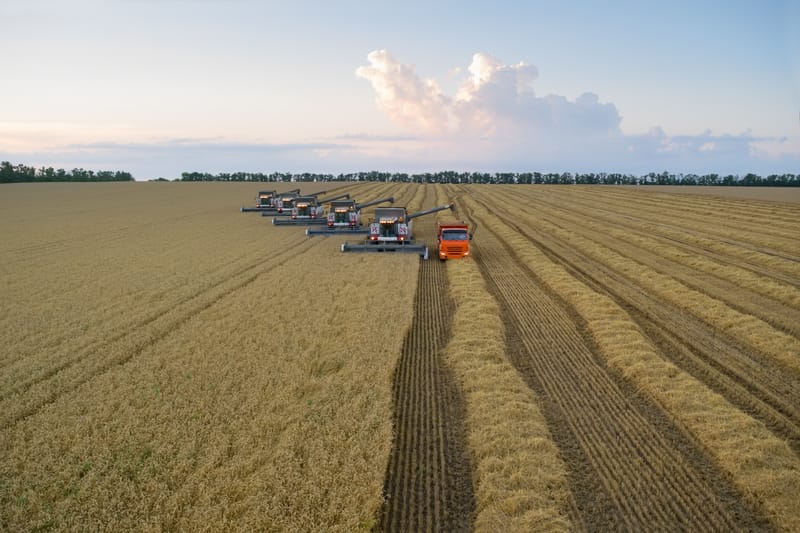
This is despite their farmers suffering through an extra dry spring, in fact it was their driest April in more than ten years, with rainfall barely 25 per cent of the long term average.
April rainfall is as important for Northern Hemisphere farmers as it is for us in the Southern Hemisphere.
Added to the dry start in Russia was above-average temperatures in April, averaging 5.4 degrees Celsius above the long-term mean.
It sounded like our start to the season; only difference is here our catastrophists were moaning about climate change and demanding government do more, whereas the Russians are looking forward to climate change taking the edge off their brutal winter.
In their world, they slow little interest in following us down the path of economic suicide. Mind you, Putin’s doing a good job destroying their economy by picking fights with the neighbours.
To add to the Russian farmers woes, in May they were hit with frosts as temperatures plunged below minus 4 degrees Celsius at night, which is unusual for their grain belt at this time of year.
With the crops up to three weeks further advanced than normal, temperatures of that magnitude are right on the damage threshold. While winter wheat is a tough plant, being able to survive all winter under snow, even they do not like a frost when it’s flowering time.
As the world’s largest wheat exporter, Russia’s production and exportable surplus significantly influence international prices. After two consecutive bumper wheat harvests, Russia has been exporting record quantities, flooding the market with cheap grain and progressively pushing global prices lower.
Consequently, global grain markets focus heavily on Russian weather in the northern spring for signals of global trade prices, which is why the dry followed by the cold helped spike prices in April and May as traders were looking at the forecasts and predicting drought and frost.
But, as we all know, the money is made in the last month of the growing season, and Russia is now back on track to pull another big crop out of the bag, which has helped push global prices down.
In that part of Russia, the harvest is now well underway. Operational data, the stuff that modern headers hoover up, disappears up into the cloud without you knowing it, which can then be sold to the big grain traders. It shows that farmers harvested early cereals on 22 per cent of the area in the Rostov region, achieving the long-term average yield of 3.6 t/ha (that’s good money with their input costs).
In the Stavropol Territory, they completed harvesting on 53 per cent of the area, with an average yield of 3.56 t/ha, slightly lower than last year. Farmers in the Krasnodar region (which translates as Esperance in Russian) harvested winter wheat on 50 per cent of the area, maintaining an average yield of 6.5 t/ha, which matches last year’s figure.
Don’t buy one of these
While I’m taking you on a journey through Russia, I came across an article about the labour shortage the Russian economy is facing. This is partly due to a collapsing birth rate, but a contributing factor is the war hoovering their young men up off the streets and into the meat grinder of the front line.
Any visitor to Dubai or Bali will note the large number of English-speaking Russians in their 20s and early 30s hanging out in cheap hotels; obviously being a draft dodger is a smarter bet than dodging bullets in Ukraine.
The exodus is in full swing, with over a million having done a runner, this is not good for Russia as they are losing internationally transferable skills—the sort of skills needed to make drones and build and fix headers.
The Russian Academy of Science’s Institute of Economics estimates that Russia was 4.8 million workers short of what the economy needs.
Adding to the labour shortage are the sanctions that have hit domestic production. All those Russian-made Rostelmash, Agromash, and Kirovets tractors and headers that they export and use locally to produce their annual harvest of 120 million tons of grain are rapidly running out of parts.
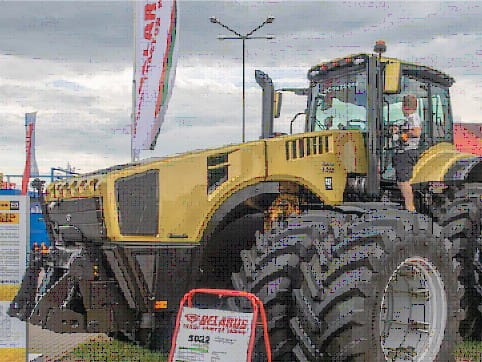
So, don’t rush out and buy any Russian-made equipment, or for that matter anything from Belarus, which is closely aligned with Russia. Which means putting a line through buying the Cat-powered Belarus 500hp four-wheel drive (pictured), no matter how cheap it may be.
Luckily for Versatile owners worried about the Russian connection, (Rostelmash bought Versatile in 2007), the old Canadian brand has just been sold to a Turkish tractor manufacturer, Basak Traktor.
It was a forced sale as for some strange reason their market sales had collapsed in North America, something about anything to do with Russia was not popular.
Mind you, the reputational damage of being associated with Putin has probably made Versatile tractors a good buy here and in North America, although the Versatile headers sold in the US and across Europe are actually rebranded Rostelmash machines which would not be a good buy as parts would be a issue.
So, despite a shortage of skilled labour to make, fix, and drive Russian farm equipment and a shortage of parts for everything from the chips in the electronic control boxes in the cab to mobile phone tower parts, the Russians are still managing to get their crop off.
I told you they are a resilient mob. Something the Ukrainians are finding out the hard way.