


Author and ‘Living Treasure’ Tim Winton AO says lack of action on climate change hasn’t been challenged enough in the arts. Painter Laura Jones is working to change that. She said “When I flew to Perth for a sitting [of Winton for his portrait], the Great Barrier Reef was suffering its fifth mass bleaching event in eight years”. (Laura Jones: Tim Winton :: Archibald Prize 2024 | Art Gallery of NSW)
Scientific debate about climate alarmism in respect of the Great Barrier Reef has certainly been challenged in the courts. Professor Peter Ridd was sacked by James Cook University for attempting to expose what I would describe as the Dying Reef Scam. Unfortunately, academic establishment groupthink prevailed over science in that case and “The Full Federal Court has not stood up for academic freedom”. (James Cook University wins appeal against Professor Peter Ridd, Sterling Law (Qld))
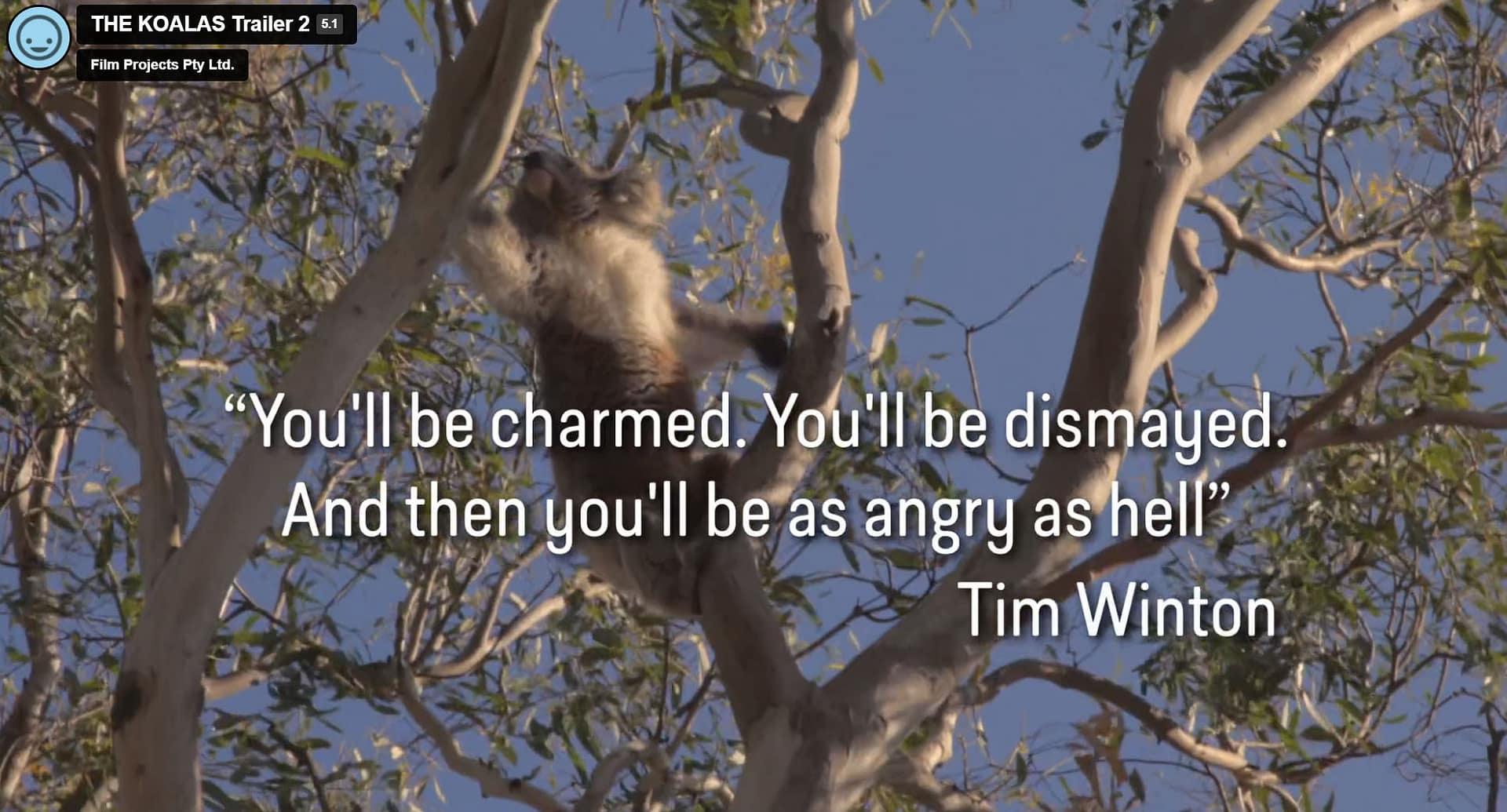
Now, Jones’ prize-winning portrait of Winton is helping to promote a documentary film supposedly aimed to save koalas from extinction.
Winton says of the film “You’ll be charmed. You’ll be dismayed. And then I bet you’ll be as angry as hell at what’s being done to koalas in your name and in your own lifetime. But I hope you’ll act on that rage and be a part of the change that desperately needs to happen”. (The Koalas – Q&A Event | Orpheum Cinema; https://www.thekoalasfilm.com; https://www.filmink.com.au/georgia-wallace-crabbe-fights-for-the-koalas/; https://www.acf.org.au/northern_beaches_nsw_film_screening_protecting_sydney_s_koalas)
Bob Brown AO endorses this. He says that “Action comes out of brilliant movies like The Koalas”. I presume that Brown is referring to protest action such as that which stopped development of fairdinkum renewable hydroelectricity in Tasmania. I haven’t seen any news of similar action against fake renewable projects in Queensland which have government approval to kill supposedly endangered koalas using a hammer blow to the skull if necessary. (Why claims about euthanasing koalas to make way for a Queensland wind farm are missing context – ABC News)
The Koalas premiered on 16 June in Victoria where they are not listed as a rare or threatened species. This must be confusing for koalas whose home ranges straddle the border with New South Wales where they are officially endangered. Ticket sales are supposedly raising money to save them from extinction in ACT, NSW and Qld.
Showings of the film at Campbelltown were promoted by the NSW Government. Residents of Sydney’s North Shore, where there are many Teals, were treated to a special screening on Thursday 27 June, followed by Q&A with filmmakers Gregory Miller and Georgia Wallace-Crabbe, as well as Greens MP Sue Higginson. (https://www.orpheum.com.au/movie/the-koalas—qa-event; )
I’d like to ask them some Q’s, but it’s ‘a bridge too far’ for me. In any case, I already know the real A’s. Their publicity material indicates that these won’t be forthcoming. The trailer covers all the usual propaganda about climate-caused bushfires, disease, dog attacks, vehicle injuries, and death by logging or highway construction. But there seems to be a focus on the ‘threat’ of housing development at Campbelltown.
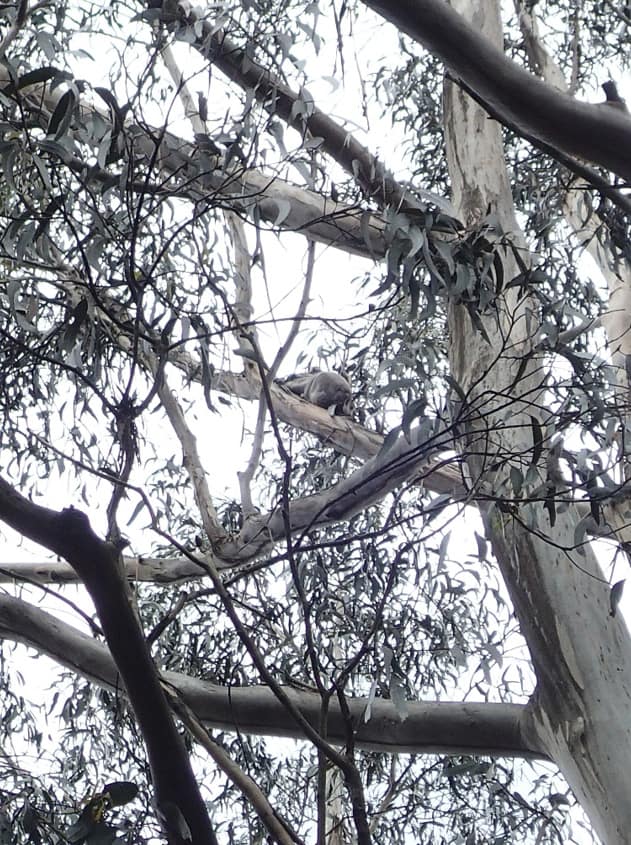
The short text attached to the trailer includes these statements:
“On the East Coast [of] Australia, where ancient forests meet the urban fringe ”¦ the koala [is] facing extinction. Scientists identify the main culprit behind the alarming drop in koala populations is habitat loss. In southwest Sydney, a key koala colony lies in the path of a proposed housing development. In Victoria, where the land was cleared earlier than in other states, translocated koalas persist in plantations”.
The publicity is demonstrably false. Koalas are a naturally rare species which first irrupted in the 1830s when dense young forests had grown up in the foothills of the Blue Mountains, west of Sydney, after Aboriginal burning was disrupted. Now there are many more koalas over a much wider area than there were when Europeans set up camp at Sydney Cove in 1788. Koalas didn’t live around Campbelltown when settlers started clearing.
Fifty farmers gathered when Governor Macquarie marked out the town site in 1820. It’s named for his wife’s family. (https://www.campbelltown.nsw.gov.au/About-Campbelltown/History/History-of-Our-Suburbs/History-of-Campbelltown). Koalas invaded the farming areas at Campbelltown after they had been cleared, when eucalypts in improved pastures were declining and constantly turning over soft young growth – that is koala food.
Historic records gathered by NSW National Parks and Wildlife Service show that koalas occurred “in almost every tree” by the close of the 19th century. However, NPWS reports an “apparent population crash from the early part of the [20th] century and recovery in the 1980s”. This ‘recovery’ began when suburban development extended into the rural lands about a decade after a major wildfire devastated the adjoining Sydney Water catchments in 1977.
Alienation of formerly grazed bushland for urban development, and thick wildfire regrowth in the water catchments, produced the recent irruption of koalas that is misrepresented as recovery. Exclusion of fire and grazing from native pastures causes eucalypt decline in much the same way as does pasture improvement. High intensity wildfires also produce an abundance of soft young growth.
NPWS claims that “the population is low and always has been. ”¦ historical clearing of fertile plateau land for agriculture and urban development resulted in an initial decrease in the Campbelltown population”. In fact, what really happened is that plagues of overcrowded and malnourished koalas suffered disease as paddock trees declined. People responded humanely and pragmatically by shooting them and selling their skins.
But the more mature koalas that were culled, the more young that found enough food to survive and breed. Numbers crashed after eucalypt leaves frizzled in the Federation Drought. Euthanasia was also employed at Cape Otway in Victoria only a decade ago, after woodlands with unsustainably high numbers of koalas suffered in the Millennium Drought. (Starving koalas secretly culled at Cape Otway, ‘overpopulation issues’ blamed for ill health – ABC News)
Koala numbers were not so obviously high at the Pilliga Scrub in NSW and on the Koala Coast in Queensland. They were left to fend for themselves. The inevitable crashes in numbers were later reported as declines due to climate change or clearing.
Koalas at low densities in healthy open forests survived both the Federation and the Millennium droughts. But they are virtually invisible. Each animal’s home range of around one square kilometre contains thousands of trees. The koala industry uses this natural invisibility to promote the fiction that koalas are in decline because they are rarely seen.
The unseen koalas have chlamydia but not chlamydiosis because they aren’t stressed. Disease is a consequence of overabundance, malnutrition and stress in koalas, as it can also be in human populations.
People have short memories. Koalas were supposedly extinct in NSW and mainland Victoria by the 1930s. In 1966, Foundation Professor of Zoology at Monash University A.J. Marshall wrote that “few Australians have ever seen a wild koala”. Ten years later, “the most significant outcome” from a symposium at Taronga Zoo was “unanimous agreement [of 43 experts] that the koala is no longer an endangered species”. After another decade, NPWS was cynically using mail out surveys, recording casual sightings of this admittedly cryptic species, to support their claims for more national parks to save koalas.
Koalas at Campbelltown continued to increase through the Millennium Drought. They had only reached about three times their natural density. But researchers were already translocating some to supposedly unoccupied habitat further south. The invisible residents down there soon found and bred with the forced immigrants. The members of the “last healthy koala colony” at Campbelltown are really part of a mostly low density and healthy population that extends through continuous forest all the way into Victoria.
It’s amazing how many koalas from supposedly isolated ‘declining colonies’ were burnt in the Black Summer fires. About 61,000 according to the film-makers. So the NSW Koala Inquiry found they were threatened with extinction. But NSW Dept. of Primary Industries has published precise data from intensive monitoring which shows that koalas at low altitudes on the north coast continued to increase, even though 10 per cent of their habitat was incinerated in high intensity fires. (More of the great koala scam: Vic Jurskis)
After combining these with less precise data from the wider region they quietly reported that numbers remained stable. I suppose you can’t blame the film-makers for overlooking this good news. Full details of the broad-scale monitoring weren’t published in a scientific journal until last month. https://onlinelibrary.wiley.com/doi/full/10.1002/ece3.11351 DPI suggested that “Ongoing monitoring is crucial for tracking future changes, especially with predictions of more frequent, severe forest fires due to climate change”. This statement is not supported by their precise data from intensive studies, nor by historical observations of koala irruptions after high intensity wildfires.
In 2023, the incoming NSW Labor Government quickly found that NPWS had been using dodgy data. They announced that they were initiating effective field surveys, using drones and sniffer dogs, of 1000 sites across the State. They soon found more koalas where very few had been seen historically. But suddenly the information stopped. Nothing came out of the 2024 closed door Koala Summit except vague statements about declining numbers. (NSW Koala Strategy – Extinguish native forestry)
It seems that nothing will be forthcoming until after the Great Koala National Park is in place to ‘protect’ koalas from logging which has been found to have no effect on numbers regardless of its intensity. Retained trees in logging areas and all trees on unlogged edges flush with new growth when they are released from competition. Soon after, there’s even more abundant koala food in the new regrowth.
But the film-makers are concerned with “an increase in sick and injured koalas coming into care”. (https://documentaryaustralia.com.au/project/the-koalas-aka-the-koala-corridor/) This is a consequence of increasing numbers, not a cause of decline. NSW’s roads authority introduced warning signs for koalas after increases became noticeable 25 years ago. Recently these signs have been proliferating along with the koalas.
Like Tim Winton, but for an entirely different reason, I’m “angry as hell at what’s being done to koalas”. Our Lock It Up and Let It Burn conservation paradigm promotes the species whilst many thousands of individual animals suffer overcrowding, disease, immolation in megafires or dog attacks and vehicle injuries as they invade suburbia searching for food that is not already controlled by established animals.
Our real environmental crisis is caused by green propaganda like The Koalas movie, not by climate change. Prime Minister Morrison took advice from the Emergency Leaders for Climate Action and gave us a Natural Disasters Royal Commission instead of a genuine inquiry into the reason we have uncontrollable bushfires. The Royal Commission ensured increasing megafires.
Nevertheless, Phascolarctos cinereus is in no danger of extinction. For example, Victoria’s supposedly last remaining ‘population’ of genetically ‘natural’ koalas, in the Strzelecki Ranges, has seen 20 fire disasters in 200 years, massive clearing after 1870, and short rotation plantation forestry with clearfelling over 75 years since 1949. The first megafire occurred around 1820. In 1840, Strzelecki’s party of exploration ate koalas to survive in the dense young forest because their traditional fare of terrestrial animals was not available. Koalas are still in unnaturally high densities there.
The multimillion-dollar, multinational koala industry is part of the problem, not the solution. Well-meaning people are unwittingly donating money to increase koalas’ suffering. Sensible fire management could restore healthy and safe landscapes with naturally low densities of healthy koalas and higher numbers of the genuinely endangered species whose habitat is being choked by scrub.
Vic Jurskis has written two books published by Connor Court, Firestick Ecology and The Great Koala Scam.
This article relates to the ongoing debates on Australian Rural & Regional News into Koalas and also into Bushfires, Logging, Burns & Forest Management.
Australian Rural & Regional News welcomes and has sought the response of the filmmakers to the issues raised in this article.

