

Peter Rutherford, South East Timber Association (SETA) Secretary, May 2024
After reading Mark Poynter’s brief critique of The Forest Wars and the David Lindenmayer response, a few points seemed to need further exploration.
Mr Poynter noted that: “Arguably, the book’s doubling-down on some obvious misconceptions and errors reflects a tendency to ignore or dismiss valid (and more advanced) forest science research, knowledge and advice, especially in relation to assumptions and concepts.”
David Lindenmayer’s immediate reply was: “But readers should be acutely aware of Mr Poynter’s strong connections to the native forest logging industry.”
The implication would seem to be that anyone, like me, who has “strong connections” to the native forest industry could not possibly have a reasoned argument informed by a scientific education and decades of real-world experience to dispute opinions that do not make sense in the Australian forest environment. Communication of the differences of opinion to the general public, is a key component of a well-informed as opposed to a poorly informed public.
Many SETA members and others working in the forest industry have been curious as to what appear to be strong connections that Mr Lindenmayer has with a number of media reporters, who regularly report his opinions on native forest issues.
Three years ago, SETA submitted a Freedom of Information (FOI) request to the Australian National University (ANU) to try to get a better understanding as to why the two reporters named in the request seemed to report Mr Lindenmayer’s opinion verbatim, while alternate opinions are often editorialised to cloud the key points or else omitted.
The first two requests were refused, because the requests would substantially and unreasonably divert the resources of the agency from its other operations’. The first request was refused, as the ANU identified at least 2,200 documents that appeared to fall within the parameters of the SETA request. On the third attempt, when the request had been reduced to two reporters, the request passed the “practical refusal” test.
On 21 November 2021, over two months after the SETA FOI was finalised, the two reporters had a story published in The Sydney Morning Herald and The Age under the heading “Timber advocates use freedom of information to access emails from scientist and journalists”. In part, the article stated:
In a freedom of information (FOI) request lodged with ANU, a timber industry advocate applied to access any emails between Professor Lindenmayer and The Age’s environment reporter Miki Perkins. The same person, who can’t be named, also requested emails between Professor Lindenmayer and Michael Foley, the climate and energy correspondent for The Age and The Sydney Morning Herald.
“I do my work to make my contribution to the country and it’s impossible for journalists to keep up with science these days, so we’re asked to communicate our results, as we should,” Professor Lindenmayer said.
“This whole process of trying to shoot the messenger – which is journalists – and beating up on scientists is not in the spirit of trying to progress discussions and debates.”
Then an unnamed ANU spokesperson said: “We actively encourage all ANU researchers to engage with the media,” the spokesperson said.
“We would be deeply concerned if external forces were attempting to gag our researchers from speaking to the media, especially if it was motivated by a disagreement with the research or scholarly ideas produced by our experts.”
Neither of the reporters who wrote the article made any attempt to directly contact me prior to the story going to print. Given the SETA FOI request seemed to be the initial trigger for the story why was no attempt made by either of the reporters to get comment from me?
The twelve ethical standards contained in the Media, Entertainment and Arts Alliance Journalist Code of Ethics is very relevant to the way this story was handled by the reporters and their employer. The following standards would seem to be of particular relevance.
3. Report and interpret honestly, striving for accuracy, fairness and disclosure of all essential facts. Do not suppress relevant available facts, or give distorting emphasis. Do your utmost to give a fair opportunity for reply.
4. Do not allow personal interest, or any belief, commitment, payment, gift or benefit, to undermine your accuracy, fairness or independence.
Given the reporters were a key part of the story, why did they not deal with the potential conflict of interest by passing the story to another journalist working for the Age or SMH? Was their personal interest the reason they chose to silence my opinion? This omission does make the concerns of the ANU unnamed spokesperson about people like me “attempting to gag our researchers” seem rather hollow and out of touch.
Why were the reporters, who are happy to use the FOI process to gain access to material for stories, so reactionary, when they were subject to a lawful FOI request by SETA?
In the end, 28 emails were released and access to another eight was refused. The only matters of substance that were contained in two of the emails were apologies issued by two people who had previously been pursued on defamation grounds by Mr Lindenmayer.
The best way to describe the other 26 emails is that they were a whiteout.
The reporters were represented by Editorial Counsel. If SETA understands correctly, the Publisher objected to release of the dialogue in the emails on the basis of ‘journalistic privilege.’ Apparently, there is a journalism ethical obligation to protect the identity of informants.
Counsel didn’t seem to understand that we already knew the identity of the informant, because the much-cited Mr Lindenmayer, was named on the SETA FOI request. Counsel argued that the disclosure of the identity of someone we already know, would adversely affect the business and professional interests of the Publisher. The majority of dialogue redactions used Section 47G of the Freedom of Information Act 1982 (Cth).
Section 47G of the FOI Act relates to the public interest conditional exemptions for business. A document is conditionally exempt if its disclosure under this Act would disclose information concerning a person in respect of his or her business or professional affairs or concerning the business, commercial or financial affairs of an organisation or undertaking, in a case in which the disclosure of the information:
- would, or could reasonably be expected to, unreasonably affect that person adversely in respect of his or her lawful business or professional affairs or that organisation or undertaking in respect of its lawful business, commercial or financial affairs; or
- could reasonably be expected to prejudice the future supply of information to the Commonwealth or an agency for the purpose of the administration of a law of the Commonwealth or of a Territory or the administration of matters administered by an agency.
If an academic is writing to a reporter about subjects like the latest research, which is to be publicly reported, what possible business reasons could be used to redact page after page of email dialogue?
What possible matters would be subject to email exchanges between an academic and a journalist that could unreasonably affect their lawful business or professional affairs or those of their employers? After three years, SETA is still waiting for transparency on this request.
I have already bought one copy of a book called The Forest Wars by former ANU academic Judy Adjani, so don’t intend to buy another book with a sensationalist, but in my view inappropriate title.
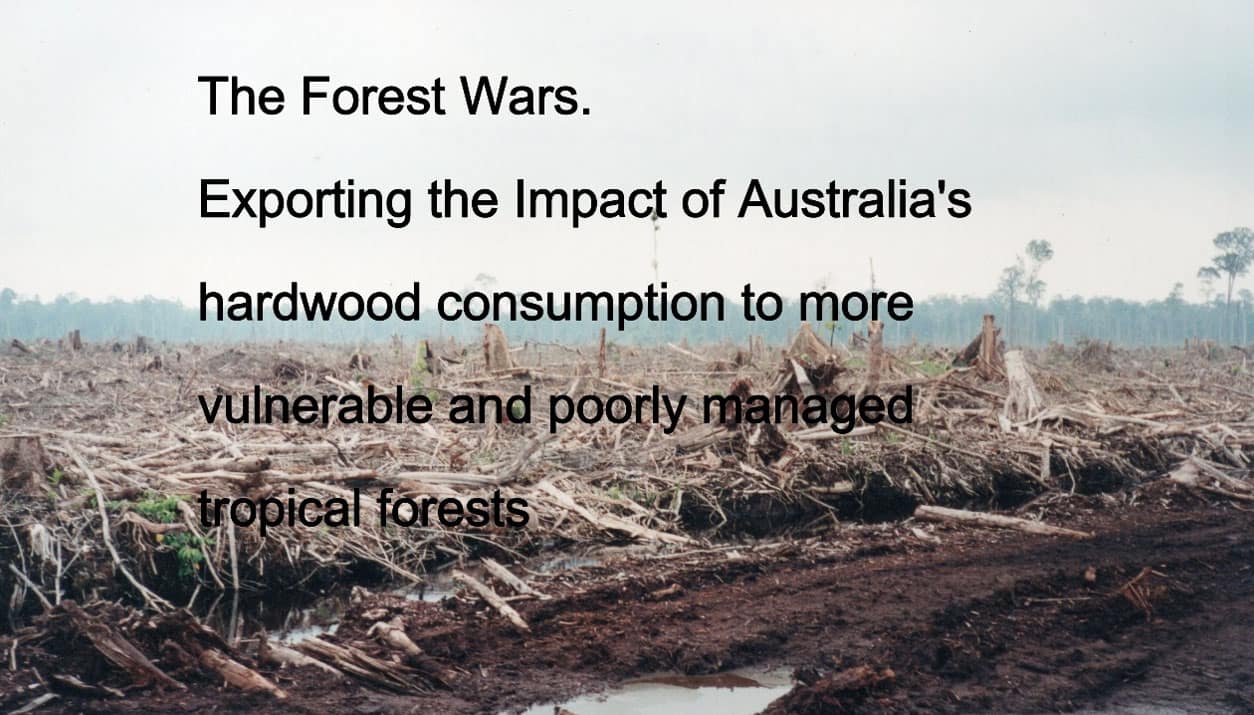
One key knock on effect of the “forest wars,” which is rarely acknowledged is the unethical, selfish and immoral export of the environmental impact of Australia’s hardwood consumption to more vulnerable and poorly managed tropical and temperate forests.
Related story: The Forest Wars – review and response.
Australian Rural & Regional News welcomes a response from any of the parties mentioned in this article.