
This article relates to the debate on Australian Rural & Regional News into Bushfires, Logging, Burns & Forest Management, in particular, into a debate into self-thinning forest understoreys and wildfire risk. The series of articles relating to this particular debate are all extracted on the general debate page.
Australian Rural & Regional News sincerely thanks Jack Bradshaw, Philip Zylstra, Roger Underwood and Peter Rutherford for sharing their expertise and experience with our readers and for being prepared to engage in this important and challenging debate. Their further contribution on related topics is most welcome.
In light of the discussion over many submissions on the topic of self-thinning forest understoreys and wildfire from our notable commentators and the continuing differences of opinion, each was asked the following question, with a view to concluding the debate, at least for the time being, and hopefully on a constructive note:
ARR.News: What more might it be useful to explore?
Responses: Jack Bradshaw – Philip Zylstra – Roger Underwood – Peter Rutherford
Jack Bradshaw
Comment on ‘Self-thinning forest understoreys reduce wildfire risk, even in a warming climate’: Jack Bradshaw;
Self-thinning forest understoreys and wildfire risk debate – Jack Bradshaw responds to Philip Zylstra;
Jack Bradshaw to Philip Zylstra #2 – self-thinning forest understoreys and wildfire debate.
Jack has nothing more to add to these submissions on this particular issue at this stage.
Philip Zylstra
‘Self thinning forest understoreys reduce wildfire risk, even in a warming climate’: Philip Zylstra responds to Jack Bradshaw;
Philip Zylstra continues the debate – self-thinning forest understoreys and wildfire risk;
Philip Zylstra’s response #3 – self-thinning forest understoreys and wildfire risk debate;
Philip Zylstra’s response #4 – self-thinning forest understoreys and wildfire debate.
ARR.News: What more might it be useful to explore?
There are two main areas to explore:
Q1. How exactly does this all work?
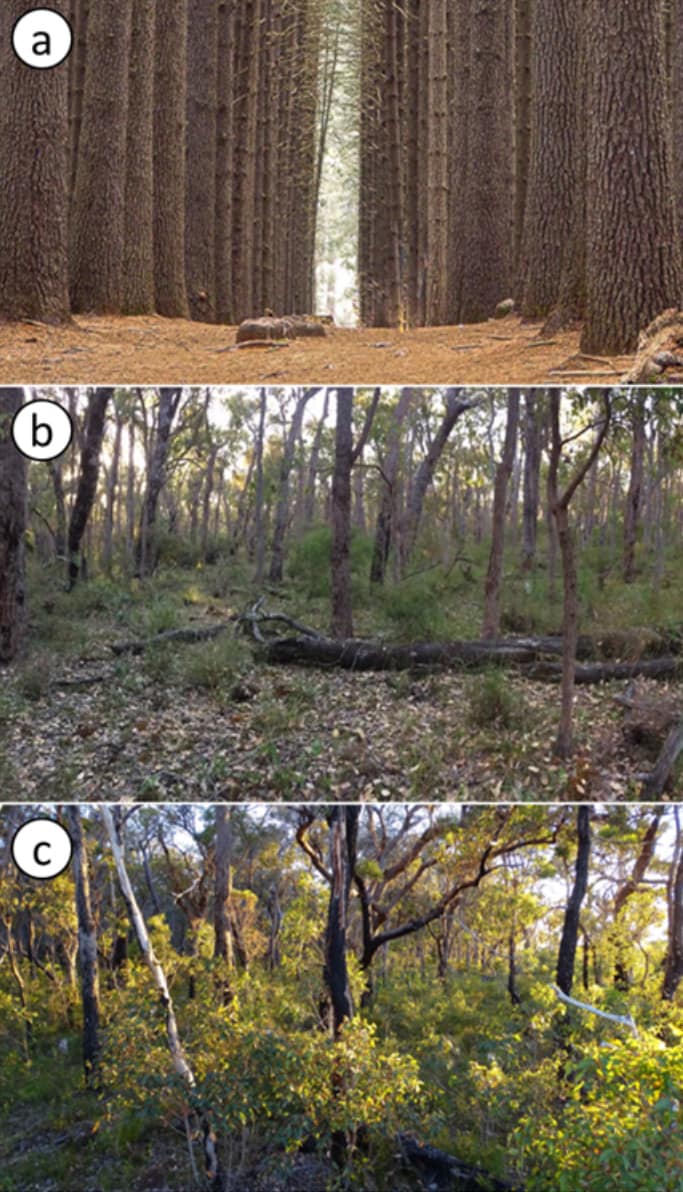
Our study shows that forests and woodlands where the understorey naturally thins over time will be less flammable if they are not disturbed, but that isn’t the whole picture. Some plants also ‘self-prune’ by dropping their lower branches so that canopy foliage is out of the reach of flames, and in other forests, less flammable species take over the understorey as the shade increases. These ecological controls on fire naturally limit its impact if we don’t get in the way, but if we learn how they work, we have to opportunity to reinforce them and use them to create landscapes that are less flammable. We call this ‘Cooperation with Country’: protecting forests like the one in Fig. C from fire until it again becomes more like Fig. B, then using the advantage of the more open forest to help us control fire even more effectively.
Q2. How do we cooperate with country?
While there are some places close to houses etc where the only way to reduce fire risk enough is to clear the vegetation by slashing or very frequent burning, this is not possible across the broad landscape, and not something we should try if we still want to have forests and wildlife. Ecological controls offer us a second tool, whereby we can allow the forest to follow its natural course and create a broad landscape that is much less flammable than the current one. To cooperate with this process though, we need to understand the specific fire advantages and limits of each forest and stage of growth. In 2002, for example, I was planning strategies to contain fires in an area that had rainforest patches. The old locals had for a long time successfully used these as control lines, but this year the rainforests started to burn through because the drought was so severe. Although the rainforest couldn’t stop the fire that year, the flames in it were very small and if we’d known in advance, we could have used strategies such as ‘wet lines’ or rake-hoe lines to hold the fire there.
We need to know under what conditions fire advantages will directly stop a fire, or when they will allow us to safely stop it ourselves. When we know these things, we can plan our resources properly and reinforce them. Cooperation means that the maturing forest helps us control fire, and by doing that we help the forest mature.
One of the main issues facing us is that so much forest is now in that most flammable state of regrowth. How do we help it to age into maturity so that we have a broad landscape characterised by easier-to control fires? This is less of a barrier than we might think because the natural amount of fire in the southwest is relatively small. Out of every 100 hectares burned in the southwest, Government records show that only 4 of them were lit by lightning. People lit the other 96 – mostly as prescribed fire, but sometimes they were accidents, arson, or escaped prescribed burns like the 2011 Margaret River fire that destroyed 32 homes.
The recent blaze devastating forests north of Walpole was also an escaped prescribed burn, conducted to prevent a repeat of the intense wildfire there in 2009, which was also an escaped prescribed burn. These are human actions, so humans can change them.
There are also many ways to contain the remaining natural fires while they are small. New technology is being rapidly developed to find ignitions as soon as they occur, but this requires immediate response. I’ve worked with other leading fire scientists to develop state of the art fire behaviour modelling that can account for everything from growing plants to changing species and drought-stressed leaves. We’re linking this to the ecological controls operating in different forests to tell us what the most effective suppression approaches will be under different conditions.
What we cannot afford to do is to stay with the existing approach where small fires become monsters because a bulldozer breaks down or all the plant has been tasked to lighting prescribed burns. We need to restructure our firefighting resources so that the necessary skills and equipment are available when a fire starts.
This may also mean the introduction of new skills and technology such as RAFT (Remote Area Fire Trained) firefighting. This is very different to the American style Smoke Jumpers; when I did it we were winched into fires by helicopter only if we could be safely winched back out. Of course, there is a risk, but although colleagues have been killed conducting prescribed burns or fighting fires in trucks, I know of no serious injuries on a RAFT mission. RAFT firefighting is a highly skilled profession, whereby practitioners extinguish fires with little or no water. The main deterrent for many is that lugging all your equipment up a mountainside in a heatwave is much harder work than fighting from the back of a truck. We know that this approach works in the eastern states where there is far more lightning and the terrain is much rougher, so there is definite potential in the southwest. To supplement this, new technology is already being developed and tested to do jobs such as waterbombing a new ignition using autonomous aircraft before the storm has passed, while it’s still unsafe to put people in the air.
Fire has been part of Australia since long before humans existed on the earth, but forests filled with fire sensitive species thrived without anyone torching them. Most of our fire problem will be solved if we just stop fighting that natural cycle and let the forests age as they always did, but we can do even better. If we learn more about how these controls function, get a clearer understanding of how and when we can work with the advantages offered by the forests and then research and restructure our skills and resources to cooperate with this, we can halt the damage from decades of bad science.
Roger Underwood
Self-thinning forest understoreys and wildfire risk debate – Roger Underwood responds;
The Zylstra theory: a final comment: Roger Underwood.
ARR.News: What more might it be useful to explore?
I think it would be useful to promote independent field research into forest flammability. This could be done by locating forests where the fuel in a specific forest type is of known age since last fire – say 10, 20, 30, 40, 50 ”¦ 90 years since last fire. In these areas, using randomised plots, careful measurement could be made of the bushfire fuel in each fuel-age class. This would demonstrate whether or not forests became non-flammable over time. To be able to be classified as non-flammable, a forest would be incapable of sustaining a running fire under moderate weather conditions.
The studies would need to be done in the same forest types and in the same climatic zones, Western Australian examples being, karri forest, southern jarrah forest, wandoo forest. The work would need to be designed to allow credible statistical analysis of data. The results would need to be published in an international journal.
Until actual research studies of forest flammability are done in actual forests, the debate will continue between (on the one hand) people like me whose opinions are based on experience and observation in the field, and (on the other hand) university academics whose opinions are based on computer models.
Peter Rutherford
Philip Zylstra’s fire research: Adding value or creating risk? : Peter Rutherford;
Peter Rutherford to Philip Zylstra #2 – self-thinning forest understoreys and wildfire debate.
ARR.News: What more might it be useful to explore?
A first step would be to take a systems approach to the management of high intensity bushfires and other threats posed to the Australian native forest estate.
It would be useful to further explore the different outcomes that regular low intensity prescribed fire has, compared to irregular high intensity bushfires.
Due to the long burn time that occurs with high intensity fires in heavy fuel loads, which is exacerbated by dense understorey, there is a devastating impact on forest values, including flora, fauna and soils. More frequent and broadscale prescribed burning can have a positive role in threatened plant species recovery and reducing the horrific death toll that largescale, high intensity bushfires inflict on our precious native fauna.
Further investigation is needed into the difference in ecological response our forest biodiversity has, under a low intensity burn regime, compared to the impacts of disasters as we experienced in 2019-20. For example, low intensity patch burns can stimulate regeneration of native grasses and forbs.
In Victoria, it has been found that small terrestrial orchid survival decreased, as the dormancy period was prolonged beyond one year. While drought can prolong dormancy, a continuous and deepening layer of ground fuels enforce dormancy, regardless of rainfall, by smothering small orchid tubers. The delicate shoots cannot physically break through the litter layer.
As the per hectare tonnage of ground fuels increase, high intensity bushfires have more time to heat the soil and kill any remaining dormant orchid tubers.
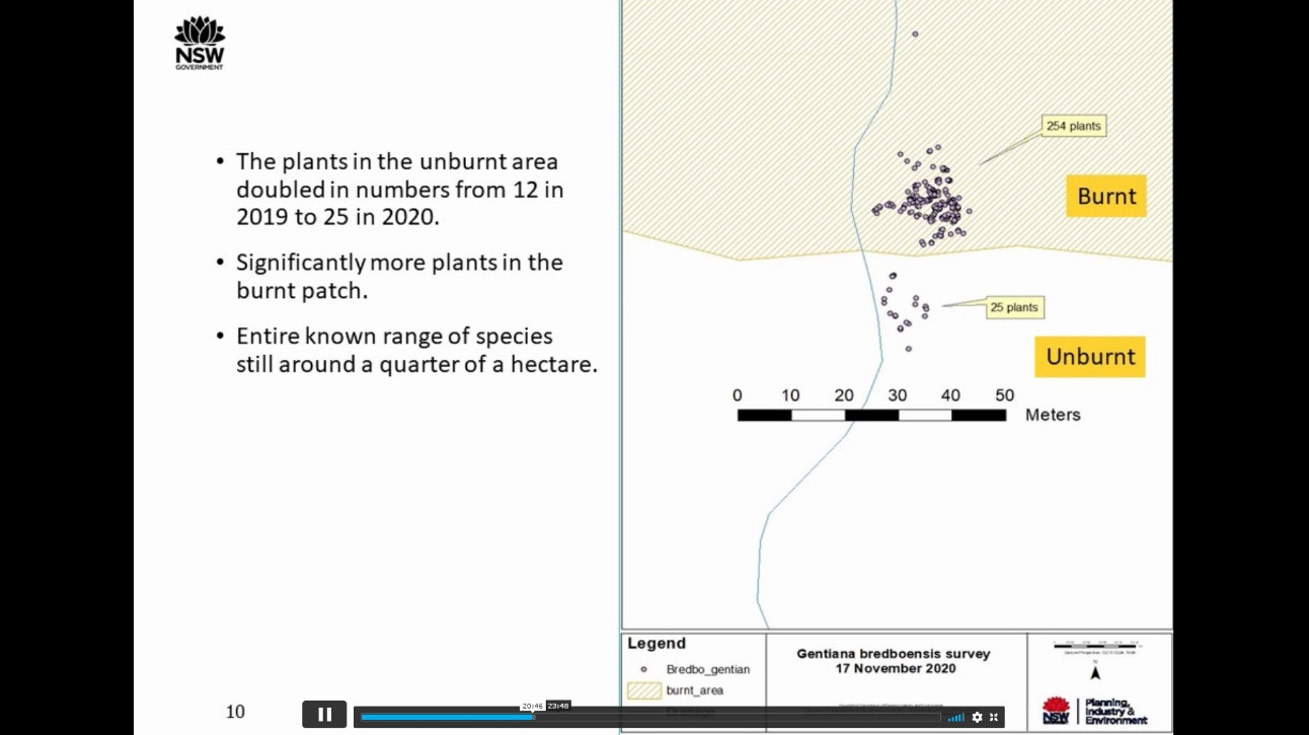
In low site quality eucalypt forests, with low fuel layers, NSW conservation agencies have reported an increase in the number of individuals of rare orchids and other threatened species post the 2019-20 fire season. The example below refers to the critically endangered Bredbo Gentian.
Regular low intensity burns have been found to counteract soil acidification. More acidic soils make higher levels of toxic metals such as manganese and aluminium available to tree roots. Consequently, tree health is affected and chronic tree decline sets in. See Turner et al, Forest Ecology and Management Volume 256 Issue 5 20 August 2008. Chronic tree decline has, among other things, a negative impact on eucalypt flowering potential.
More long-term research is needed in this field of science.
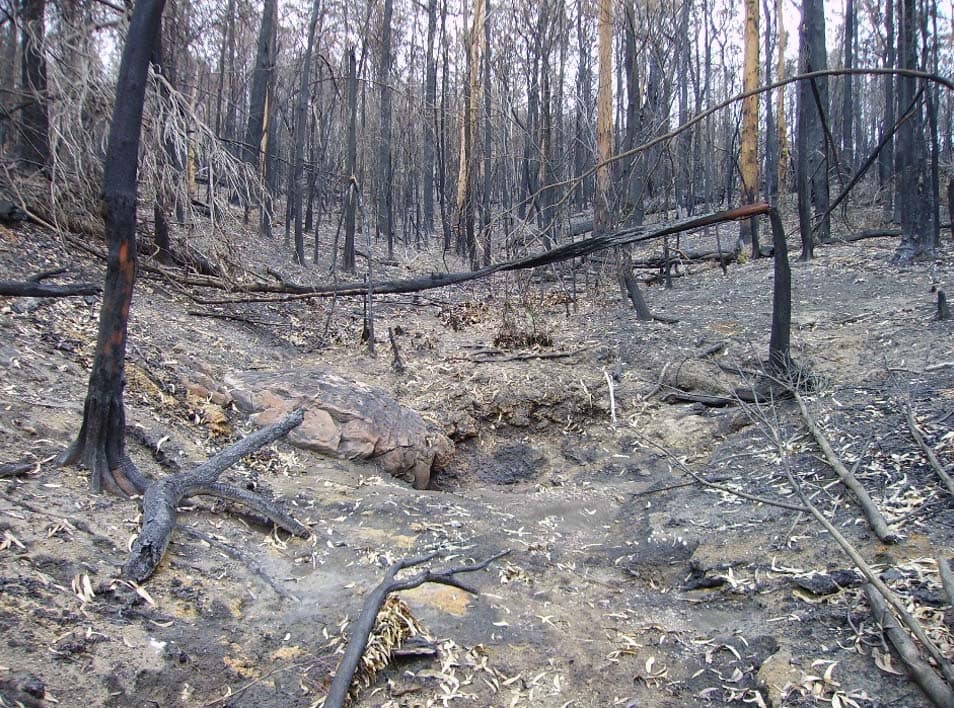
Prescribed burns do not expose bare mineral earth from ridgetop to riversides, as high intensity bushfires do (see photo below) and the potential for catastrophic impact on catchments and water quality in the event of bushfires is reduced.
The regulatory framework that governs the use of prescribed fire needs radical overhaul. Recent additions to the regulatory burden have not addressed deep flaws in the current system.
The tolerable fire interval needs to be changed, to differentiate between high and low intensity fire effects. Low intensity burning regimes should have a much lower return time than high intensity regimes. Ecologically necessary low intensity burns are often stopped because the burn would bring tolerable fire frequency below the magic number for the vegetation type. Consequently, the risk of an area again being burnt in future, by a high intensity bushfire increases.
The Threatened Species Scientific Committee (TSSC) Fire Regimes That Cause Declines in Biodiversity – Advice to the Minister April 2022 also fails to provide clear guidance on future fire management.
The TSSC advice to the Minister fails to clearly articulate that the key threats to individual species and most native ecosystems, are long-term fire exclusion and consequently, more frequent high intensity, landscape scale bushfires. The advice does not provide clear guidance on future fire management and will further stifle active and adaptive mitigation of the risk of future high intensity bushfires.
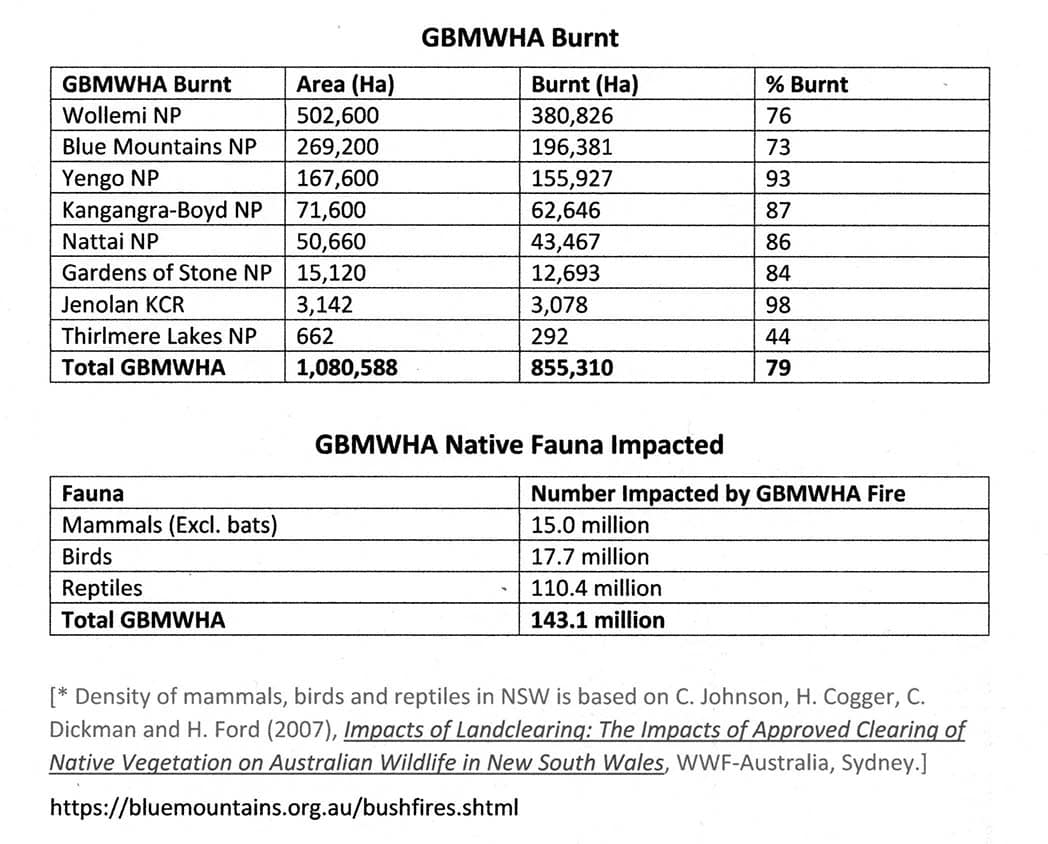
The 2019-20 Greater Blue Mountains World Heritage Area (GBMWHA) bushfires were just one illustration of the need for fire management reform in NSW and Australia more generally. Seventy nine percent (855,310 hectares) of the 1.08 million hectares of the GBMWHA was burnt.
More than six separate high intensity bushfires had burnt up to 100,000 hectares in and around the GBMWHA in the 2013-14 fire season. In late 2019, the largest fire from a single source, the Gospers Mountain fire, traveled over 35 kilometres, before re-burning the 55,000 hectare footprint of the State Mine fire of October 2013. Repeated high intensity bushfires, in our parks and reserves system, are not delivering the permanent biodiversity protection, promised by environment ministers, with each addition to the parks and reserves system.
Following the 2019-20 megafires, the International Union for Conservation of Nature (IUCN) — the official advisor to UNESCO stated, “Many species that are attributes of the Outstanding Universal Value of the site were impacted by the fire.” The conservation outlook for this site has been assessed as of “significant concern.” This is a formal downgrade to the second lowest category in the world heritage ratings.
Therefore, much more attention needs to be paid to the growing body of evidence that is coming from paleoecology research being undertaken by Dr Michael-Shawn Fletcher from Melbourne University and Professor Simon Haberle from the ANU, if the ecological health of our native forests is to be restored.
High intensity bushfires have a long-term impact on the flowering capacity of eucalypts. It will be a decade or more before the flowering capacity of the eucalypts in the photo below begins to recover. How do nectar and other flower dependant species survive in the meantime?
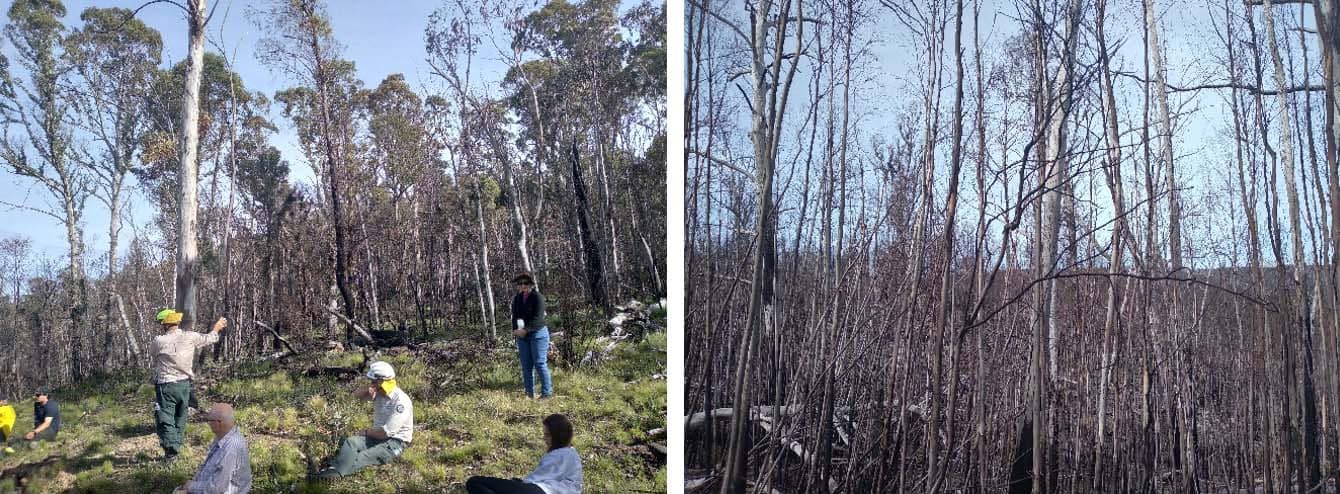
Eucalypt flowering capacity will be affected for a decade or more across one to two million hectares of the 2019-20 fire ground. Despite the diminishing area of prescribed burning being undertaken, the benefits of reduced fire intensity in fuel reduced areas can still be found.
While I have presented the facts in a reasoned way, I understand they may not be accepted by readers wedded to a wilderness view of the Australian biota.