


Victorian Farmers Federation, Media Release, 23 June 2026
The Victorian Farmers Federation (VFF) says Victoria’s $25b dollar agriculture sector must not be forgotten in the face of a rapidly expanding data centre infrastructure boom sweeping the state. The VFF has today released an issues paper outlining the scale of potential development and competition for resources like land, water and energy.
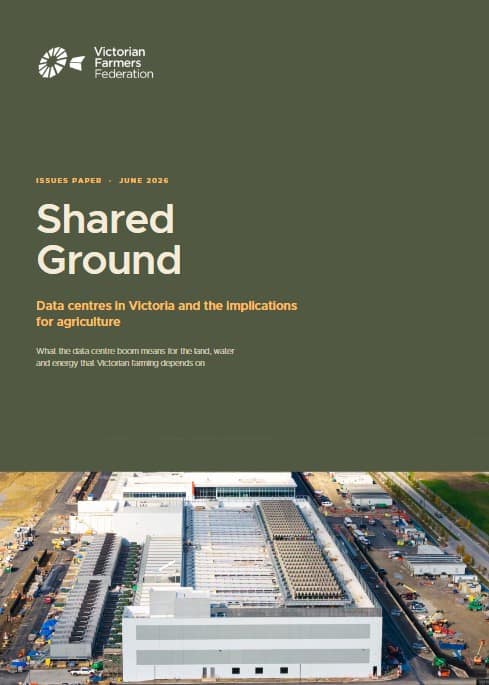
VFF President Ryan Milgate said while the exponential growth of the data centre sector may present opportunities for Victoria’s economy, policy reform is needed to first understand the impacts on agriculture, regional communities and essential resources.
“This is not a debate about whether data centres should exist. It’s about ensuring we properly understand the consequences of going all-in without a plan for these incredibly resource-intensive facilities.”
“We absolutely must have a conversation about the impact of this infrastructure and it needs to be now. We need to learn about any land use conflict when it comes to energy, transmission and mining projects.”
“With this issues paper, we’re looking to make sure farmers are front and centre in that conversation.”
“This issue doesn’t just exist inside the farm gate. We’re seeing huge data centres rising up in the suburbs and their needs impact all the way to farmers and regional communities hundreds of kilometres away,” Mr Milgate said.
Analysis in the VFF’s issues paper highlights the unprecedented scale of proposed data centre developments across Victoria, with more than 30 projects currently proposed that could collectively require around 9 gigawatts of electricity, equivalent to four Loy Yang A power stations. Water demand is also set to skyrocket by 2030, with conservative estimates suggesting demand will surge to equal the annual water use of an extra 330,000 Victorians.
The VFF has outlined these pressing questions:
- How will data centre locations be chosen?
- How will water allocations would be managed during drought?
- Who pays for additional infrastructure and will the burden of increased renewable energy generation increasingly fall on regional Victorians and landholders?
- What protections exist for neighbouring landholders and how will cumulative impacts across multiple projects will be assessed?
“We’re on a collision course where Victoria’s farming sector will compete with this infrastructure for water and land to host renewable energy infrastructure. We’re already seeing this and with massive investment in the pipeline, this could just be the tip of the iceberg.”
“We must learn from what’s happened overseas. Many countries eventually introduced specific rules to manage the impacts of large-scale data centres, but only after pressure on local infrastructure, water supplies and electricity systems became apparent.”
“Victoria has an opportunity to learn from those experiences and ask the hard questions now.”
“We know that state and federal policymakers are already grappling with these issues, and it’s important that farmers are at the table in those discussions.”
“We need confidence that the impacts on agriculture have been properly considered and that farming communities have a genuine seat at the table when decisions are made.”
“The decisions being made today will shape Victoria’s landscape and resource use for decades to come and we need to make sure we get them right,” Mr Milgate said.

