

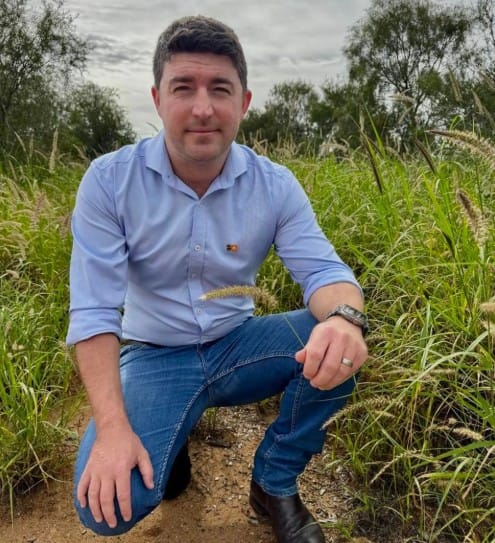
The controversial buffel grass permits announced by Environment Minister Joshua Burgoyne (pictured) last week apply only to its importation from outside the NT.
Once here, the use, propagation, selling and transport of the declared weed has blanket clearance on pastoral lease land, nearly half of the NT, as the Minister is due to approve.
Amber Clarke, the Buffel Grass Program Manager, says the importation requires individual permits to allow for greater departmental oversight on where the material is coming from, reducing the risk of the introduction of new varieties to the NT that may be even more aggressive or adapt better to local environmental conditions.
Will the public have access to information about permits granted?
Ms Clarke says some of the details around the permits specifically for buffel grass are still being worked though, although “permit to use declared weeds are not typically made public due to privacy considerations”.
She emphasises two objectives of the Buffel Grass Weed Management Plan: To take steps to reduce further spread of the weed and take steps to reduce impacts in priority sites.
“There is no hope of eradicating buffel grass at present but we can reduce impacts and minimise further spread.”
The Weed Management Branch (WMB) will concentrate on “education and assistance,” says Ms Clarke, “supporting land holders and land managers, public, private and Aboriginal, to improve buffel grass management on their country.”
Neighbours, out in the vast cattle station areas as well as in the quarter acre suburban blocks, must take “reasonable measures” to at least contain the weed in their properties under the Weeds Management Act 2001.
What “reasonable” means isn’t very clear. Not deliberately introducing buffel into your backyard seems obvious. Grazing cattle doesn’t get rid of the buffel plant. And so on.
Reasonable measures may include working with neighbours, managing buffel grass along boundaries, and maintaining boundary firebreaks in line with fire management requirements.
Under existing fire management legislation (Bushfires Management Act 2016 and the Fire and Emergency Act 1996) landholders are obliged to control the fuel mass (which after this year’s rains is going to be enormous) but controlling that is another issue.
The WMP of the Department of Lands, Planning and Environment (DLPE) in the Centre has seven staff, who work on weed management issues which include some “compliance responsibility” – three of them specifically focussed on buffel plus two each in Alice Springs and Tennant Creek on weed issues more generally.
Pastoral Land Board already exists to manage Crown Land leased under the Pastoral Lands Act.
There is no comprehensive knowledge about the extent of the buffel infestation even in the iconic West MacDonnells. This has meant it hasn’t been possible to develop more specific targets in the WMP.
“The DLPE will prioritise collection of distribution data in coming years, which will inform operational plans and future versions of the WMP,” says Ms Clarke.
Most national parks in Central Australia are Aboriginal owned but leased to Parks and Wildlife, which makes this statutory body responsible for land management including buffel control.
There are conservation areas but no accurate weeds data.
Ms Clarke says there are many different approaches to managing buffel grass and this will depend on the scale of the infestation, level of resources available and “what outcomes you’re looking for.
“We will continue to work with landholders and land managers such as Central Land Council and Parks and Wildlife Rangers to improve buffel grass management.”
She says she has no knowledge about a bug in Queensland eating mostly buffel, seen as a hope by some buffel foes.
Different distribution models have shown that buffel grass could potentially cover much of the Australian mainland: “We prioritise trying to prevent further spread into areas such as the Barkly, Tanami and western borders where density is still low.”
This article appeared on Alice Springs News on 26 March 2026.

