


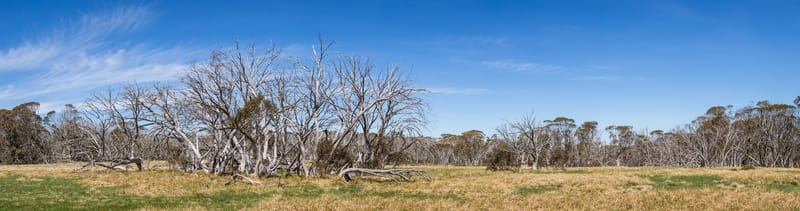
Photo: Michael Evans
The recent Snow Gum Summit in Jindabyne has drawn attention to the health of this notable tree of the Australian alps.
The causes or primary cause of widespread snow gum decline, with a particular focus on fire regimes, climate change and insects, and the appropriate response to this problem, are the subject of a considered exchange of differing views here between two experts from different generations but not entirely different schools or schools of thought.
The various debates on forestry issues on Australian Rural & Regional News have tended to show that it is anathema to those of the older school of thought to blame all manner of environmental issues on climate change without a full investigation and fearless debate about all possible contributing factors, and without fully taking into account their experience and research over multiple previous decades. Defaulting to an all-encompassing climate change explanation also has the effect of excusing poor past, present and future land and fire management practices since it puts the problem beyond our (immediate) control.
This exchange of views between Vic Jurskis and Dr Matthew Brookhouse delves more deeply than this into the current snow gum dieback and paves the way for further investigation of causes and treatment of this environmental problem.
Vic’s article, Snow gum dieback was published on ARR.News in response to an article focusing on the research of Dr Matthew Brookhouse in the lead up to the Snow Gum Summit in Jindabyne in March 2026.
The Corryong Courier, Corryong’s independent newspaper based in Victoria’s High Country and a contributor to ARR.News, published the article Climate change gums up the works after the summit, also featuring the research of Dr Brookhouse.
Following the publication of Vic’s article, he and Matthew have been debating the snow gum dieback through ARR.News. What follows is Matthew’s final response to the key claims as he identifies them in Vic’s article, together with Vic’s responses to these.
Australian Rural & Regional News hopes such constructive discussion will continue and inform future research.
It is recommended that readers read both the original articles first in order to better appreciate this exchange.
Dr Matthew Brookhouse: The recent piece on snow-gum dieback (Snow gum dieback, Vic Jurskis) raises important questions about fire management and eucalypt health that deserve careful answers. I want to directly engage with each of the central claims. Before doing so I want to acknowledge what I see as common ground. Fire management in forested landscapes is genuinely complex. Indigenous land management practices represent accumulated ecological knowledge that deserves serious engagement. The relationship between fire history and eucalypt health is worth continued investigation. Snow-gum dieback demands urgent, coordinated attention that draws on multiple knowledge traditions. On all of these points I expect Vic and I are in agreement. We do differ, however, on what the evidence specific to snow-gum dieback currently indicates.
Claim: The high country was frequently and mildly burnt by Aboriginal people, and this beneficial regime was disrupted by European settlement.
Dr Matthew Brookhouse: Quantitative fire history records derived from charcoal and tree scar analysis show that prior to European settlement the Australian Alps burned infrequently (approximately once every 25 years). This is not a frequent fire regime by any management standard. However, from 1830 to the 1950s, colonial graziers burning to promote grass regrowth reduced that interval to approximately 3.5 years — a seven-fold increase in fire frequency that is documented to have caused substantial degradation of high-elevation areas. Any fire-induced dysfunction in subalpine forests is therefore more plausibly the product of damage during the period of maximum fire application than from its subsequent reduction. This is not a minor chronological quibble — it inverts the causal sequence on which the fire management argument rests.
There is also an important distinction to make between Indigenous burning, which occurred at low frequency under strict custodial protocols, and colonial burning motivated by livestock production. These are not the same fire regime and cannot be presented as a continuous tradition of beneficial burning that national-park management then curtailed.
Vic Jurskis responds: Aboriginal people burnt snow gum woodlands every year or two. Alpine graziers carried on the tradition. ‘Snowgum dieback’ seems to be another example of chronic eucalypt decline with lack of mild burning and/or grazing.
Infrequent high intensity fire regime was initiated by bans on burning by graziers and was adopted de facto by National Parks Service from the 70s.
Charcoal and fire scars don’t record mild burning which produces little charcoal and negligible scarring. Dr. John Banks worked on fire scars and claimed that a mature snowgum woodland hadn’t been burnt in 200 years. Surveyor Townsend described the pre-European regime. Aboriginal people gathered from all directions to feast on Bogong moths burnt the alpine areas when they arrived and the subalpine forests on their various ways home.
Chronic decline of snow gum and plagues of woodgrubs followed the reduction of prescribed burning and disbandment of the Hume Snowy Fire Protection Scheme.
There was nothing magic about Aboriginal burning; it was part of their economy. They travelled the country without boots or overalls and kept forests clean as efficiently as possible by burning as soon as there was enough continuous fuel to carry a mild fire.
Alpine graziers used mild fires. Mountain Cattlemens Association of Victoria has exclusion plots which graphically demonstrate loss of biodiversity through smothering by rank grass in absence of management.
Claim: Alfred Howitt’s observations demonstrate that fire removal causes insect plagues in eucalypts.
Dr Matthew Brookhouse: Having lived in the areas he wrote about (I lived in Glenmaggie, Heyfield, Marlo, Rawson and Hinnomunjie as well as working in all of the associated forest-management areas), I love Howitt’s clear description of the eucalypt species from a field botany perspective. His words should be read carefully and completely. In his Eucalypts of Gippsland, Howitt makes two related but distinct arguments that are both worth engaging with honestly.
His first argument is that fire historically acted as a direct check on insect life that destroyed surface-dwelling insects including folivores, and that reduced fire after European settlement allowed insect populations to increase to plague levels. He wrote:
“Bush fires, which swept the country more or less annually, kept down the enormous multiplication of insect life, destroying myriads of grasshoppers and caterpillars, which now devastate parts of the Gippsland district.”
This seems a coherent observation for the lowland and lower montane forests he was studying.
Howitt’s second argument is hydraulic and separately important. He wrote that insect attack was greatly aided by,
“the sickly state in which many of the Red Gum forests in Gippsland now are. The long continued use of the country for pasturage, and the tramping of the surface of the ground by stock, has greatly hardened the soil, so that rain which formerly soaked in, now runs off… the Red Gum is deprived of much moisture which it otherwise would have in reserve. The trees are wanting in vigour, and thus unable to withstand the attacks of insect pests.”
Here, Howitt identifies moisture stress caused by grazing-induced soil compaction as a critical predisposing factor for insect attack. No mention of fire is made.
Both arguments can be considered in the context of snow-gum dieback. First, the insects Howitt observed were leaf-eating Lepidoptera (butterfly and moth) larvae. These insects live and gestate at or near the surface of the landscape where ground fire could quite plausibly disrupt life cycles. The beetle responsible for snow-gum dieback is a wood-boring cerambycid whose vulnerable larval stages are spent at the cambial level of living trees, physically protected from surface fires. Whether fire suppression releases wood-boring beetle populations through the same mechanism Howitt described for surface-feeding folivores is questionable. Second, Howitt’s hydraulic insight may be more relevant to the current outbreak. Although the driver of moisture stress has changed—in red-gum forests in 1890 it was grazing-induced soil compaction while in snow-gum woodlands now it is climate-driven increases in temperature and vapour pressure deficit—Howitt’s words are a reminder of the primacy of host water status in determining vulnerability to insect attack.
I also note, as someone who began my career in the Omeo Valley, that the lowland red gum and manna gum country on Gippsland valley floors and plains is ecologically, geologically, and climatically very different from snow-gum woodland at 1,600 metres and above. Ecological inferences between these systems require explicit demonstration.
Vic Jurskis responds: Howitt observed plagues when aboriginal burning was disrupted and inferred that burning had been a direct check on insects. Observations of many different varieties of chronic eucalypt decline indicate that canopies thin before pest outbreaks. Traditional burning expert Victor Steffensen talks of sick trees with lazy roots on damp soils.
Yes, roots are affected first. Howitt’s reference to Aboriginal burning was general. His reference to compaction is specific to red gum plains.
All eucalypt forests and woodlands are susceptible to chronic eucalypt decline in absence of mild fire and/or grazing. Contributing pests vary with forest type. An important predisposing factor can be shallow soils with impeded drainage. In NSW, blackbutt and spotted gum forests on relatively fertile, well drained soils have been the last to exhibit chronic decline.
Claim: Frequent mild burning maintains healthy eucalypt roots, and fire suppression degrades them.
Dr Matthew Brookhouse: This is a plausible hypothesis in Western Australian dry sclerophyll forests on deeply weathered lateritic soils where fire genuinely drives nutrient cycling. I am familiar with the literature on which this framework rests and it has not been demonstrated in subalpine snow-gum woodland. This is important because the soils of the Kosciuszko massif are geologically young, shallow, and derived from granitic, metamorphic, and basaltic materials with entirely different nutrient and hydrological dynamics—differing substantially from those in WA. The claim that a mechanism demonstrated in a forest community under very different conditons applies without modification to a fundamentally different one really needs explicit evidence. This is an area where more research is genuinely warranted given the soil biology of subalpine snow-gum woodland under different fire regimes is incompletely understood.
Vic Jurskis: The Karri Study is in moist forests generally described as wet-sclerophyll forests. It relates canopy decline directly to infrequent fire. It shows that canopy decline can occur in the absence of soil chemical changes that have been observed in declining eastern forests. So the hypothesis is that the roots are impaired by physical changes with a build-up of mulch and often mesic understorey.
I’ve seen a good example where a stand of snow gum was partly mulched. The stand looked sad during the Black Summer Drought. When the drought broke, the mown part recovered and the mulched trees died.
Claim: A study of ectomycorrhizal colonisation supports the root dysfunction hypothesis.
Dr Matthew Brookhouse: The study cited found no statistically significant difference in ectomycorrhizal colonisation between healthy and dieback-affected trees. Further, the observation that dieback-affected trees had fewer available feeder roots is the expected physiological consequence of hydraulic failure following beetle-induced cambial damage. That is, root death follows vascular failure, it does not precede it.
Vic Jurskis responds: There were more ECM on more roots of ‘healthy’ trees.
Claim: Eucalypts develop sick roots from fire suppression before beetles attack — pests are symptoms, not causes.
Dr Matthew Brookhouse: This argument has a specific testable requirement: physiological deterioration must precede infestation. Our work on morphological and physiological traits examined in affected and unaffected trees in the current dieback show no evidence of pre-infestation physiological decline. These are not trees weakened by management history. They are physiologically normal trees encountering a beetle operating under a changed thermal environment.
Vic Jurskis responds: There is zero chance that the ‘dieback’ trees were affected randomly. There must have been some predisposing environmental factor that stressed the trees making the sapwood accessible and nutritious for woodgrubs.
Dr Brookhouse could prove his hypothesis by selecting some pairs of healthy trees enclosing the stems with fine mesh and putting fertile beetles on one of each pair. Then reinfecting some more healthy trees with the emergent beetles if any. But I suggest that a bit of adaptive management and monitoring would be more productive.
Claim: Reduced managed burning has produced a dangerous shift to high-intensity wildfire.
Dr Matthew Brookhouse: Comprehensive analyses of the 2019-20 Black Summer—fires that burned through areas now heavily infested by beetles—found an overwhelming dominance of weather over past forest management, including prescribed burning, in driving fire severity. Fuel loads were not anomalously high relative to the preceding 30 years. Under extreme fire weather the moderating effect of fuel treatment is substantially overridden by atmospheric conditions. I agree that wildfire may play a role in predisposing snow gums to beetle attack. Mounting evidence points in this direction, and this is an important area for further investigation. However, the primary cause of those wildfires is climatic, not managerial.
Vic Jurskis responds (italics): Reduced managed burning and ineffective response has produced a dangerous shift to high-intensity wildfire. This was very clearly illustrated in the 2003 fires when there were as many or more fires lit by lightning in surrounding lands as in the Park and they were all contained. Also in the record Wollemi fire where lack of burning and delayed response caused mayhem under the same conditions as the settlement drought when Aboriginal fires were burning everywhere.
“Comprehensive analyses of the 2019-20 Black Summer—fires that burned through areas now heavily infested by beetles”- Which suggests fire regime is the driver.
“Fuel loads were not anomalously high relative to the preceding 30 years.” When fuel levels were very high compared to pre-European conditions.
“…the primary cause of those wildfires is climatic, not managerial.” This statement is wrong. The number and extent of wildfires is inverse to the extent of prescribed burning as has been shown by data from more than 60 years of management in WA.
Claim: The solution is reintroduction of frequent mild burning.
Dr Matthew Brookhouse: Evidence indicates that snow-gum woodland is not a fire-maintained community. Long-unburnt stands now comprise less than 1 per cent of snow-gum forests in the Victorian Alps. This is not because of insufficient burning but because of the frequency and severity of recent wildfires. Mature snow gum stands are empirically less likely to burn than younger forests. Snow gums are vulnerable to stem kill from repeated fire and clump death increases substantially at multiply-burned sites. Applying frequent burning to a community in which most stands are already recently burned, and in which long-unburnt refuges represent the most significant conservation priority, is difficult to reconcile with it perpetuation.
Vic Jurskis responds (italics): “Evidence indicates that snow-gum woodland is not a fire-maintained community.” – No. Historical evidence and current fire regime indicate the importance of mild fire.
“Long-unburnt stands now comprise less than 1 per cent of snow-gum forests in the Victorian Alps.” – Which is 1 per cent more than pre-European condition.
“This is not because of insufficient burning but because of the frequency and severity of recent wildfires.” – Frequent mild burning maintained healthy mature resilient snow gum stands.
Mild fire is different to wildfire.
Claim: Co-evolved pests cannot kill healthy hosts.
Dr Matthew Brookhouse: This is undoubtedly true under conditions of environmental constancy. However, the current conditions are not constant. Even recent surveys have shown that Phoracantha mastersi adults can emerge as late as the least weeks of February or far earlier in December as a consequence of temperature. Current temperature conditions equate to a two-month advance in phenology. This is not a co-evolutionary shift, it’s an environmental forcing event operating at timescales orders of magnitude faster than any evolutionary response. The thermal environment to which this co-evolutionary relationship was formed no longer exists.
Eucalyptus pauciflora subsp. niphophila—the subspecies most severely affected—evolved in the uppermost elevational band where moisture surplus was historically greatest. Research conducted in the Snowy Mountains forty years ago established that this subspecies uses a feed-forward stomatal strategy governed by vapour pressure deficit and lacks the osmotic adjustment mechanisms that buffer other eucalypt species (including lower elevation E. pauciflora subsp. pauciflora) against hydraulic stress. There was no evolutionary pressure to develop drought tolerance where water was reliably abundant. As temperatures rise and vapour pressure deficit increases (i.e., becomes more strongly negative), bark resaturation that constitutes the primary defence against larval penetration of the phloem and cambium—consistent with findings for related Phoracantha species attacking water-stressed hosts—is compromised precisely when beetles, now attack. The host is not physiologically compromised, it is a physiologically normal tree in a thermal environment that has moved beyond what its evolutionary history prepared it for. The elevational pattern of the outbreak in which infestation effectively disappears at the boundary of the snow-gum subspecies is fully consistent with this mechanism. No soil-mediated, fire-history mechanism produces this spatial signal.
Vic Jurskis responds (italics): “This is undoubtedly true under conditions of environmental constancy.” – The environment or climate has never been constant.
“The thermal environment to which this co-evolutionary relationship was formed no longer exists.” – It doesn’t matter when beetles emerge unless there are stressed trees susceptible to infection.
Presumably there were some uninfected stands of niphophila. Otherwise all the physiological comparisons are invalid.
Where more research is needed
Dr Matthew Brookhouse: We do not yet fully understand the spatial extent of the outbreak. The relationship between wildfire stress and subsequent beetle predisposition needs further characterisation. The specific role of bark resaturation in P. mastersi defence is still under direct study. The soil biological communities of subalpine snow-gum woodland under different fire regimes are incompletely characterised. And the potential for biological control through parasitoids attacking P. mastersi eggs is at an early stage of investigation. On all of these questions more research is warranted. We are actively pursuing them.
What the current evidence does support clearly is that temperature is a primary determinant of an outbreak in which altered beetle phenology and compromised host hydraulic defences are the critical interacting factors. Management responses should reflect that understanding.
Snow-gum dieback is not an academic dispute. These woodlands are the dominant tree community of the Australian Alps and an important component of the hydrology of the upper Murray-Darling Basin. The beetle front now moving across the landscape from Mt Buffalo to Kosciuszko to the Brindabellas is without historical precedent. Every season lost to misattribution is a season in which intervention options narrow. The urgent priority is a coordinated, evidence-based response to a biological crisis that is unfolding now.
Vic Jurskis responds (italics): “What the current evidence does support clearly is that temperature is a primary determinant of an outbreak in which altered beetle phenology and compromised host hydraulic defences are the critical interacting factors.” – Suggests that ‘healthy’ trees are stressed. Supports the roots up hypothesis of chronic eucalypt decline.
“Management responses should reflect that understanding.” – Adaptive management would reintroduce frequent mild burning and monitor the outcome.
At the conclusion of this exchange, when asked where there might be common ground between them and where further investigation is warranted, despite their differing views, both Matthew and Vic gave a useful, some may even say promising response.
Dr Matthew Brookhouse: Both Vic and I share concern for the condition of forested landscapes. We both recognise that fire management is complex and needs to draw on multiple knowledge traditions including Indigenous land management. We both agree that the relationship between fire history and eucalypt health is worth continued investigation. I also think we both agree that the current dieback demands coordinated attention. We do differ, though, on what the evidence specific to snow-gum dieback indicates as to its primary driver, and therefore what an appropriate management response might be.
Vic Jurskis: After a regime of high intensity fire or long unburnt mild burning may be difficult. There may be heavy fuel accumulation around the base of trees. Intense burning with long residence time can severely damage or kill trees. So trial burns might need raking fuel away from trees. If the plagues are so extensive, all the more reason to try mild burning and research any available management contrasts.
About Vic Jurskis and Matthew Brookhouse
Vic Jurskis is an ecologist, author and regular contributor to Australian Rural & Regional News. He gained a Degree as Bachelor of Science (Forestry) from the Australian National University.
Vic has a long-standing interest in eucalypt decline. He received a Fellowship from the Joseph William Gottstein Memorial Trust and a Max Jacobs Award from Australian Academy of Science to investigate eucalypt decline across Australia. Vic’s paper, Eucalypt decline in Australia, and a general concept of tree decline and dieback1 was published in 2005. As his career and also his many articles on ARR.News alone show, his interest in forest, land and fire management, and koalas and ecological issues is ongoing.
Dr Matthew Brookhouse is currently a leading researcher into snow gum dieback at the Fenner School of Environment and Society at the Australian National University. Matthew trained as a forester at ANU (as did Vic), and began his career at Hinnomunjie in the Victorian highlands surveying the surrounding forests. He led field forest inventory programs in Victoria as part of the State Forest Resource Inventory and served on fire-suppression crews during campaign fires before moving into research.
Matthew teaches field survey methods and inferential statistics with the Fenner School of Environment and Society, as well as wood anatomy for the Gottstein Trust (which also supported Vic’s work). His snow gum research is outlined at saveoursnowgum.org.
References
1. Forest Ecology and Management, Volume 215, Issues 1-3, 25 August 2005, pages 1-20


I would like to share some experiencess from the jarrah forest in WA, admittedly a long way fro snow gum, that may be of some value. In summer 2011 and again in 2024, as a result of very dry preceding winters, there was noticeable scorch and some tree deaths on sites with shallow soil. The dead and dying trees were riddled with Phorocantha tunnels and larvae. Researchers prophesised that this irruption would then spread widely to adjacent healthy trees . This did not happen, the unaffected trees survived. This pattern with substantial Phorocantha attack on weakened stems and then sudden decline has been observed multiple times,
The dry winters were classed as unprecedented and blamed on climate change. Again this is not so. Rainfall data from widely spaced stations from 1880 and tree ring studies from three sites show that similar ( and worse) dry periods occurred in the 18th and 19th Century, when carbon dioxide was at pre-industrial levels. Periodic drought is a recurring environmental factor that the forest is adapted to. I wonder if there are similar studies of tree rings on snow gum or other alpine species that may assist the ongoing research. Regards
Frank Batini Professional forester and Consultant
I would like to add that as a volunteer firefighter I am often bemused at the current NSW fire management protocol of extinguishing all lightning strike fires.
This to my mind removes the effect of nature creating a mosaic of fuel loads.
This I believe is a recent development (approx 50 years) due to increased firefighting capability which perversely has created the fuel loads that support the severe fires that have recently occurred.
Good news is that locally in the Tinderry Mtns the Snowgum stands still appear to be hale and hearty including those areas that are regenerating from the 2009 fires.