

Housing Industry Association (HIA), Media Release, 12 March 2026
The Housing Industry Association (HIA) has lodged a major submission calling for a comprehensive overhaul of the National Construction Code (NCC), warning that excessive regulation and complexity is slowing the delivery of new homes across Australia.
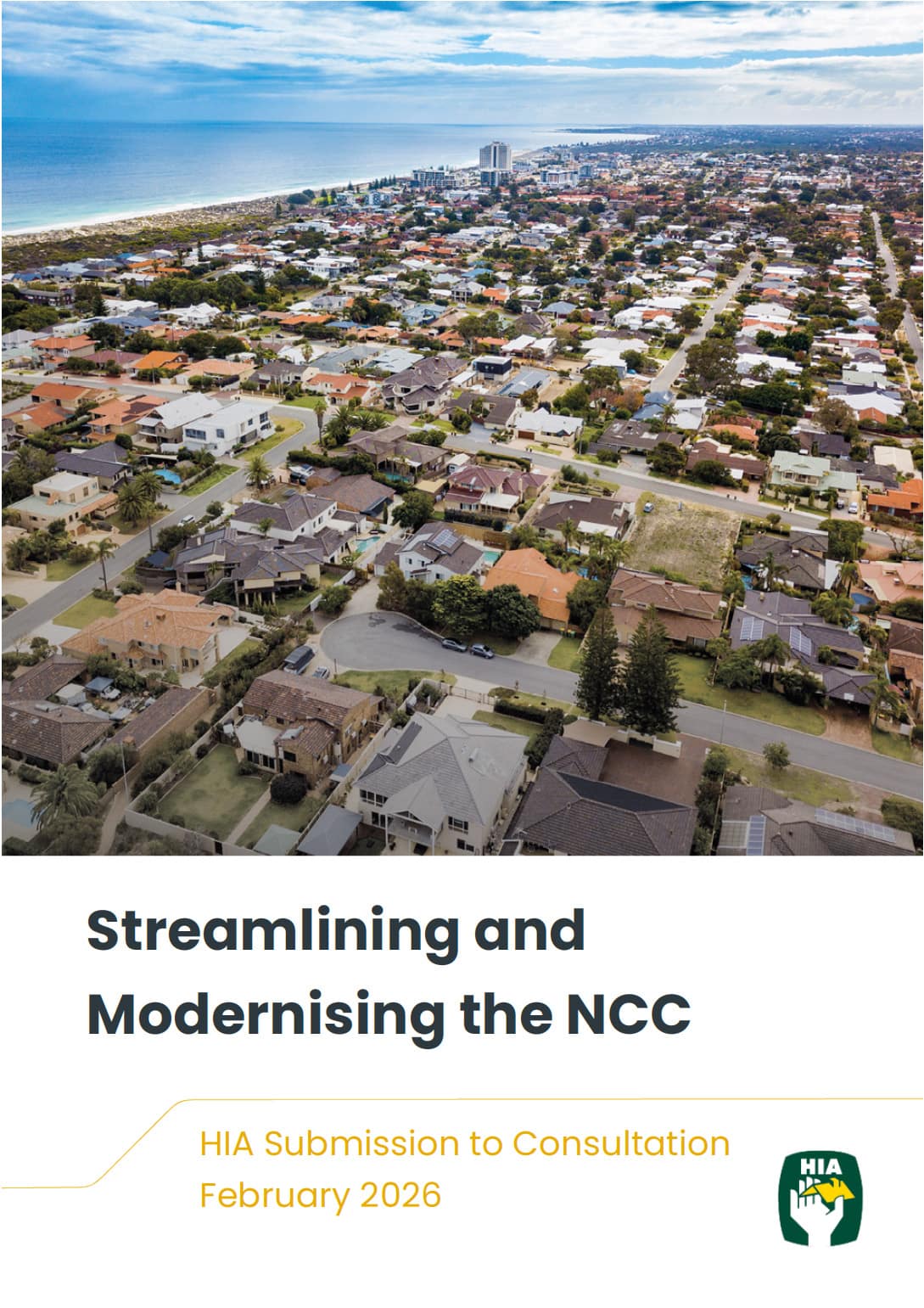
The submission to the consultation on Streamlining and Modernising the NCC outlines a suite of reforms aimed at simplifying the code, reducing red tape and supporting innovation in home building.
HIA Executive Director Building Policy, Shane Keating said the review presents a once-in-a-generation opportunity to reset the code, so it better supports housing supply, productivity and affordability.
“It has become increasingly difficult to build a home in Australia. Builders want to be on site delivering homes for Australians, not buried in paperwork trying to navigate a regulatory maze.”
HIA’s submission highlights the dramatic expansion of building regulation over time, with the NCC now more than eight times longer than when it was first introduced and referencing almost twice as many supporting standards.
“Over decades the NCC has grown layer upon layer of new objectives and requirements. What began as a technical code focused on issues like structural integrity and fire safety has expanded into a much broader policy tool,” said Mr Keating.
“Many of these changes are well intentioned, but the cumulative impact and their interaction have added complexity and cost to new homes.”
Mr Keating said regulatory complexity is contributing to declining productivity in the construction sector and slowing the delivery of new housing.
“If we are serious about improving housing affordability and delivering the 1.2 million homes target, the regulatory system must support supply rather than working against it.”
HIA’s submission calls for a number of key reforms including – simplifying code provisions, move the code to a 5-year amendment cycle to provide builders with stability and certainty, make all referenced Australian Standards free, improve usability of the NCC, reduce unnecessary regulatory burden and create clearer pathways for adoption of AI, innovation and modern construction methods.
The association is also calling for the Australian Building Codes Board to be strengthened, with clearer governance and resources to ensure the NCC operates as a truly national code.
“Housing affordability cannot be an afterthought when developing building regulation, the NCC must return to its core role as a clear, technical minimum standard that ensures safe homes while allowing the industry to deliver housing efficiently and affordably.
“The NCC is only one part of the broader regulatory framework affecting housing supply, but it is an important piece of the puzzle.
“It’s time for a genuine overhaul to deliver a modern code that works for the way housing is delivered, supports innovation and ultimately helps more Australians achieve home ownership,” concluded Mr Keating.