Jarrod Mohr has been fighting fires across New South Wales and the Northern Territory since 1987.
Thirty-seven years of experience, countless major incidents, big fires in Grafton, Casino, Sydney in 1994, significant blazes across the region in the late eighties and early nineties.
He thought he’d seen it all.
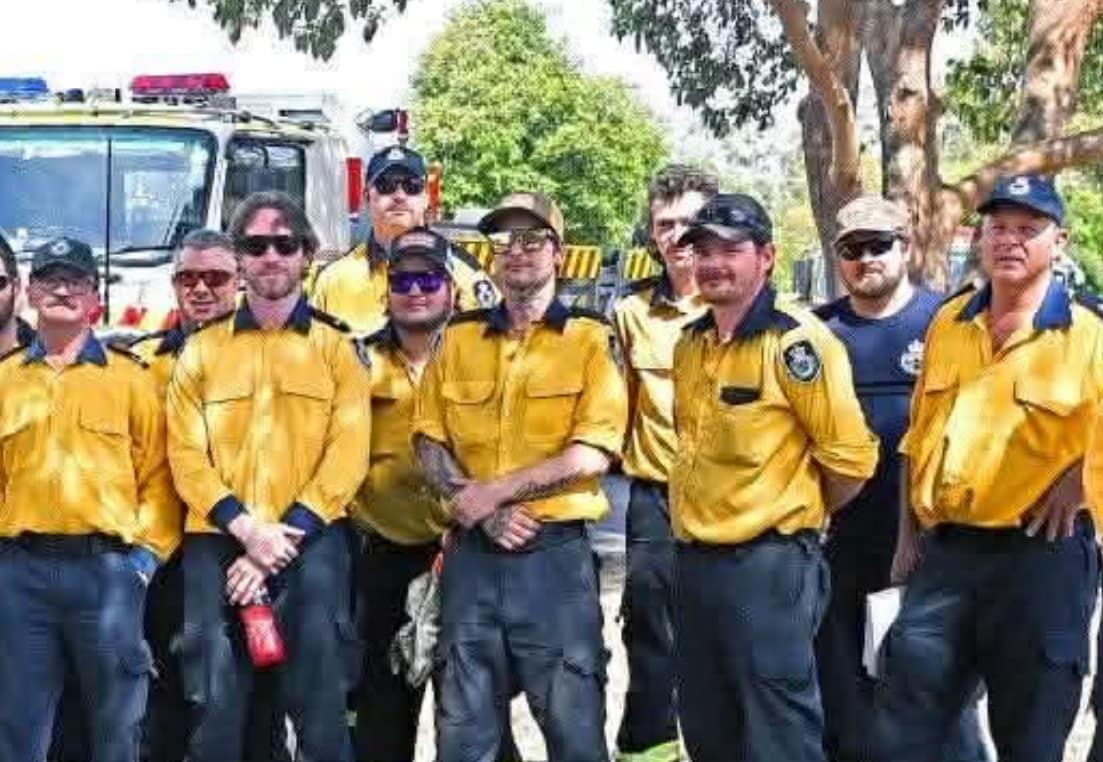
bushfires. Photo: supplied.
Then he went to Victoria’s Yarra Valley in late 2025, and everything he knew about fire behaviour was rewritten.
“I have never experienced fire behaviour like it on the ground,” Jarrod said, and the weight of those decades of experience makes the statement hit harder.
“The first day we experienced temperatures of about 62 degrees on the top of the hill, 108 kilometre an hour winds.”
The conditions were beyond anything the Australian landscape typically throws at firefighters.
Eucalypt forest with fuel loads far higher than anything around Hay.
Terrain with hills at 45 degrees and greater, where fire speed actually doubles for every 10 degrees of slope.
“You just don’t experience it, and I’ve never experienced it anywhere,” he reflected.
The fire moved with a speed and ferocity that defied prediction or control.
There was no getting in front of it, no containment strategy that could work against something moving that fast under those conditions.
“Basically, we were on what’s called defensive. It was too big to get in front of, too big to do anything with.”
Instead, Jarrod and his team focused on property protection where they could, evacuating when they had to.
On two occasions, they were overrun, surrounded by fire with the curtains down on the truck and the sprinklers on top of the vehicle running to protect them.
“We were actually overburnt, we were surrounded by fire,” he recalled.
“It just happened so quick with the behaviour of the fire.”
Jarrod went to Victoria as a strike team leader, responsible for seven trucks and their crews.
The weight of that responsibility, combined with the unprecedented conditions, took its toll.
“I came out that afternoon second-guessing my qualification, second-guessing my decisions,” he admitted.
It’s a rare moment of vulnerability from someone with nearly four decades of firefighting experience, a glimpse into the psychological pressure that comes with making life-and-death calls in conditions you’ve never encountered before.
But through after-action reviews and debriefings, Jarrod learnt that his decisions had been sound.
He’s been commended for how he handled the situation.
Everyone came home. A couple of trucks had some droopy plastic on their mirrors, some paintwork and scorched stickers, but those were replaceable.
It took a few rough days for him to come to that conclusion, to accept that he’d done right by his team and his training.
The second-guessing, the replaying of decisions, the wondering if there was something different he could have done, these are the invisible scars that firefighters carry home from incidents like these.
The Yarra Valley fires demonstrated something terrifying about modern fire behaviour.
In one of the valleys where Jarrod’s team was caught, they experienced fire tornadoes, towering columns of flame about six or eight metres high and probably about 500 millimetres across.
“Once they started moving, they just lit up everything,” he said.
It’s the kind of fire behaviour that exists at the extreme end of what’s possible, the kind that can lift a truck and hurl it into the bush, as happened to one firefighter who was killed during the 2019-2020 fires.
Every area has its own fire behaviour, Jarrod explained.
The fires he saw in 1989 in the Northern Territory would actually spot several hundred metres ahead of themselves at all times, creating new ignition points before the main fire front even arrived.
That didn’t happen in Victoria, but the fire burnt through the bush just as quickly because of different vegetation, different landscape, different conditions.
“Everything changes,” he said.
What also changes is how quickly fire can turn deadly.
People underestimate it, Jarrod observed, and you can see why.
During the Black Saturday fires of 2009, roughly 160 people were killed around Kinglake and the surrounding areas. Since then, emergency warning systems have been implemented.
People get text messages from emergency services, fires are classified as ‘act now, leave immediately’ incidents.
Those changes in mechanisms to deal with the public have saved lives.
The Longwood fire, Jarrod noted, only claimed one life despite burning through more hectares than the 2009 fires. The improvements in warnings and community education, the lessons learnt from inquiries and coronial investigations, have made a measurable difference.
But the fundamental danger remains.
Fire behaviour can change so quickly with a shift in wind, and you don’t even need a wind change for conditions to become catastrophic.
Fires can create their own weather systems, generating electrical storms in front of themselves.
A simple thing like a doormat left at the front door can become a fire hazard.
It catches fire, the front door catches fire, and suddenly your house is compromised.
People think it’s just one doormat, but with enough heat, pyrolysis, a chemical reaction between heat and fuel, can actually ignite materials before the fire physically reaches them.
Jarrod’s advice for people facing fire is straightforward and born of experience.
Listen to warnings. Be prepared.
Clean your gutters, get debris away from your house, maintain green grass around your property where possible.
“You see the ones that have been prepared, and you see the ones that have done nothing,” he said.
Properties with green grass around them, clean gutters, and basic fire preparation seem to survive.
The ones that have let maintenance slide, that have allowed fuel loads to build up, don’t.
“You can’t be complacent,” he said.
“You always have to be ready for whatever nature throws at you.”
Jarrod’s journey into firefighting began where so many volunteer firefighters’ journeys begin, with family.
His father was a member of the Hay brigade many years ago, joining in around 1969.
As a kid, Jarrod would go to the fire station with his dad, and his dad would point at the last peg on the lineup of guys’ uniforms.
“One day that will be yours,” he was told.
It’s the kind of moment that shapes a life, that quiet assumption that this is what you’ll do, that this is how you’ll give back.
Now, Jarrod is one of only 11 group leaders in the Murrumbidgee region.
“Basically, I can be thrown at an incident with trucks, no problems, and run that,” he explained.
It’s a significant responsibility, the kind that comes with decades of training and experience.
He’s had a couple of big fires this year, including some way down the bottom end of the state, though the last couple of years have been relatively quiet compared to what they could have been.
The camaraderie among firefighters runs deep.
“It becomes a very big family,” Jarrod said.
When things went wrong in Victoria, people rang him, checking in, offering support.
It’s not just about fighting fires together, it’s about the relationships built through shared danger, shared purpose, shared commitment to protecting communities.
For Jarrod, firefighting is how he gives back to the community.
“Everyone’s got to give back to the community in some way,” he reflected.
“Some people do it on committees, some people do this, some people do that. This is my way of giving back.”
It’s a philosophy that’s sustained him through 37 years of service, through the routine callouts and the catastrophic incidents, through the nights where everyone comes home safely and the ones where the second-guessing starts.
The fires in Victoria’s Yarra Valley tested him in ways he hadn’t been tested before.
They pushed him beyond his considerable experience, forced him to make decisions in conditions he’d never encountered, and left him questioning himself even as he performed exactly as he’d been trained to do.
But he came home, and so did everyone under his command.
In firefighting, that’s what matters.
The Rural Fire Service is always looking for new volunteers, Jarrod notes.
They’ll provide training, support, and a pathway into service.
There’s plenty of training available, and for those willing to commit, the opportunity to develop skills that could save lives, including their own. It’s challenging work, definitely dangerous, but for people like Jarrod, it’s also deeply meaningful.
As climate patterns shift and fire seasons intensify, the experiences Jarrod had in Victoria’s Yarra Valley may become less exceptional and more routine.
Fire behaviour he’d never seen in 37 years might become the new normal.
The 108 kilometre per hour winds, the 62-degree temperatures, the fire tornadoes, the unprecedented speed of spread, all of it could be a preview of what’s coming.
But if that’s the future, communities will need people like Jarrod Mohr.
People who show up, who lead under pressure, who bring everyone home even when they’re second-guessing every decision.
People who understand that you can’t be complacent, that you’ve always got to be ready for whatever nature throws at you.
People who’ve been doing this for 37 years and still show up when the call comes, still drive to Victoria when the fires are beyond anything they’ve ever seen, still put the curtains down and the sprinklers on and protect their crew while the fire burns over them.
“This is my way of giving back to the community,” Jarrod said. After 37 years and counting, Hay is lucky to have him.
This article appeared in The Riverine Grazier, 4 February 2026.