


Gippsland Critical Minerals (GCM), Media Release, 5 December 2025
Gippsland Critical Minerals (GCM) will commence work on its Mining and Rehabilitation Demonstration Pit (MRDP) in early 2026 with the workplan formally approved by Resources Victoria, marking an important step forward in progressing the redesigned project.
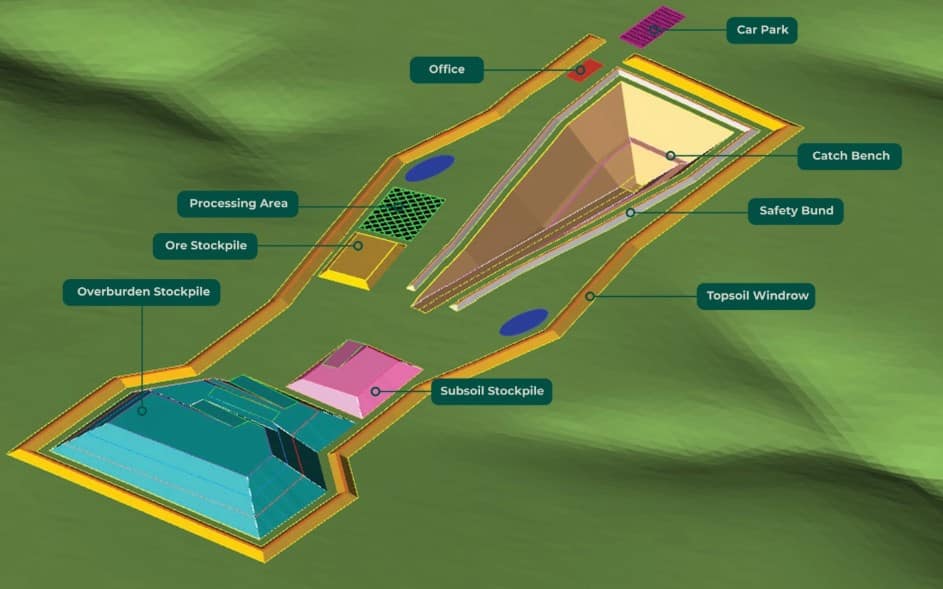
Positioned in the eastern section of the Fingerboards mining boundary to best reflect broader site conditions, the MRDP forms part of GCM’s reporting obligations under its Retention Licence (RL2026), which requires it to undertake large scale rehabilitation trials.
“In completing its early rescoping work, we determined that to reliably test our proposed new approach to rehabilitation, we needed to conduct full-scale trials through an MRDP,” said GCM CEO Michelle Wood.
“Through the demonstration pit, we will track the rehabilitation of productive soil structure, vegetation establishment and long-term erosion control. Monitoring will continue for the long term and results will provide site specific evidence on how mined land can be rehabilitated safely and progressively.”
“It is exciting to get the go ahead to commence this work which will give the community some real insight into our mining methods and how the project has changed.”
The MRDP will be 170 metres long, 55 metres wide and up to 22 metres deep and will also test excavation techniques, material behaviour, water management, tailings characteristics, landform stability and rehabilitation techniques. Results will inform environmental impact assessments, validate assumptions and allow for any changes to be made to the project design to further minimise environmental impacts.
AECOM Technical Director Bryan Chadwick said the demonstration pit reflects GCM’s data-led approach that will provide key information into the required environmental studies.
“From an impact assessment perspective, staged real world testing is incredibly useful to understanding how certain aspects of a project will perform over time.”
“Working with GCM, we are seeing a clear commitment to grounding the design in site specific data and using each stage of testing to strengthen environmental performance and long-term land stability.”
The MRDP will also guide decisions on project materials, including flocculants. All products under consideration are safe and well regulated, with any operational clearance dependent on demonstrated in pit performance under strict on-site controls.
Through its East Gippsland-First procurement policy, GCM is prioritising local suppliers with more than $1 million in procurement contracts to be awarded to local businesses, generating up to 15 local jobs across construction, civil works and site services.
Bairnsdale companies Whelans Group Investments and Riley Earthmoving are among the first 12 businesses already engaged. Community and Stakeholder Lead Mick Harrington said it’s exciting to see the project delivering practical economic benefit for East Gippsland.
“This work is creating real opportunities for local businesses and workers. Early contracts have gone to East Gippsland firms, keeping investment in the region and supporting local jobs from day one.”
“As more stages of the demonstration pit and rehabilitation trials roll out, we’ll continue prioritising local contractors, so the economic contribution flows directly to the people and businesses who call this region home.”
WGI CEO Leigh Brennan said the project arrives at a pivotal moment for regional employment in East Gippsland.
“As an employer of around 200 people, we see firsthand the effects of local industry contraction. The Fingerboards Project represents a critical opportunity to diversify and strengthen our region’s economic base through sustainable employment, investment and innovation. Provided the project is implemented to the rigorous standards GCM has committed to, the benefits will significantly outweigh the risks.”
Once excavation is complete, GCM will host community open days to give residents a firsthand look at the pit and hear from technical staff about the work underway. Additional supervised access will be offered during key rehabilitation milestones, enabling the community to observe how the project performs throughout the trial.
“I’m looking forward to people seeing for themselves how the redesigned project works on the ground and showing them around,” said Mick.
To register for our upcoming community webinar, or to stay up to date with the latest news from GCM visit gippslandcriticalminerals.com.
Related stories: : Letter to the Editor – Concerns for the Victorian Government’s push for critical minerals: Mine Free Glenaladale; Letter to the Editor – Gippsland Critical Minerals responds to Mine Free Glenaladale; Letter to the Editor: Mine Free Glenaladale responds to Gippsland Critical Minerals


Dear Editor,
After receiving correspondence from Resources Victoria, noting the depth to which Kalbar/Gippsland Critical Minerals are authorized to dig as a part of their mining demonstration pit, I’m baffled.
How can a community member, such as myself, ensure the groundwater depth is actually at 70 metres, and not 7 metres? Where can I find this information?
Additionally, when will the community be informed of the Minister for Planning’s decision for another EES process? Previously, it was advertised as 11 December 2025, and no further clarity has been given.
I have zero confidence in Resources Victoria’s policing of the depth in which the proponent will dig, nor do I trust that the groundwater and aquifers will be ‘safe’ during this test period.
I would appreciate an outline of:
– How Resources Victoria will ensure Kalbar/GCM will not dig further than the approved depth in the work plan?
– How will Resources Victoria ensure Kalbar/GCM will not contaminate groundwater and aquifers during the test period?
– To what end does Victorian Treaty, and the notion of aqua nullius, ‘Country as a living relative’, enter the cultural heritage management plan process which was approved in November 2025?
Per Bourke et al (2025):
https://theconversation.com/how-the-myth-of-aqua-nullius-still-guides-australias-approach-to-groundwater-270374#Echobox=1766000453
“Australia’s recent critical minerals agreement with the United States will lead to more water-intensive production and processing and substantial long-term environmental impacts.”
“Mine closure is rare in Australia. Mine rehabilitation often falls short of societal expectations. The legacy of decisions made now is likely to last for thousands of years. And they will disproportionately affect Indigenous communities.”
– When will Kalbar/GCM commence digging? And how could this NOT be classified as ‘mining’!
– Are Kalbar/GCM inspected by Resources Victoria on a weekly basis during the construction of the test pit, to ensure excavation and vegetation clearing remains ‘legitimate’ during construction? That’s a paradox that East Gippsland should NEVER have to deal with after the EES process in 2021.
– Does Resources Victoria understand that the proponent is digging a hole in an area where the 2021 EES process suggested mining activity should not occur?
– Can Resources Victoria release the data and modelling to community members that Kalbar/GCM submitted as part of the work plan approvals for the test pit? Or does a community member need to request this information from Kalbar/GCM?
Respectfully,
Merryn Padgett
Paynesville
Cc: Minister D’Ambrosio, Laura Helm, ERR Feedback