Christine Webster, Murray Pioneer
A descendant of the first settlers at Lowbank, east of Waikerie, has written a book on the history of the former local school, providing an insight into education in the area from 1913 to 1942.
The book, titled ‘Low Bank School History’, was published last month, and is Cheryl Paschke’s fifth book about the history of the area.
Ms Paschke’s career background is in administration, but she enjoys writing as a hobby.

She has previously compiled three books on her family history, and one about the Lowbank Church.
Ms Paschke grew up on a fruit property at Waikerie, and now lives at Lowbank where her great-grandpa Friedrich ‘Bill’, Wilhelm Paschke, and his brother Johann ‘Jack’ Berthold Paschke settled.
The two Paschke brothers named their landing, Low Bank Landing, and settlers in the area later used Low Bank as a name for the area, which later just became one word, Lowbank.
Ms Paschke was inspired to write the book about the Low Bank School after a photo of students from 1929 was posted about 18 months ago on the Lost Waikerie Facebook page.
She said someone showed her the photo and it triggered her interest.
Ms Paschke said with input from various people, it was possible to name these students in the photo.
“I wondered what other information about the school was out there and I started looking, thinking that there would be a small amount of information to be found,” she said.
“I found a lot more than was expected, a few of the former students who have since passed away, had written memoirs about life at Lowbank.”
These included the late Art Kalisch, and the late Anne Nitschke (nee Schmidt).
Ms Paschke also visited former Low Bank School students Ivon Kuchel, and Ronda Cain (nee Irrgang), and asked them about their school years.
She also used information from several unpublished memoirs and writings from Anne Nitschke.
At the Waikerie Primary School, Ms Paschke found the inspector report books for the former school, which she said made interesting reading.
She said the observations of the education inspector, which she outlines in her book, describes how many of the Lowbank students attended school barefoot.
“He did not think that this was a good thing and he often commented about the barefoot rural children,” Ms Paschke said.
She said the inspector also noted the German accents of the students, when they were speaking English.
“Some of the students spoke German at home and had to learn English at school,” she said.
Ms Paschke said the education inspector’s report reflected the view that people of Germanic ancestry should become ‘good Australians’.
She said this was part of an anti-German sentiment that existed in Australia after World War I.
“It was because they still spoke German,” Ms Paschke said.
She said many of these German settlers had been in Australia since the 1830s and 1850s, and by the time the Low Bank School was operating, the parents and the children were born in Australia.
Ms Paschke originally planned to print a booklet about the former Lowbank school on her own printer, but she kept on discovering more fascinating information and photos.
She funded the project herself because of her love of local history and the Lowbank area.
“It was something that interested me and I thought people would like to buy it once it was finished.”
For more information about her book contact Ms Paschke (paschke5330@gmail.com), or on 0490 048 118.
Snapshot history of Low Bank School
A provisional school for the Lowbank area, first called Holder School, opened in 1913 in a building next to the Lowbank Lutheran Church, and a short time later was renamed Low Bank School.
The first teacher at the school was William R Pattrick and the original building, owned by Gottlieb Schmidt, was made of galvanised iron and lined with boards.
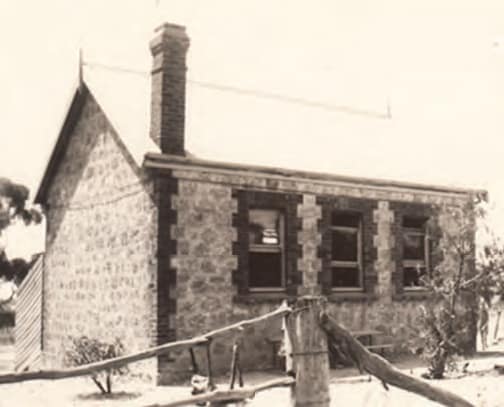
This building was leased from Mr Schmidt by the Education Department, and in 1918 a new stone building for the school was completed.
In the one classroom was one teacher responsible for children from grades 1 to 7.
Some of the children lived up to 8km away from the school, and had to walk there and back home each school day.
Over its short life the school had 21 teachers and provided an education for at least 119 students.
Some of the students received their full education at the school, while some were only there for a short time.
The school closed in 1942 due to the low number of students, and the building was given to the Lowbank Lutheran Church, who enlarged it and presently use it as their church hall.

This article appeared in Murray Pioneer, 20 August 2025.