


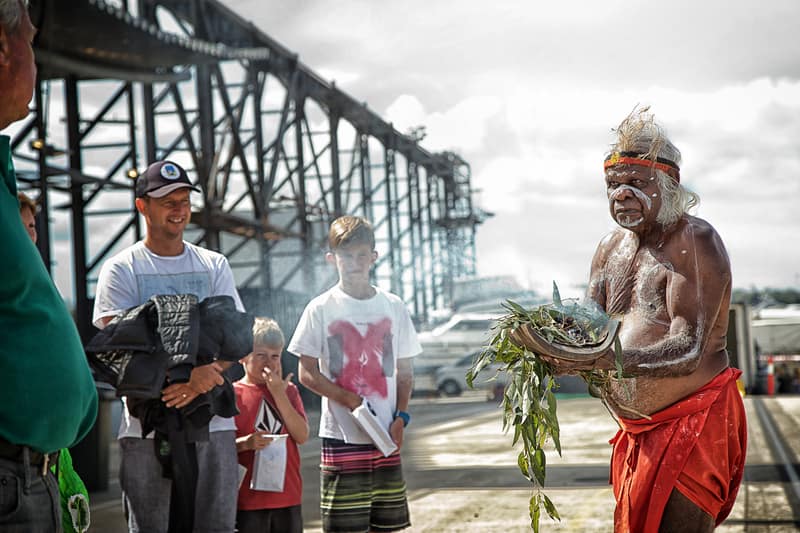
As we mark the 50th anniversary of NAIDOC Week July 6-13 (a milestone celebrating the rich history, culture, and achievements of Aboriginal and Torres Strait Islander peoples) it’s time to ask a deep question: What can today’s leaders truly learn from the world’s oldest living culture?
For over 65,000 years, Aboriginal communities have led through complexity, change, and survival with a wisdom that far predates modern management theory. The leadership principles embedded in Aboriginal culture (stewardship, deep listening, collective wisdom, and intergenerational thinking), offer not just inspiration, but practical guidance.
In boardrooms across the world, leaders are wrestling with complexity: hybrid workforces, global uncertainty, Ai driven disruption, social fragmentation, political ineptitude, and an environmental tipping point. Amid this turbulence, many Leaders are coming to a sobering realisation, traditional leadership models are no longer sufficient. The command-and-control style, rooted in speed, dominance, and short-term wins, is being outpaced by the moment we are in.
If we are serious about building sustainable, ethical, and adaptive leadership for the future, we should look to the enduring wisdom of our Aboriginal culture for six leadership lessons that are relevant today.
1. Leadership as custodianship, not ownership
One of the most striking features of Aboriginal leadership is the idea of custodianship. Leaders are not owners of land, resources, or people, but they are stewards, responsible for safeguarding the community and environment for future generations.
For leaders today, this mindset is transformative. Amid growing pressure from ESG standards, shareholder value, voter needs, and community expectations, the idea that leadership is not about control but care of people, culture, and planet. This shifts the axis of leadership thinking entirely. Leading any organisation or community in 2025 requires thinking 50 years ahead, not just one quarter forward, or the next election cycle.
Leader takeaway
Treat your role as a guardian of legacy, not just performance.
Ask yourself: What are you leaving behind, and for whom?
2. Practice deep listening (Dadirri)
From the Nauiyu people (Daly River region of Northern Territory) comes the concept of dadirri. Deep, respectful listening. It’s not passive. It’s a deliberate, mindful act of creating space before making decisions. Listen to understand – not listen to reply!
For leaders today, dadirri is a counterforce to the speed-at-all-costs world we live in. Deep listening allows you to understand not just what people are saying, but what they’re not saying. It uncovers underlying tensions, unmet needs, unintended consequences, and hidden potential. Cultivating a culture of deep listening is how humans connect, understand each other, and build trust. Without deep listening and understanding it is impossible to lead a team that performs well consistently and over a sustained period of time.
Leader takeaway
Leaders who listen deeply are better equipped to make wise decisions,
build trust, and avoid blind spots.
3. Storytelling as a strategic leadership tool
Aboriginal cultures pass on laws, ethics, land maps, and survival strategies through oral storytelling. The Dreaming isn’t just myth, it’s a sophisticated system for transmitting knowledge, values, and identity across generations.
Modern leaders are slowly rediscovering the power of narrative, but few use it with the depth and discipline Aboriginal culture demonstrates. Stories have the power to align teams, convey purpose, and embed strategy in ways data never can. Words are how we think. Stories are how we link.
Leader takeaway
A leaders stories shape culture.
Craft them with care, deliver them with authenticity, and use them to anchor meaning, whilst shaping mindsets and endorsing behaviours.
People will forget facts and data, but they never forget good stories.
4. Collective wisdom over individual heroism
Aboriginal leadership is inherently collective. Decisions are made with consultation, consensus, and a deep respect for community impact. The “hero Leader” model is absent, instead, influence is earned over time through service and contribution.
Today, with employee and community disengagement rising and hierarchical models crumbling, this approach is more relevant than ever. Adaptive leadership means drawing on the intelligence of the whole team, not just the leaders deemed in charge.
Leader takeaway
Build leadership structures that empower voices at every level.
The best ideas never always come from the top.
5. Connection to place and context
For Aboriginal leaders, land is not just a physical location, it’s alive, relational, and integral to identity. Leadership is grounded in an intimate knowledge of “Country” and its cycles, seasons, needs, and stories.
This idea of place-based leadership is gaining global traction, right in front of our eyes, as leaders confront geopolitical tensions, tariffs, supply chain fragility, cultural misalignment, and a new global order. Understanding your environment, whether physical, social, or ecological, is essential for making smart, context-aware, local decisions.
Leader takeaway
Know your context deeply.
Leadership divorced from place often results in solutions that don’t stick.
6. Intergenerational leadership and eldership
In Aboriginal communities, leadership is passed down not through rank but through experience. Elders are revered not for their authority, but for their wisdom, humility, and service.
Contrast this with modern organisations, where leaders are rewarded for tenure, financial performance, or short-term outcomes (regardless of the social, environmental or cultural impact). Too often leaders are revered for their title, rather than their wisdom and service. Authentic leaders are those who can blend the energy of youth with the guidance of seasoned experience.
Leader takeaway
Build pipelines for intergenerational learning.
Honour experience, mentor upward and downward, and recognise that wisdom is a resource worth protecting.
Final word: Leading with the long view
If you’re an aspiring leader today, your challenge is not only to deliver growth, but to create meaning, build trust, and navigate complexity with integrity. That’s a tall order. And it’s why the oldest continuing culture on Earth may hold some valuable leadership insights. Just because it is not taught in business schools, does not mean it should be ignored.
Leadership Lesson
Aboriginal leadership teaches us to lead not just with strategy, but with soul.
Not just for profit, but for people and place.
Today, this is no longer a “nice to have”, but a necessity.
The invitation is clear: listen, learn, and lead differently.
The world needs it, and so does your organisation and community.
Facta Non Verba – Deeds Not Words

