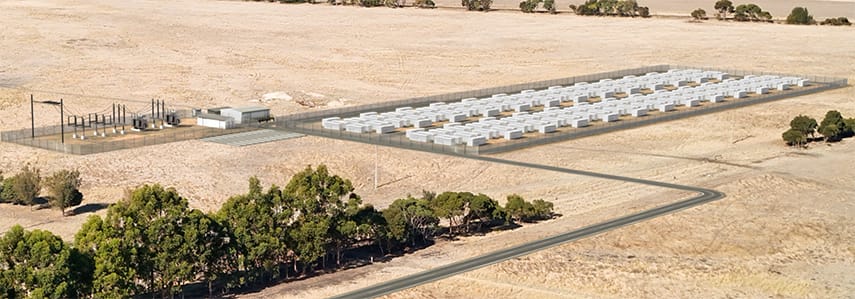
A $240m Battery Energy Storage System (BESS) is proposed for a site 3.5km west of Naracoorte by renewable company ACE Power.
The project will be known as the Kincraig Battery and 60 people are expected to be employed during its construction phase, with two to four people required long term to maintain it.
Development manager Fraser Woodley said there were a number of reasons why ACE Power identified the site as an ideal location for one of its projects.
“These include securing a parcel of land directly adjacent to the Kincraig substation, as it has available capacity to connect a new battery and means no new transmission lines are required to connect the project,” he said.
“In terms of geography and environmental considerations, the site is relatively flat, and cleared of vegetation where the battery will be located, which means it is considered as having low environmental value.
“However, existing vegetation that is on the site will be retained and will provide an excellent natural screening, which will reduce visual impacts.
“Finally, the site is adequately separated from residential neighbours, which further reduces potential impacts.”
Mr Woodley said the proposed project was best described as a “grid connected utility scale battery energy storage system”.
“In layman’s terms, batteries store electricity to be released into the network during peak periods and to also help supply reliable electricity,” he said.
“In more technical language, this means that battery modules about the size of a 20ft shipping container are connected to the ElectraNet network and configured to store electricity at times of oversupply and dispatch during times of peak demand.”
Mr Woodley said the project could store enough energy to power about 25,000 homes.
That was because it was planned to be a 150MW hour, four-hour storage system with a 600MWh storage duration.
“ElectraNet will also use the battery to improve system strength and help them meet their obligations to provide a reliable supply,” he said.
Regarding employment opportunities, Mr Woodley said the majority of the jobs generated for the local community would be during construction, “with approximately 60 during the construction peak.”
“The project is planning to partner with local businesses as much as possible and we hope to provide opportunities for local civil and electrical engineering firms, plant hire services, construction staff, catering services etcetera,” he said.
“The project has already heard from several local companies and individuals with construction project experience.
“The workforce requirements will also generate indirect economic benefits to local businesses such as cafes, hotels and shops.
“Once operational the project anticipates approximately 2-4 ongoing jobs to manage and maintain the site, with additional site maintenance roles contracted.”
Mr Woodley also explained the company’s plans regarding fire prevention.
“Many existing battery projects utilise older battery technology of nickel-manganese-cobalt (NMC) which are more prone to fire risks,” he said.
“However, modern batteries such as Kincraig have moved towards the use of Lithium Iron Phosphate batteries which are much more fire resistant, reducing the likelihood of fire.
“The battery units also have in-built management systems which can detect faults such as overheating, remotely isolate the affected battery and deploy in-built fire suppression systems.
“In terms of defence to external bushfires the project has engaged a bushfire specialist to survey the project site and determine the necessary boundary setbacks to surrounding vegetation, and the location of the on-site water tank.”
Mr Woodley believes projects like the Kincraig Battery will eventually lead to reduced power prices.
“Renewable energy is the cheapest form of energy generation,” he said.
“Batteries also allow the grid to use the cheapest forms of energy – renewables – for a greater percentage of the time.
“In the long term the roll-out of more renewable energy including grid scale batteries like ours, will help to reduce SA power bills.”

This article appeared in The Naracoorte News, 11 June 2025.