


Bushfire History
Roger Underwood
The Bushfire Front is a small professionally-led organisation dedicated to raising the standard of bushfire management in Western Australia. It comprises mainly former government officers with lifetimes of experience in bushfire mitigation, operations, research, administration and politics. They see themselves as activists, but also as “insiders”, people whose views are based on experience in the real world, dealing with real bushfires and real people, not on academic theories or ideology.
Over the last 25 years the BFF has been active, and to some degree influential, in pointing government Ministers and bureaucrats in the right direction, and in holding them to account for flawed policies and incompetence. Bushfire management in WA leads the nation but is still far from perfect. Indeed the situation on private land at the rural/urban interface is frightening, and the responsible agency in southwest forests is grossly under-resourced. Nevertheless the BFF can take credit for convincing successive governments of the need to invest in prevention and mitigation, rather than focusing solely on suppressing fires after they start. This policy approach has been achieved in the face of a decades-long campaign by environmental activists and academics, who want the (absolutely essential) prescribed burning program in southwest forests shut down or curtailed.
One of the things the BFF has had to overcome is how poorly basic bushfire science is understood by politicians, the media and urban communities. This allows fooolish and sometimes dangerous theories about bushfires to flourish and ineffective solutions to be proposed.
Nor are people sufficiently familiar with the facts or lessons of bushfire history. Memories of past fires quickly fade, and every new fire is described as “unprecedented”. Statements from “fire chiefs” that current bushfire risks are the result of global warming go unchallenged and provide an excuse for incompetence. Fire prevention and damage mitigation is always ignored or downplayed; instead there are constant calls for more and bigger water/retardant dropping aircraft (whose cost/effectiveness is never questioned) and ever-more sophisticated suppression technology.
The BFF sees the need to inform and educate the community about bushfire science and bushfire history as one of its most important roles. Nobody else does it, especially not the media, bureaucracy or the education system. And if it is not done, the community is misled, and things go awry.
As part of this strategy the BFF has published a series of pamphlets and books aimed at the WA bushfire leadership and the general community. The focus of the books is first-person stories from people who were “there at the time”. This not only helps to preserve the history of real events, it puts a human face to them.
The two most notable BFF publications are Tempered by Fire – stories from the 1961 bushfires (in which four towns and hundreds of thousands of hectares of jarrah forest were burned) and Cyclone Alby – stories from the 1978 storm and bushfire crisis (in which five people died and the bulk of the State’s southwest was ravaged). The two books not only describe what happened but contain over 100 personal memoirs from people who were involved in some way with the two disasters. Several hundred copies of both books have been sold, and both are still in print and continue to sell. The BFF has also donated numerous copies to politicians, schools and libraries.
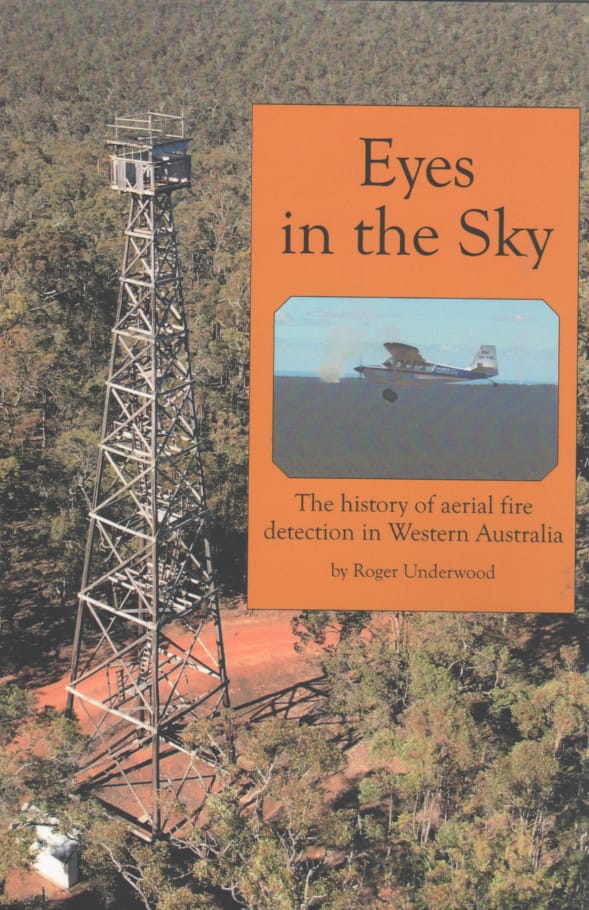
Now a new book has been published in the BFF’s bushfire history series. This is Eyes in the Sky – The history of aerial fire detection in Western Australia, the story of the development of the bushfire detection system in the southwest, and of the incorporation of fire spotting aircraft into this system. It is a timely release, coming at the time when the environmentalists are trying to convince the government that replacing the current system of fire detection with a new “hi-tech” system using tower-mounted cameras and satellites will make fire suppression so rapid and easy that fuel reduction burning will no longer be needed. As the BFF demonstrates in the new book, this suggestion fails to take into account the fact that current fire detection (based on an integrated system of lookout towers, aircraft and satellites) is highly effective, relatively cheap and has been field-tested and refined and updated over decades.
There are three essential components to an efficient and cost/effective bushfire management system:
(i) rapid and accurate detection and appraisal of new ignitions;
(ii) maintaining an effective suppression capability; and
(iii) preparation of potential firegrounds so as to minimise fire intensity, mitigate fire damage and make fires easier to control.
As the BFF emphasises, removing any one of these three components is like removing one leg from a three-legged stool – it will always fall over.
Copies of Eyes in the Sky – The history of aerial fire detection in Western Australia are available from the ARR.News bookshop for $30 including postage. All of the money collected by the BFF from their bushfire history series is put to use in their campaign to improve bushfire management in WA.
Author: Roger Underwood
Publisher: Bushfire Front
Year of publication: 2025
Buy Eyes in the Sky – The history of aerial fire detection in Western Australia through the ARR.News Store.
Roger Underwood has contributed articles and to many discussions on forestry issues on Australian Rural & Regional News.

