

Scott O’Keeffe, ecologist, The Nimbin GoodTimes
The red-bellied black snake (Pseudonaja porphyriacus) is a venomous Australian Elapid snake. Elapid snakes have permanently erect fangs at the front of their mouths, which deliver venom to their prey.
Red-bellied black snake prey consists mostly of frogs, but they also eat fish, small mammals and reptiles. The venom immobilises or kills prey by attacking the nervous system and causing muscle paralysis.
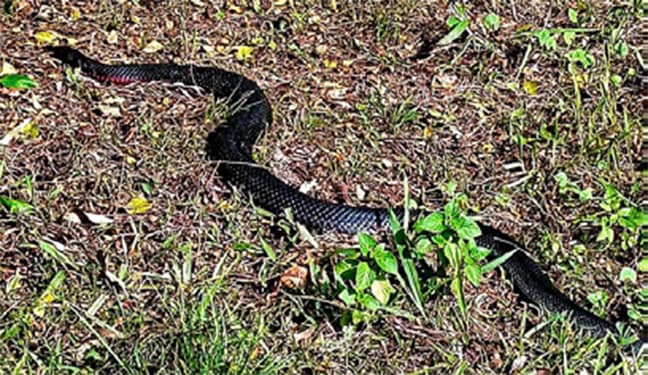
In humans the venom can induce serious illness but bites have not resulted in any human deaths.
Also, red-bellied black snakes are timid and avoid confrontation.
Red-bellied black snakes (RBBS) occur through eastern coastal and sub-coastal Australia. They inhabit forested and wooded landscapes, frequently around shallow fresh water bodies and marshlands. This is hardly surprising given that they mainly eat frogs. These snakes are sometimes seen in urban areas that are adjacent to woodlands, forest or wetlands.
Cane toads (Bufo marinus) have proven toxic to a wide range of native predators and scavengers, including RBBS and other native snakes. The rapid spread of toxic cane toads gave rise to predictions of a wave of native animal extinctions. Many species of vertebrates were thought to be at risk. These predictions have proved partly correct and many native predators and scavengers are already adversely affected.
Total RBBS numbers have been declining for several decades, and cane toads are often cited as the cause of this decline. However, it seems unlikely that this is the whole story.
Cane toads were introduced to Australia in 1935 as a biological control for cane beetles. They spread rapidly and now occupy large areas of Queensland, New South Wales and the Northern Territory. Cane toads are still expanding their range.
Cane toads are certainly toxic for RBBS’s, but are toads alone the cause of a population decline? The apparent disappearance of very large RBBSs and the supposed higher rate of survival of smaller individuals have been proposed as evidence.
The ‘logic’ here is that large highly toxic toads can only be consumed by very large snakes with mouths large enough to swallow them. Thus, large snakes disappear, leaving only small snakes.
But this only explains why large RBBS seem to be disappearing. It doesn’t explain why small RBBS might be surviving. Small toads and frogs are part of their diet, so why would small RBBS not be poisoned by small cane toads? To complicate things further, it seems that recently the proportion of large RBBS has been increasing.
Could RBBS be increasing their survival rates by learning to avoid eating cane toads? Other animals have adapted in this way. Could individual snakes with repeated exposure to sub-lethal doses of toad toxin eventually develop a resistance to the toxin that can be inherited by offspring? Both of theories have been tested.
The results show that RBBS do not learn to avoid eating toads, nor do individual snakes develop an increased tolerance to toad venom through repeated exposure. Rather, toads exert evolutionary pressure on RBBS such that snakes with an innate high tolerance of toad toxin have high survival rates.
Further, RBBS with large bodies and relatively small heads have a high survival rate because they are less likely to be able to consume a toad large enough to deliver a fatal dose of poison. A single factor such as the presence of toxic toads does not adequately explain the decline in RBBS, nor does the increased tolerance to cane toads ensure the species’ survival.
Widespread habitat loss and fragmentation, persecution, serious declines in frogs (the RBBS most important food) together with the introduction of exotic cane toads give a fuller explanation for their decline.
Rapid physiological adaptation might explain the increased survival of large RBBS. The increased survival of large mature snakes could be mitigating other adverse impacts.
RBBS have a generation time of about three years, so this species has shown significant adaptation to the presence of cane toads in about 23 generations. Such a rapid response to adversity is reassuring.

This article appeared in The Nimbin GoodTimes, October 2024.

