

GWMWater has recently provided an update on a study entitled “Donald Community Power Plant Study” investigating the feasibility of a community power plant and potential microgrid infrastructure to supply the residents of Donald with locally harvested and stored green energy.
This is not the first time the concept has been investigated for the town. A study led by C4Net explored the possibility of Donald being set up as a microgrid. Powercor was a participant with Donald being explored along with a number of other towns. Donald was considered viable but not as viable as other towns based on the criteria used by Powercor. The C4Net led study concluded in 2023
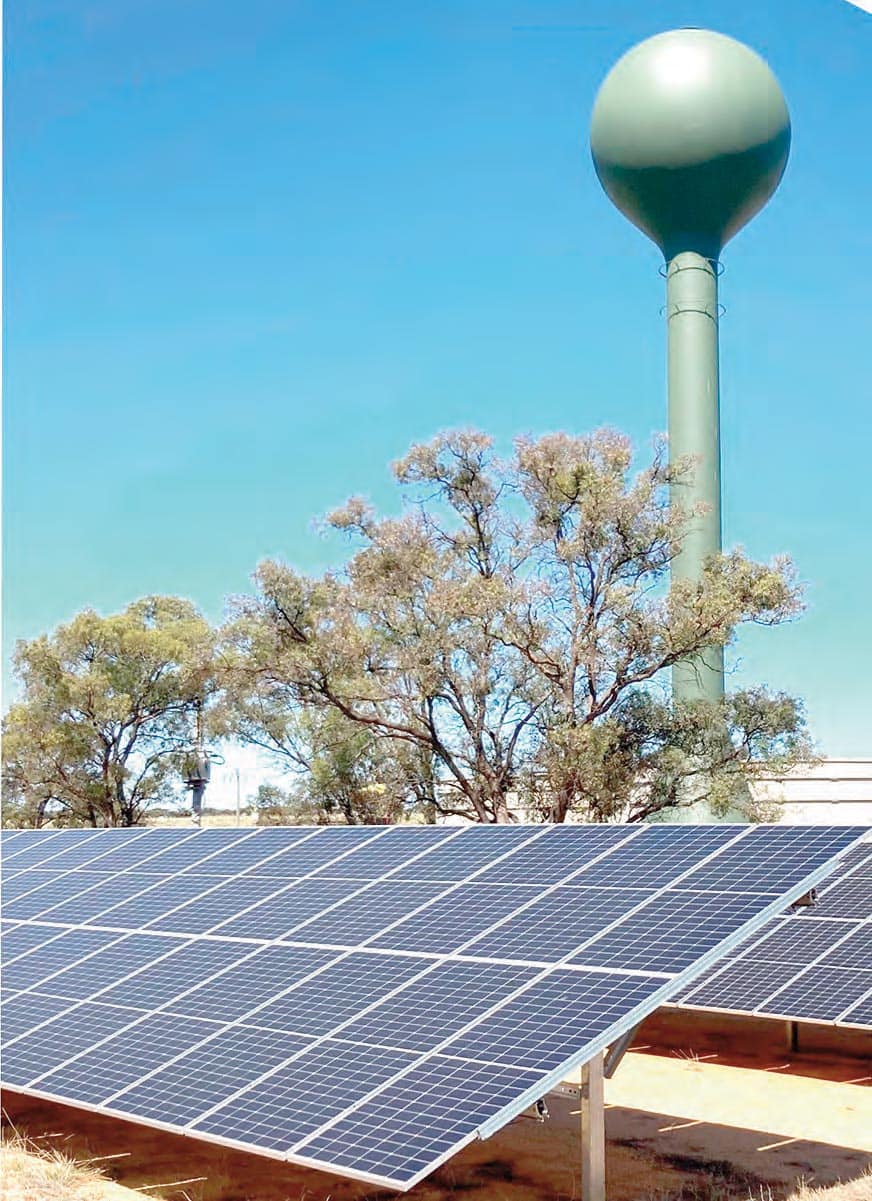
The new study provides a deeper dive into the community energy concept for the town of Donald. Under the model, GWMWater would utilise its redundant water storage sites as potential solar and battery farms, generating energy from the solar panels and utilising the battery to store the excess power from the solar panels constructed, as well as soaking up the excess power from rooftop solar in the town. Seventy percent of the residential housing in Donald has solar panels installed.
The concept earned GWMWater the runner-up place in the 2024 Water Minister’s Climate Innovation, which awarded the company with $85,000 to be be used for a commercial options assessment and to determine how this local electricity supply would benefit the community.
Background
The interest in the subject, and why it has had two studies dedicated to it comes from a growing need for self-sustainability for our businesses and local inhabitants. Communities across Victoria and beyond are becoming increasingly interested in alternative energy sources as either enhancements or simply alternatives to their current options. Donald is fed midway from a long rural feeder from the Charlton Zone Substation, which in turn is fed from a very long radial subtransmision line from Bendigo. This long line opens up a major reliability risk due to fire, weather and potential accidents which can cause rural areas like Donald to be without power for days.
A microgrid is an increasingly enticing option across Australia for rural communities looking for answers to growing power needs. A microgrid would allow for lower costs to local businesses and people whilst also offering more reliability during the chaotic fire seasons. While the previous study by Powercor and C4Net showed that economically a DNSP-owned micro gird wouldn’t stack up for the Distributed Network Service Provider (DNSP) however, this study brings forward the potential for GWMWater to use one of its redundant water storage sites as both a battery and solar farm. The proposed plan would have this site soak up excess daytime solar energy and store it for use in the evening, allowing for higher stability for the local grid and more benefits for the community around it.
The findings
So far the study has shown some key outcomes such as 1.3MW of rooftop solar exists in Donald and 50 per cent of that solar generation is exported. The reason so much of it is exported is because we currently do not have a reliable way to store the amount of power generated, something that is addressed in this proposal. Another hurdle we face is shown in the previous report, mentioning that due to our location the capabilities of the lines to feed that power back through those supply lines is limited. The lines are simply not equipped to send power back to higher consumption areas.
In those findings is also the commercial opportunity for GWMWater and the community, as Donald’s electricity bill is 2.5m and the retail charges make up just under half of that at 1.2m. The beauty of this study is that it shows the potential to grow, the outcomes include a staged infrastructure idea that could increase with community involvement allowing for more flexibility and opportunity to grow alongside our regional area.
The future
While this idea is still in the investigative stage, the study is expected to be finalised by the end of 2024, with the focus on developing it alongside the community to ensure benefits to everyone; GWMWater gains by accessing green energy through its own infrastructure, leading to operational cost saving that passes on to the consumer.
GWMWater Managing Director, Mark Williams, said, “GWMWater’s interest in the project stems from its connection to the community. By utilising an asset that is sitting idle, GWMWater can meet its energy requirements as well as assisting with their aspirations in relation to energy supply.”
All GWMWater’s energy initiatives are cost neutral, in that it covers its own costs, with the aim of trialing whether GWMWater can provide higher reliability power at a lower cost to consumers. It is not interested in making money from power supply, rather trying to install electricity infrastructure that benefits its customers and supports the transition to net-zero emissions. This infrastructure needs to be able to pay for itself so that the project does not have a negative financial impact on customers.
Support
Local legend John McConville has been in support of independent power supply since the concept was first investigated.
“Personally, I’m very happy for my community to keep its excess power,” he said. “It would be great for the town to be able to have its own reliable green energy power supply; but let’s get real, we haven’t the money for the battery storage infrastructure and all the excess power we’re generating from our rooftop solar is going to waste.
“GWMWater has the potential to provide the required infrastructure. GWMWater builds it and maintains it, and at every stage of this concept you have a choice to buy power from them, or any other supplier.
“Just think, if every town had its own power supply, there’d be no need for all these industrial turbines and transmission lines!”
This article appeared in The Buloke Times, 8 October 2024.

