Around 82,500 cattle and 480,000 sheep grossed $149.9 million last financial year at the Naracoorte Regional Livestock Exchange, South Australia’s largest saleyard facility.
Currently valued at more than $13.3 million by Naracoorte Lucindale Council it is also considered one of Australia’s premier saleyards, helping to underpin Naracoorte’s economy.
For almost 51 years the NRLE has created ongoing employment for stock agents, truck drivers, meat buyers, PIRSA agents, EPA officers, farm workers, canteen staff, council workers, fuel companies and the nearby Teys abattoirs which employs more than 500 people.
While the Naracoorte Lucindale Council owns the asset, it is mostly funded by farming families.
NRLE operations
Last financial year 84 percent of more than $1.8 million was raised from farmers via yard fees. A truck wash pumped in another 13 percent, and paddocking fees – 3 percent.
The facility returned an operating surplus of $902,297.20 for the council. But the council’s administration has listed its future risk to ratepayers as “Extreme” in a report for its audit and risk committee.
The report excludes NRLE committee chairman Cr Cameron Grundy’s question to council’s June meeting “where is the depreciation for the last 50 years?”.
The NRLE featured in two items of the council’s August 10 audit and risk committee meeting.
NRLE and audit committee
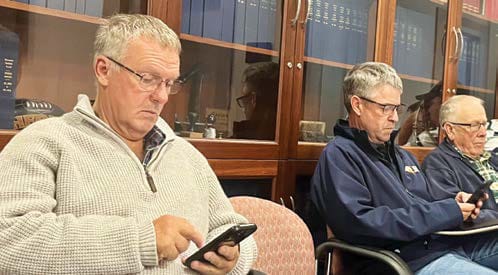
Stock agents representing PPHS, SAL, Nutrien and TDC gathered in the public gallery to see why. They were joined by Crs Grundy, Peter Ireland, Abigail Goodman and Trevor Rayner.
The audit committee includes Cr Damien Ross (chairman) and Naracoorte’s Brett Armfield, John Finnis, Cr Darren Turner, Peter Westley and mayor Patrick Ross.
The first NRLE matter was headlined: Monitor Performance of the NRLE and the fine print said “to ensure the facility remains commercially viable”.
An attachment carried the July 24 NRLE committee meeting agenda and minutes. Included was the 2023-24 end of year financials featuring livestock throughput, gross livestock sales and the operating surplus, among other things.
Depreciation for 2023-24 was listed as $378, 469. Other reports affecting the yards included PIRSA and footrot, as well as electronic identification for sheep (EID).
The State Government introduced its mandatory EID scheme, but has failed to fund it, shifting costs on to farmers, stock agents and saleyard owners – including the council.
The second saleyards matter was headlined: NRLE- Assessment of Financial Position.
It delved into Cr Craig McGuire’s motion to council’s June meeting, and his preamble regarding NRLE finances “and what the effects on council and ratepayers may be in the future”.
Cr Grundy had seconded Cr McGuire’s motion and called for the whereabouts of 50 years of depreciation.
At the time mayor Patrick Ross said he imagined that depreciation would be picked up under a revenue source and asked Mr Smart: “Would you think so?”
Mr Smart replied: “Under AMPs (Asset Management Plans). Financial plan.”
But it was not included in the August 10 agenda.
In a written report for the meeting, Mr Smart said the council’s strategic risk register identified “the NRLE poses a significant financial and strategic risk to council through projected NRLE financial position”.
“The committee already has a role to have oversight of the finances of the NRLE, but this review seeks a more extensive assessment,” he said.
“The request for a review does not suggest that the NRLE is unviable, or not being operated and managed appropriately – it is purely an assessment to assist council and the NRLE board on what various options may be considered in the future.”
He said the council’s administration had done some initial work providing historical information, forward projects, fees and charges comparisons – “attached for your information and consideration.”
Mr Smart explains
After the meeting, Mr Smart told The [Naracoorte Community] News there was no mention of the 50 years of depreciation because council records only go back to 2005-2006.
“This is as far back as we can capture from existing records,” he said.
From then until last financial year council’s depreciation for the NRLE totalled $4791,628 for buildings and infrastructure and $579,220 for plant and furniture.
He explained Cr McGuire’s motion and preamble was included, but not Cr Grundy’s question about depreciation, because Cr McGuire provided a motion and Cr Grundy did not.
“I am sure that if the audit and risk committee wishes to pursue that question, they are able to,” Mr Smart said.
Mr Smart believed the $13.3 million value of the saleyards appeared to be low, but the facility would be soon independently revalued.
Saleyard giant RLX visit
While Mr Smart recently met with saleyard giant RLX (Regional Livestock Exchange) representatives he said they did not express an interest in a possible lease or purchase of the NRLE.
Regarding local interest to sell or lease the saleyards, Mr Smart said he could only speak on behalf of himself and staff, and there was “no interest”.
“Council committee members and elected members would need to speak to that themselves,” he said.
“Regardless of any personal or professional opinion – from CEO, staff, committee, or elected members – only the elected council has the authority to buy or sell an asset of council, including the NRLE.
“As council CEO, I meet with many people and organisations including some that may have an interest in council assets, including land – and while I can listen and advise – I will not (and cannot) make any commitment on behalf of council unless they have authorised me to do so.”
This article appeared in the Naracoorte Community News.