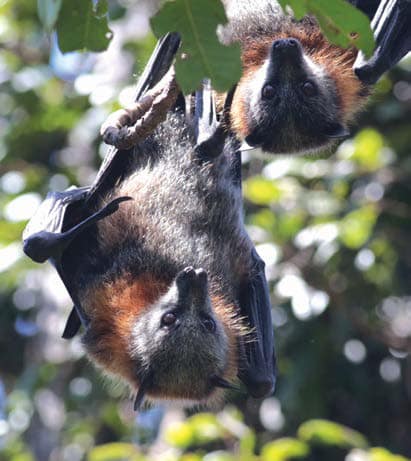
Around 5,000 or so grey-headed flying foxes, often called fruit bats, currently have two main camps – one near Naracoorte and the other around Mount Burr.
The flying foxes can carry the deadly Lyssavirus and Hendra virus – anyone scratched or bitten must seek urgent medical attention.
Even dead bats are considered too dangerous to touch, particularly as the highly fatal Lyssavirus has been found in SA bat populations.
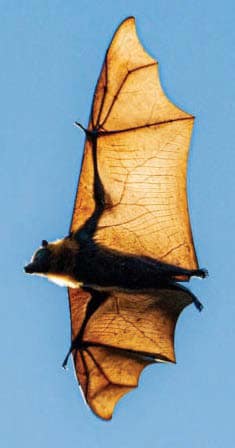
With a wingspan of up to one metre, they can weigh as much as one kilogram.
During the day bats can be seen roosting upside down in their “camps”.
At dusk they leave their camp to forage for food up to 20 kms away, sometimes much more, returning at dawn.
They usually like to feed on nectar from flowering gums.
One of the main camps for flying foxes locally is in pines near the Naracoorte Caves.
But readers have reported sightings to The [Naracoorte Community] News after spotting them in the pines around the Naracoorte Hospital and in the North Parklands.
The flying foxes have also been spotted in backyards throughout Naracoorte, on surrounding farms and in Western Victoria – especially during summer.
When startled at dusk or during the night, they whoosh out of fruit trees after eating or spoiling summer fruit, particularly figs.
While native to Australia and considered nationally as a vulnerable species, the flying foxes are relatively new to the South East.
“Grey-headed flying foxes, sometimes known as fruit bats, have been sighted in the (South East) region since at least the mid-1990s,” a spokesperson from the Environment Department said.
“However, they established more permanent camps in the South East over the last five or so years, mainly in pine forest areas around Naracoorte, Mt Burr, Caroline and between Mt Gambier and Glencoe.
“As the flying foxes move among camps, including camps outside the South East region, it is difficult to estimate their number in the region accurately.
“That said, monitoring at the Mount Burr and Naracoorte camps indicates there are typically around 5,000 flying foxes using these two camps combined.
“Flying fox abundance often varies with food availability and other seasonal variables.
“Being a wide-ranging species – ranging from Queensland through to South Australia – factors like climate, land clearance and other disturbances can influence their movements and consequently local abundance and distribution.”
The flying foxes themselves are not considered dangerous.
But even if dead they can carry Lyssavirus, a rabies-like virus transmitted from bats to humans.
According to the SA Health and Victorian Health, infection with the virus is “invariably fatal”.
A national report found 10 cases of Lyssavirus identified in bats last year during the six months from January to June, including four in South Australia.
Potentially infectious contact with humans was reported for three of the infected bats, according to the Australian Bat Lyssavirus Report.
The bats can also carry the deadly Hendra virus which is thought to pass from bats to horses after they ingest matter contaminated by bat urine, saliva or birth products.
Humans can then contract the highly fatal disease from infected horses. The infection of dogs from sick horses has also occurred.
While the Hendra virus has been known to kill horses and humans in Queensland and NSW, as yet there have been no reported cases in SA.
The Menangle virus is also thought to be linked to bats but there have been no reports of it since 1997.
“Flying foxes generally pose no human health risks unless a person is bitten or scratched, so it is very important that people never handle any species of bat, even if injured or dead,” the spokesperson said.
“Anyone encountering a flying fox that is sick, injured or orphaned that needs assistance should contact a wildlife rescue organisation so that an appropriately trained, vaccinated and permitted carer can provide assistance.
“Flying foxes themselves are not a risk, but they can carry diseases that can affect people and horses.”
People wanting to deter flying foxes from their trees and back yards “could consider using wildlife-friendly fruit netting to protect backyard fruit trees”.
“Wildlife-friendly fruit netting has small apertures – choose netting that you cannot poke your finger through – to help protect fruit and flying foxes.
“Anyone who is scratched or bitten or comes into contact with bat saliva requires urgent medical attention.
“People should follow the SA Health guidance if they are scratched or bitten by any bat.
“There are around 200 species of fruit bats, which includes flying foxes.
“These species can be found from Australia across South East and South Asia through to East Africa.”
All bats are protected under the National Parks and Wildlife Act as well as the Commonwealth Conservation Act.
“Flying foxes largely feed from eucalypt species trees but also eat fruit from both native and introduced fruit trees,” the spokesperson said.
“Flying foxes play an important role in helping conserve our many native plant species by dispersing their seeds and pollen.
“If flying foxes are sleeping on your property during the day for several days in a row, please email the Department for Environment and Water on wildlife@sa.gov.au.
“We are always interested in these observations and potential changes in their movements.
“If you find a sick, injured, orphaned or dead flying fox, do not touch it, and contact a native animal rescue organisation like Bat Rescue SA (0475 132 093) or Fauna Rescue of South Australia (8486 1139) for assistance.”

This article appeared in the Naracoorte Community News.