It’s scary and a superspreader.
That’s how a Keith farmer and elected councillor of the Tatiara District Council has described the situation involving the spread of African lovegrass in the Upper South East.
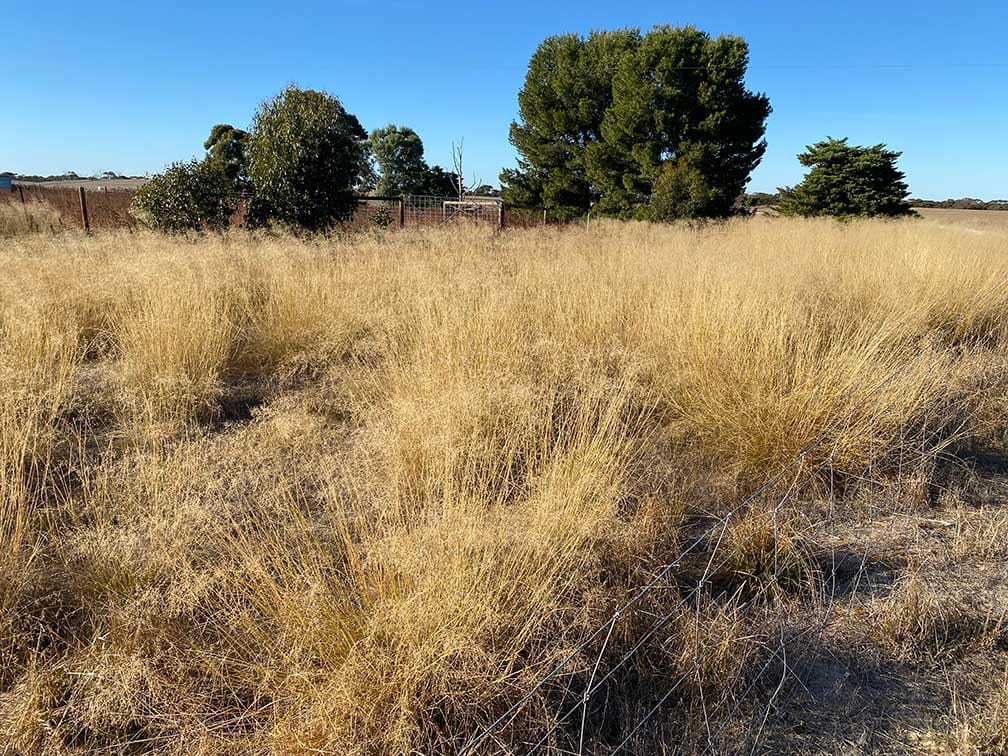
Cr Miles Hannemann says the public needs to be aware of how scary the problem is, and if nothing is done to control the spread of the weed, it will fully invade the district and destroy the agriculture sector.
Lovegrass (Eragrostis curvula) is a long-lived tussock-forming grass usually growing 30 to 120cm tall. It is regarded as a major environmental weed and can form dense stands that crowd out native species and prevent their regeneration.
Via a factsheet on its website, the Limestone Coast Landscape Board, which is mandated to reduce the impact and spread of this invasive grass in the region’s agricultural industry and the environment, said the weed’s impact was significant.
Cr Hannemann moved a motion during the council’s recent meeting to save the Limestone Coast’s agriculture industry from the invasive grass.
“I flagged this weed with the NRM Board approximately 10 years ago, which fell on deaf ears,” he claimed.
“The weed was easily controllable then. It is still and must be controlled, but now it is a huge task,” Cr Hannemann said.
He claimed the spread has gone beyond the scope of the local landscape board and is now the job of the environment minister.
“Two years ago, there were few plants on the freeway, but it is all the way to the toll gate.
“The paddocks around the Dukes Highway are scary, and we weren’t like this a few years ago.
“The problem with the weed is that people don’t identify it early, and when they know what it is, it has taken over.
“I have found it in my garden and scrub recently, and neither have had stock or been cropped, so how did it get there?
“I believe it must float in the air.”
Cr Hannemann claimed he recently had a chat with a landowner, and the issue has become such a problem on their farm that they have had to change from sheep to cattle.
“That is very scary. The reason I moved the motion was to save Tatiara and Limestone Coast agriculture future.
“The Landscape South Australia Act 2019 says you can’t sell products with lovegrass seed in it.
“At the moment, I believe people would be getting love grass in the seed and hay they purchased.”
He said he was not having a go at the Limestone Coast Landscape Board but was trying to get it on the radar of people who could provide financial help and possible manpower to spray it.
“Perhaps we could get prisoners from Mobilong Prison. This could be a source of people’s power to help.
“If this was a bushfire, we would be throwing all resources at it before it got worse.
“I, as a farmer at Keith, believe this is the biggest problem I have faced in my agriculture life. It just turns up at places where you least expect it and wonder how it got there.”
His motion that the council CEO meet with the Limestone Coast Landscape Board to discuss the issues was passed with unanimous support.
Responding to questions from this newspaper, Limestone Coast Landscape Board operations manager Mike Stevens said the lovegrass is declared a priority weed in the upper Limestone Coast, and the board was working in a number of ways to control the weed and reduce its spread.
“The agricultural impact of African lovegrass in the region is significant with the hardy perennial weed producing large, unpalatable tussocks that have low nutrition value to livestock and displaces productive plants in pastures and can create a fire hazard,” Mr Stevens said.
He said collaboration with the community was key to containing infestations in the Upper South East and preventing further spread in the lower region.
“African lovegrass is a high priority pest plant for the LC Landscape Board and PIRSA and together we have invested over $200,000 in this priority weed in the northern part of the region since 2021.
“We are methodically and carefully controlling the declared weed as we do not want to promote chemical resistance which could have disastrous consequences to the region.
“This is why we have invested in a demonstration control site to investigate control options, test for chemical resistance in our region and apply a diversity of control strategies on roadsides and provide advice to landholders.”
The board has recently invested in new fit-for-purpose weed spraying units and has employed three field officers dedicated to pest control.
According to Mr Stevens, the board has been controlling the weed on roadsides and working with affected landholders for a number of years as part of an African Lovegrass Control Program.
This article appeared in the Naracoorte Community News.