


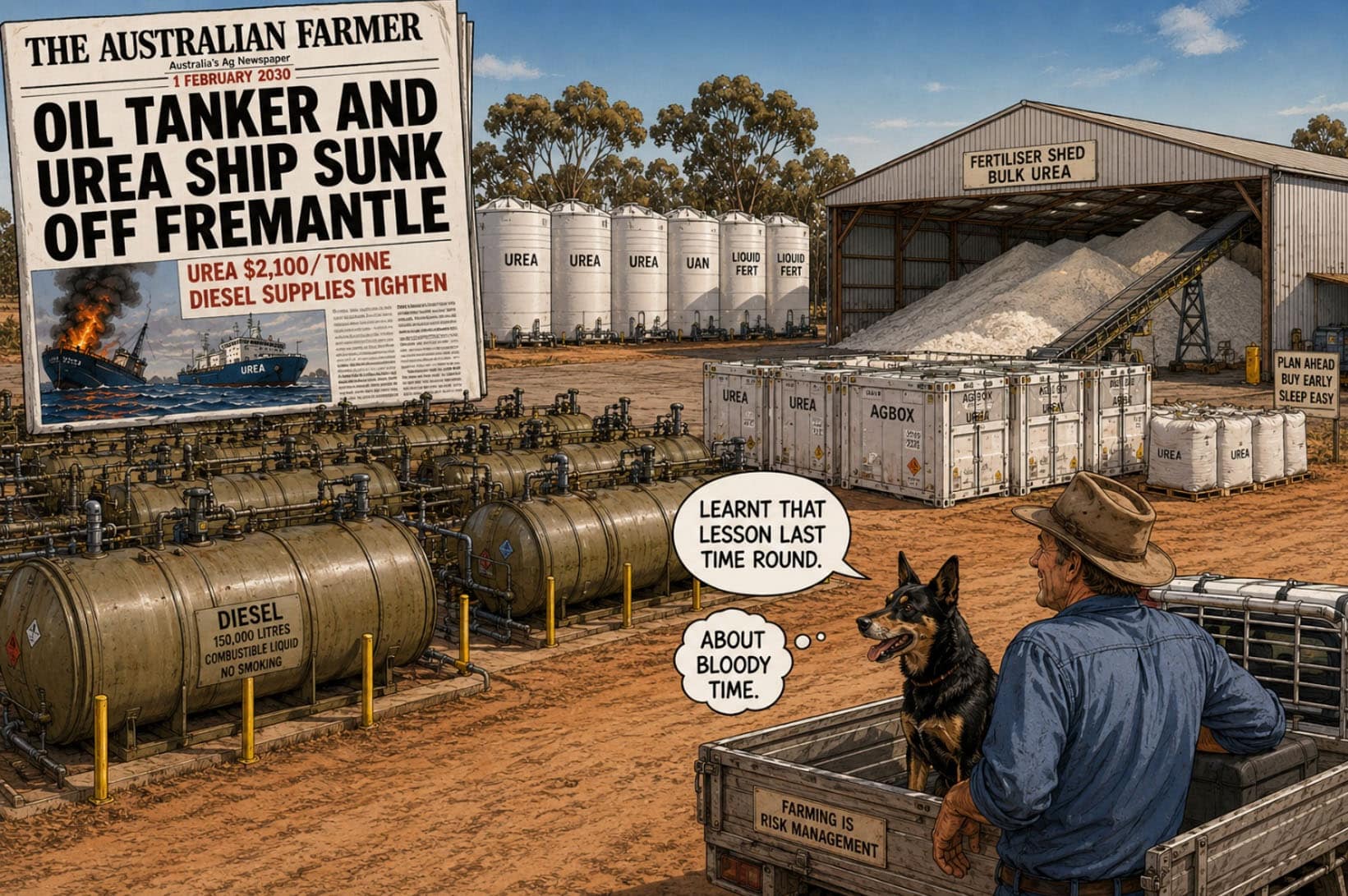
On writing this, urea had slipped back below $1,000 a tonne and oil had fallen under US$90 a barrel. The headlines had moved on, the politicians were congratulating themselves, and the market was once again telling us that everything was under control. Problem solved. Move along. Nothing to see here.
Except that is exactly what people said after the last fertiliser shock, and the one before that, and the one before that.
A few months ago I wrote an article tracing the history of fertiliser shocks through the major conflicts of the modern era. The point I was making was not that the latest Middle East crisis was unique. Quite the opposite. Fertiliser markets have a remarkably consistent habit of reminding us that they are not really fertiliser markets at all. They are energy markets, shipping markets and ultimately geopolitical markets. Every major fertiliser shock of the last 70 years has had its roots in a war, an energy crisis, a trade disruption or some government deciding that normal market rules no longer apply.
The 1973 Yom Kippur War was probably the classic example. Egypt and Syria attacked Israel, the Arab oil embargo followed, oil prices exploded and fertiliser prices followed them higher. Then came the Iranian Revolution in 1979 and almost immediately the Iran-Iraq War in 1980. Eight years of conflict sitting astride one of the world’s most important energy corridors. Then the Gulf War. Then the Iraq invasion. Then the Arab Spring. Then ISIS. Then Russia and Ukraine. Then the Red Sea attacks. Then Iran again. The names change. The flags change. The politicians assure us every crisis is unique. Yet the outcome is remarkably familiar. Oil jumps. Gas jumps. Freight jumps. Fertiliser jumps. Farmers pay the bill.
What interests me today is not the latest crisis itself. It is the lesson hiding behind it. Because while fertiliser prices may have eased and oil may have retreated, the underlying risk has not gone away. In many ways it has become larger, cheaper and far more difficult to contain.
The mistake many commentators are making today is assuming the latest conflict is simply another Middle East flare-up. I am not convinced that is what is happening. What I think we are witnessing is something much more significant. The cost of disrupting global trade has collapsed.
For most of modern history, if a country wanted to threaten shipping it needed a navy. Usually a very large navy. Battleships, destroyers, submarines, aircraft, trained crews, logistics networks and billions upon billions of dollars. The ability to project power at sea belonged almost exclusively to major powers. Britain could do it. America could do it. Imperial Japan had a crack. Russia thought it could do it. China would like to do it. Most countries could not.
Today we are learning a very different lesson. We have watched Ukrainian engineers turn what were once hobby aircraft into precision strike weapons capable of hitting targets hundreds of kilometres away. We have watched Houthi rebels operating from one of the poorest countries on earth disrupt one of the world’s busiest shipping routes. We have watched Iran force the United States Navy to retreat 1000 km from the Red Sea to protect itself against relatively cheap missiles and drones. The economics have become completely inverted.
The attacker is no longer spending millions while the defender spends thousands. The attacker is spending thousands while the defender spends billions. A drone costing less than a ute, can force the diversion of a vessel carrying cargo worth hundreds of millions of dollars. A missile costing tens of thousands can trigger military responses costing millions. The Houthis did not need to sink every ship entering the Red Sea. They only needed to convince ship owners, insurers and freight companies that they might.
That is the real revolution. The weapon itself is almost secondary. What has changed is the accessibility of the technology. Engines, electronics, GPS guidance, satellite communications and explosive payloads are no longer the exclusive preserve of major powers. A determined insurgency, extremist movement or rogue state no longer needs a blue-water navy to create global disruption. It simply needs enough capability to convince the market that the risk has become unacceptable.
That distinction matters because for decades military planners, governments and commodity markets have focused on geographical choke points. The Strait of Hormuz. The Suez Canal. The Bab el-Mandeb. The Strait of Malacca. More recently the Taiwan Strait and the South China Sea. The assumption was always that if these critical gateways remained open, global trade would continue to function.
Increasingly that assumption looks outdated.
The problem is no longer confined to a handful of narrow waterways. The problem is that vessels may be vulnerable almost anywhere.
A fertiliser ship leaving Qatar can be targeted long before it reaches the Strait of Hormuz. An oil tanker departing Singapore can face threats in the middle of the Indian Ocean. A bulk carrier carrying grain from Australia can encounter risk thousands of kilometres from any recognised conflict zone. The battlefield is slowly expanding from a series of strategic choke points to anywhere anytime.
The market understands this even if politicians do not. Insurance companies certainly understand it. The owners of ships understand it. Freight operators understand it. You do not need to sink many vessels to disrupt global trade. You simply need to convince insurers to raise premiums, ship owners to reroute vessels and freight companies to build additional risk into their pricing models. The Houthis demonstrated this perfectly. They did not close the Red Sea. They simply made it expensive enough that many operators chose to avoid it altogether.
For agriculture this matters enormously because modern farming is built upon global supply chains. The diesel in the tractor, the urea in the spreader, the chemicals in the spray rig and many of the parts required to keep machinery operating all arrive through those same shipping networks. We often talk about supply chains as though they are abstract concepts discussed by economists and politicians. They are not. Every tonne of urea spread across a paddock and every litre of diesel burnt during seeding begins its journey on a ship somewhere in the world.
That is why I believe many people are drawing the wrong conclusion from the recent easing in oil and fertiliser prices. The lesson is not that the system proved resilient, prices spiked and then settled. The lesson is that the system remains remarkably vulnerable. The market got through this disruption. The next one may be larger. The one after that may involve actors with better technology, longer range and fewer inhibitions about using it.
History suggests this is not a temporary phenomenon. Human beings have been remarkably consistent in their willingness to wage war. Depending on how one counts them, historians estimate there have been hundreds of interstate wars and thousands of armed conflicts since the late eighteenth century. The period after the Second World War is often described as unusually peaceful, yet even that supposedly peaceful era delivered Korea, Vietnam, the Arab-Israeli wars, the Iran-Iraq War, the Gulf Wars, Afghanistan, Ukraine and countless regional conflicts that most Australians could not locate on a map until they suddenly started affecting fuel prices.
The point is not that every conflict causes a fertiliser shock. The point is that enough of them do that farmers should treat geopolitical risk as a normal business risk rather than an exceptional event. Looking back over the last 50 years, the question is not whether conflict has periodically disrupted energy and fertiliser markets. The question is why anyone would assume it will stop.
Take the Iran-Iraq War. Between 1980 and 1988 the two countries fought one of the bloodiest wars of the twentieth century. During the so-called Tanker War phase, both sides targeted commercial shipping in the Persian Gulf. Hundreds of merchant vessels were attacked. Insurance premiums surged. Freight costs increased. Governments intervened. Sound familiar? The technology has changed, but the underlying problem has not. The world remains heavily dependent on a relatively small number of shipping routes and a relatively small number of energy-producing regions.
What is different today is that the barriers to entry have collapsed. During the 1980s, disrupting shipping required aircraft, missiles and nation-state resources. Today the same disruption can be achieved by actors with vastly fewer resources. The Houthis have demonstrated it. Ukraine has demonstrated it. Iran has demonstrated it. The uncomfortable reality is that future disruptions may come not from superpowers but from second-tier powers, failed states, insurgent movements or extremist groups looking to create economic chaos at relatively low cost.
That should force us to rethink the way we view risk. Most farm businesses spend considerable time thinking about rainfall risk, frost risk, commodity risk and interest-rate risk. Yet few spend much time considering geopolitical risk despite the fact that a conflict on the other side of the world can double the cost of fertiliser, send diesel prices soaring and completely alter the economics of a cropping program. The events of the past three months should be a reminder that the world remains a far more connected and far less stable place than many of us would like to believe.
What farmers should take from all this is not panic, but realism. The lesson of the last three months is exactly the same lesson as the last 50 years. When supply chains are functioning normally, fertiliser is available. Fuel is available. Freight works. Everybody assumes it always will. Then a conflict starts somewhere most people could barely find on a map a month earlier and suddenly everyone is scrambling for product. Governments panic. Markets reprice. Suppliers invoke force majeure. Politicians hold press conferences. Farmers ring around looking for fertiliser and fuel that no longer seem quite as available as they were last week.
If there is one practical lesson from all of this, it is that farmers should treat fuel and fertiliser security the same way they treat rainfall risk. Nobody knows exactly when the next shock will arrive, but history suggests it will arrive. The farmer who locks in supply early, has product physically on farm before heading away after harvest, and views storage as an insurance policy rather than a cost will probably sleep a lot better than the one assuming the market will always provide exactly what he needs exactly when he needs it.
The last three months have not been an aberration. They have been a reminder.
Somewhere tonight, in a workshop, bunker, shed, garage or military compound, somebody is bolting together the next cheap drone, the next missile, the next weapon that will be used to disrupt a shipping lane, close a port or send insurers and freight markets into a panic. The next fertiliser shock is probably already under construction.
The only uncertainty is where it happens next, and whether farmers have learnt anything from the last one.

