


AgriFutures Australia, Media Release, 24 September 2025
The Australian industrial hemp industry is rapidly evolving, supported by legislative reforms, growing consumer interest, and increasing research into hemp’s agronomic potential. The industry is gaining momentum yet still faces challenges in identifying the most suitable varieties and agronomic practices for different Australian regions. To address this knowledge gap, the Industrial Hemp Variety Trials (IHVT) were initiated to provide independent, regionally specific data on hemp variety performance.
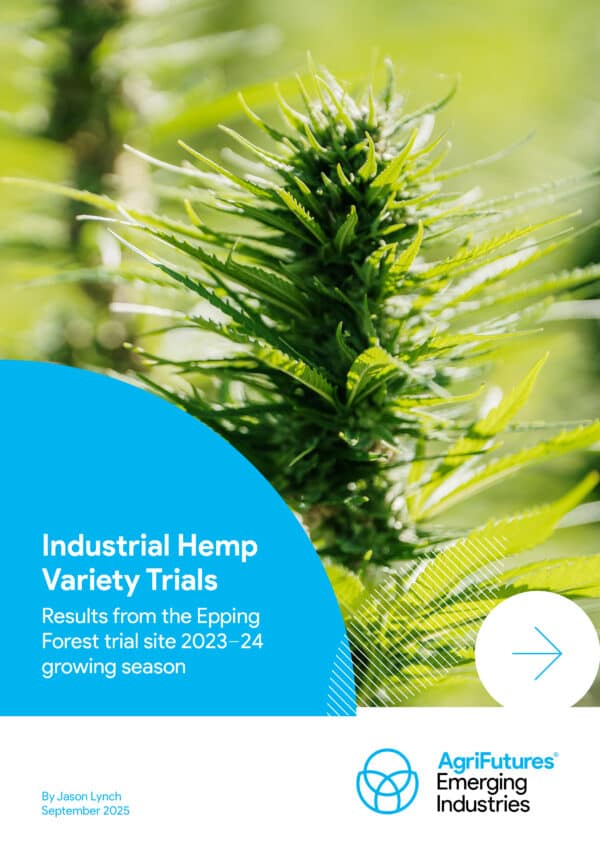
This report presents the findings from the 2023-24 IHVT conducted at Epping Forest, Tasmania, marking the third year of trials in the region. The trial evaluated nine varieties of industrial hemp under two sowing times, with a focus on grain and biomass production. The need for this work is clear: growers require reliable data to optimise crop yields, improve quality and select varieties that are well-suited to Tasmanian conditions. Inconsistent seed quality, delayed sowing and variability in plant performance continue to limit the industry’s expansion.
Key findings from this year’s trial reaffirm the importance of sowing timing, with late-spring sowing producing significantly better results in plant height, biomass and grain yield compared to early summer sowing. Varieties such as ECO-Excalibur, CRS-1 and Katani showed strong performance across multiple metrics, offering promising options for growers. Importantly, all varieties remained compliant with the legal tetrahydrocannabinol (THC) threshold for industrial hemp in Tasmania.
The trial recommends that growers aim for late-spring sowing, use high-quality seed with verified germination rates and target a plant density of at least 150 plants/m². For growers, the key takeaway is clear: timing, seed quality and variety selection are critical for maximising the productivity and viability of industrial hemp crops in Tasmania. Continued investment in variety evaluation and agronomic research is essential to support the growth and sustainability of the emerging industry.
This project was funded by AgriFutures Australia and the Department of Natural Resources and Environment Tasmania with support from the Tasmanian Hemp Association and industry partners.
This project was completed as part of the AgriFutures Emerging Industries Program, which aims to help emerging industries in Australia grow and reach new markets. For more information and resources, visit agrifutures.com.au/our-industries/emerging-industries.

