

Australia and New Zealand Banking Group Limited (ANZ), Media Release, 11 September 2025
Agriculture investment is evolving globally. Once focused on farmland, today’s investors are targeting entire supply chains. Rising costs and flat land prices are pressuring returns, and the focus is shifting to yield, resilience and ESG-linked income.
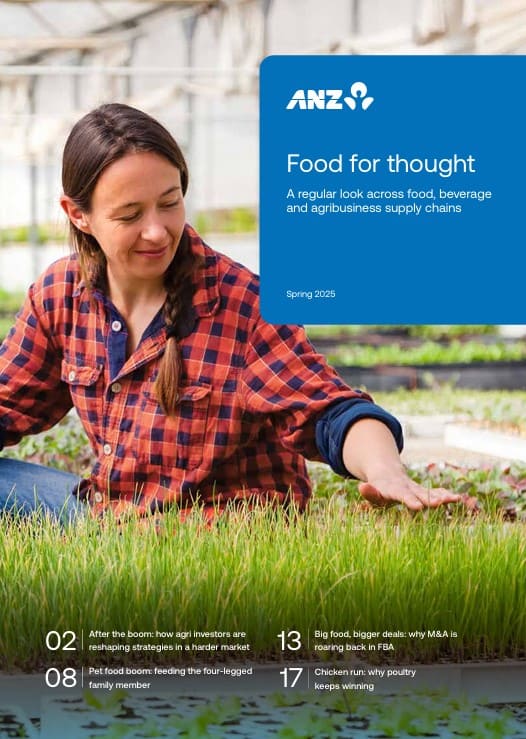
ANZ’s Food for Thought Spring 2025 report explores this transformation, unpacking how what once began as a niche allocation for a handful of early movers has now become part of mainstream real asset strategies.
Following the 2008 food crisis, agriculture emerged as a strategic asset class. Over the past decade, investors –from pension funds to sovereign wealth entities – have poured capital into farmland, water entitlements, and protein supply chains. Australia became a hotspot, with land values rising over 220 per cent between 2010 and 2022.
But by 2024, the landscape changed. Commodity prices softened, input costs remained high, and land appreciation slowed. Investors are now focused on yield, climate resilience, and ESG performance.
By some estimates, global institutional exposure to agriculture – including land, water, infrastructure and natural capital – could exceed $500 billion by 2030. This reflects a broader definition of Agri assets, encompassing not just farmland but supply chain investments and environmental markets.
ANZ Director, Food, Beverage and Agribusiness, James Dunnett, said: “Agriculture portfolios are diversifying. Investments now include storage, logistics, processing, and carbon and biodiversity projects. Investors are increasingly focused on yield and are exploring natural capital – such as carbon and biodiversity projects – as new revenue streams alongside traditional farm income.
“Despite strong global interest, Australian super funds remain cautious, citing liquidity and scale challenges, as well as the need for highly specialised management to run complex Agri portfolios. New models – such as co-investment partnerships and natural capital strategies – may unlock domestic capital.
“Agri portfolios are now broader. For many funds, the play is no longer just land, it is the whole system. Storage infrastructure, processing plants, cold chain logistics and water entitlements are now common in institutional portfolios.
“Agri investing has matured. The future lies in building systems that deliver stable returns, adapt to climate risk, and support global food security,” concluded Mr Dunnett.
Further insights can be found in the Spring 2025 edition of ANZ’s Food for Thought report.