

An artist’s vision for the birds we’ve lost and might yet see again
Joanne Heathcote (ornithologist and conservationist), The Lord Howe Island Signal
“Article reproduced from the August newsletter of the Cumberland Bird Observer’s Club by kind permission of Fiona Lumsden and the CBOC.”
About the artist
Fiona Lumsden is a wildlife artist based in Katoomba. She is passionate about birds, habitats, and the stories that link species and landscapes. Her work aims to foster a sense of belonging and a connection to nature.

In the heart of the Blue Mountains, Fiona has been working quietly and meticulously on a special project that blends ornithology, conservation, and imagination. Known for her intricate wildlife illustrations, Fiona is putting the finishing touches on a new version a “Rewild Imagine edition” – of her previous art poster of the Birds of Lord Howe Island.
The poster doesn’t claim to depict an actual future, rather, it is an “artist’s impression” a blend of reverence and hope: depicting ten past and future bird species that will be nestled amongst the island’s present-day species and their habitats. These future species might one day fill the ecological roles of the lost species and would enrich the Island’s breadth of species.
For Fiona, this project has never been about working in isolation. She feels it’s a collaborative endeavour, shaped by the collective understanding of scientists, conservationists, and bird lovers. As she explains, she builds in other people’s research to give depth to her artwork and likes to acknowledge those connections. An early article by Ian Hutton about the subtleties of Lord Howe Island’s rewilding inspired her deeply. From extinction to imagination, and from imagination to rewilding, Fiona’s poster captures that hopeful cycle.
A cautionary tale and a conservation triumph
Lord Howe Island’s story is well-known to bird lovers. The arrival of black rats in 1918 had devastating consequences, with the extinction of eight land birds, five of which were endemic species, within a matter of decades. The tiny Fawn-breasted Fantail was one of the first to disappear, a casualty of the invasive predators that reshaped the Island’s ecology. The Lord Howe Island Fantail, Gerygone, and Vinous-tinted Thrush are also symbolic of an evolutionary story abruptly halted.
Today, five years after one of the largest pest eradication efforts ever conducted on an inhabited island, the benefits are unmistakable. The forests, beaches, and cliffs of Lord Howe are coming back to life, with native species reclaiming their niches. The Island has become a beacon for conservationists around the world proof that restoration can work when backed by bold planning, long term collaboration, and a hopeful vision for the future.
Rewilding as an ongoing conversation
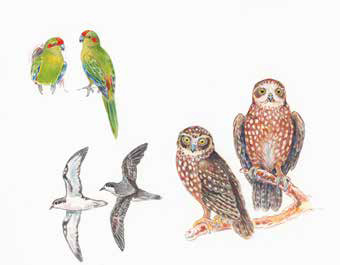
Rewilding is an evolving conversation with countless possibilities, but it is complicated and raises challenging questions about ethics and ecology. Even so, Fiona feels it’s a conversation we must have if we’re to undo some of the damage we’ve caused. Her poster invites birders and conservationists to wonder: could the call of a boobook or the flash of a fantail one day be heard and seen in the mist-clad forests of Lord Howe? Might long absent species find their way home, and new connections between plants, insects, and birds be reshaped? Fiona sees this as a picture of hope a reminder that recovery is an ongoing collaboration between people, wildlife, and the land itself. Fiona’s poster also presents a vision for restoring ecological balance. Each of the now-absent species once played a vital role in holding together the delicate web of life on this small island.
Among the species featured in the poster is the Pycroft’s Petrel a little-known seabird that once bred on Lord Howe and now survives only on islands off New Zealand. Occasional sightings hint at its tentative returns, and conservation efforts including sound playback from nest boxes could be trialled to invite the birds back.
The other species which are no longer extant on Lord Howe Island, but are depicted on Fiona’s new poster are:
- Fantails and Gerygones agile insectivores that kept insect populations in check.
- Starlings and Thrushes seed dispersers and pest controllers that shaped forest regeneration.
- White-throated Pigeons were crucial for dispersing seeds of native fruiting trees and supporting forest recovery.
- Boobook Owl a top avian predator that regulated populations of smaller birds and invertebrates.
- Gallinules and Parakeets grazers that shaped the understory and kept plant dynamics in balance.
Reintroducing these species, or using closely related species when endemics are lost, is about more than adding colour and sound to the forests. It’s about reweaving threads of life that were lost when invasive species arrived, restoring connections between species, habitats, and people. By considering close relatives or “functional analogues” (such as the Norfolk Island Gerygone or the mainland Grey Fantail) a rewilding approach for LHI could mirror the best practices of modern conservation biology. These species can enhance biodiversity and restore the ecological roles once performed by their now extinct counterparts.
A unique opportunity post eradication
With the successful eradication of rats and mice in 2019, Lord Howe is one of the few inhabited islands globally that can consider reintroducing lost species. The Island is poised to reclaim its role as a refuge for unique wildlife making it an ideal setting for a bold, hopeful rewilding project. Already, native birds like the Woodhen and Lord Howe Currawong are rebounding, and the potential for more is palpable.
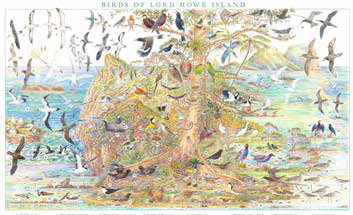
The cultural and educational value of rewilding is deeply important. Rewilding isn’t just about restoring nature it’s about restoring storytelling, heritage, and belonging. For example, the Boobook Owl and Red-crowned Parakeet are threads in the cultural and ecological fabric of Lord Howe Island. Their return would help heal wounds and deepen connections for those who live on and visit the Island.
If implemented thoughtfully, the rewilding of Lord Howe could become a model for future restoration efforts across the Pacific and beyond. It demonstrates that recovery is about more than species counts it’s about reestablishing connections within ecosystems.
Of course, any rewilding effort must be backed by rigorous ecological research, biosecurity, and deep collaboration with the Island’s community. Not every species can or should be reintroduced, and every effort must be balanced with the needs of surviving species and habitats. Rewilding choices should be ecologically meaningful, historically grounded, pragmatic – blending extinct endemics with carefully chosen proxies, timely, making the most of the post eradication moment, and emotionally and culturally resonant. These choices provide a hopeful blueprint for ecological healing, and a reminder that extinction doesn’t always have to be the end of the story. In fact, with vision, collaboration, and care, it can be the starting point for recovery and belonging.
Final thought
For everyone who cares about nature, Fiona’s poster is more than an artwork it’s an invitation. An invitation to imagine, to wonder, and to recognise that an ecological (or full Island) tapestry can be rewoven, one species at a time. In doing so, we create a future where the forests of Lord Howe Island might once again resound with the calls of long absent birds, reminding us of the resilience of nature and our role in nurturing its recovery. Each successful reintroduction can teach us valuable lessons about restoring lost species elsewhere. The benefits would ripple far beyond the shores of this tiny island.

This article appeared in The Lord Howe Island Signal, 31 August 2025.
