


Rabobank, Media Release, 30 July 2025
Annual food price inflation slowed to 3 per cent in the June 2025 quarter, the latest quarterly Consumer Price Index (CPI) data, from the Australian Bureau of Statistics, has shown.
This is down from 3.2 per cent year-on-year food price inflation recorded in the March 2025 quarter.
The easing in food price inflation followed the trend seen in overall headline inflation, which came in at 2.1 per cent on an annual basis, down from 2.4 per cent in the March 2025 quarter.
Inflation in the out-of-home food service category was stable at 2.7 per cent when measured on a yearly basis.
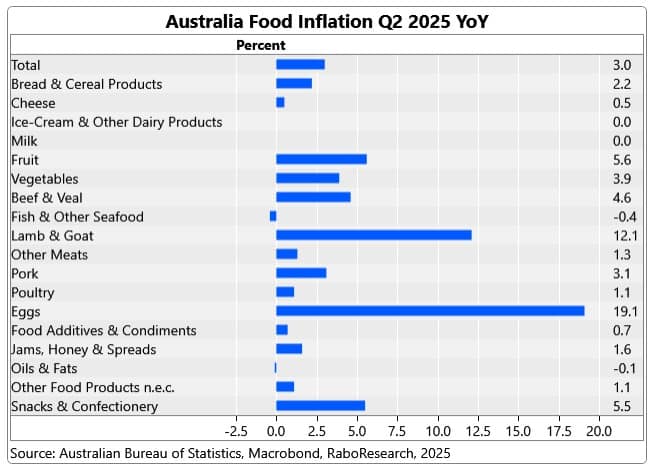
RaboResearch senior food retail analyst Michael Harvey said despite the easing in retail food price inflation seen in the latest quarterly data, food price inflation was still running above the 10-year average, “indicating persistent cost pressures in the food ecosystem”.
In particular, he said, there are some categories which are likely to draw the attention of consumers due to sharp price increases, and these may drive shifts in purchasing behaviour.
“The price of eggs was significantly up, with the rate of price increases accelerating and running at 19.1 per cent higher year-on-year,” he said.
“Consumers will also be watching coffee, with prices increasing annually by 9.4 per cent in the June quarter and this was compared with annual inflation in coffee prices of 3.8 per cent in the previous (March 2025) quarter.”

Mr Harvey said lamb prices were 12.1 per cent higher year-on-year, but the rate of inflation had slowed when compared with the March quarter (19.7 per cent).
Cooking oils, cereal products and seafood were the only three categories to post deflation (price declines) for the quarter on a year-on-year basis.
“But there will be a ‘watch’ on cooking oils for Australian households”, Mr Harvey said, “as this category includes butter, and global butter price are hovering at or near record levels again and likely to put upward pressure on local prices given Australia is a net importer of butter.”
Fruit and vegetable prices rose 4.6 per cent in the 12 months to the June quarter. This was down from a 6.6 per cent annual rise in the March quarter. “This is a sign of more stable seasonal growing conditions,” Mr Harvey said.
Consumers will also be watching the snacking and confectionery category, he said, with prices up 5.5 per cent cent in the past 12 months. This was as chocolate manufacturers passed through higher input costs, in particular cocoa, he said.
Milk and cheese prices were stable following two consecutive quarters of deflation previously.

