


Fulton Trotter Architects, Media Release, 13 December 2024
Aussies still love their local libraries, with recent data from the Australian Public Libraries Statistical Report 2022-2023 showing a rise in borrowing and in-person library visits.
The report, put together by the Australian Library and Information Association (ALIA) and National State Libraries of Australasia (NSLA), indicated Australians borrow an average of six books per year from a public library, and saw a 40 per cent increase in in-person library visits since the lifting of Covid-19 restrictions.

The report also shows the legacy of libraries across the country, as they continue to adapt in the digital age and provide a safe place for connection and belonging.
Award-winning architecture firm, Fulton Trotter Architects has also noticed an increase in community libraries since the lifting of Covid-19 restrictions in 2022-2023. Architect and Director, Katerina Dracopoulos said there has been a rise in library upgrades and refurbishment work as well as design work for new libraries.
“There has been a need for community libraries to adapt and grow and we’ve seen this through our client work with libraries to refurbish and reinvigorate spaces. Historically, the library has been a place where knowledge is sought. Although the format of the exchange of knowledge may have changed, that is still its fundamental purpose. The additional layer that a library must achieve is to create an environment that is welcoming, inclusive and familiar,” Ms Dracopoulos said.
“Though each library is unique, we have noticed libraries often look to add additional amenities such as community centres or meeting rooms to continue to flourish in the digital age and cater for the public’s growing need.”
Recently, Fulton Trotter Architects developed a self-serve library kiosk in a residential suburb development in Port Macquarie to cater for community reading, nestled close to the community’s playground.
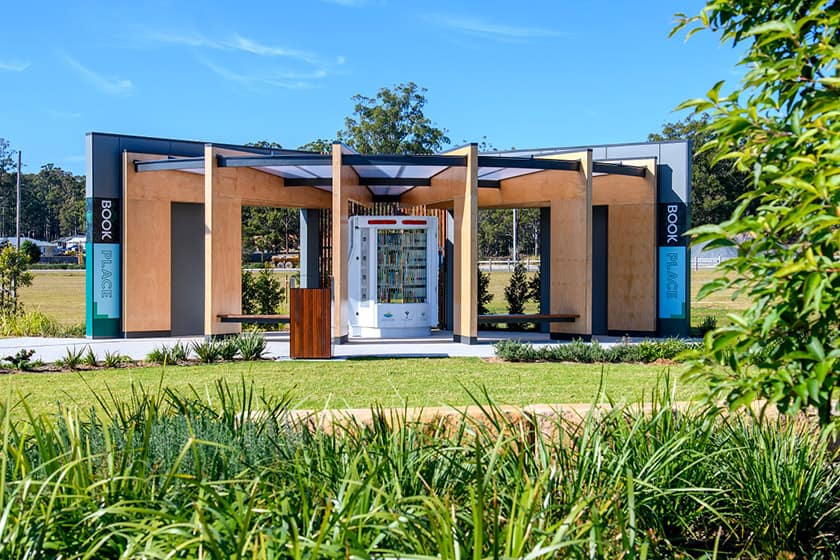
Fulton Trotter Architect Director John Ward said the kiosk was a pop-up social infrastructure project to help service the growing community.
“The library kiosk was inspired by an open book with the accordion design resembling open pages of a book with the kiosk machine inside with seating. The shelter protects the kiosk and readers from the elements and provides a place for residents to reflect and relax outside of their homes,” said Mr Ward.
The Fulton Trotter Architects team has also worked with the Balonne Shire Council, designing the regional library in St George, Southwest Queensland. Director Katerina Dracopoulos said through community consultation, the space had to be inclusive and adaptable.
“This project needed to accommodate a range of needs from quiet reading for older patrons to children’s spaces for parents’ groups, students to study and a dedicated meeting space for community groups, however, the fundamentals of a library remain the same. If a library can create a sense of belonging and people will always be drawn to that,” Ms Dracopoulos said.
Australian Library and Information Association (ALIA) Chair of the Australian Public Library Alliance, Nicole Hunt attributed the success of local libraries to their adaptability as many offer upskilling, workshops and mum’s and bubs groups to engage and serve their communities.
“People come to libraries to meet varied needs. You can see this in the numbers. For example, in 2022-23, public library programs welcomed 6.1 million participants. These statistics are important, but we know they don’t capture everything. These statistics remind us that strong investment in libraries is a strong investment in local communities,” said Ms Hunt.
Experts in design and master planning of social infrastructure, Fulton Trotter Architect’s vast pipeline of completed projects includes Wesley House in Brisbane’s CBD and the recent Queensland Satellite Hospital project across seven locations in South East Queensland.
To find out more visit fultontrotter.com.au or call (07) 3291 1511 or (02) 8383 5151.
About Fulton Trotter Architects
Established in 1937, Fulton Trotter Architects is an enduring architecture and interior design practice with offices located in both Brisbane and Sydney. Working across Australia to create lively and vibrant communities, the practice offers architectural and interior design services ranging from adaptive re-use projects to multi-million-dollar transformations.

