

Buffel grass has been declared a weed and a management plan will now be formalised towards reducing its impact in Central Australia, according to Environment Minister Kate Worden.
She says the Buffel Grass Weed Advisory Committee unanimously recognises in its strategy that areas where buffel grass poses the greatest risk to biodiversity, cultural, and community values should be prioritised for management.
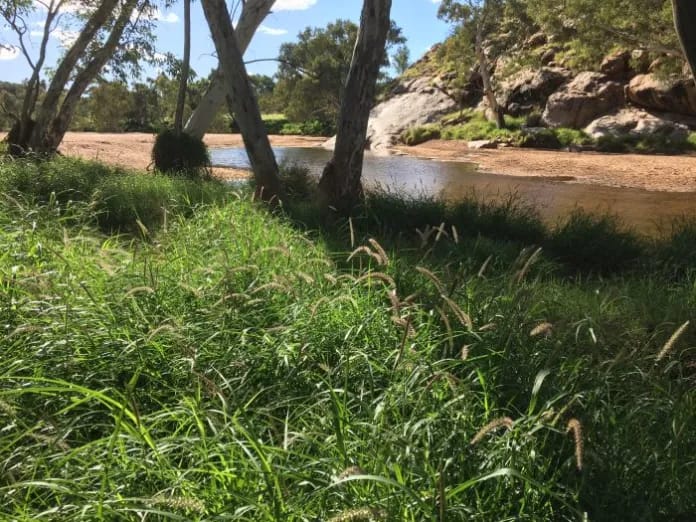
A management plan is due for completion by the end of the year.
The Arid Lands Environment Centre says it welcomes “this historic decision” following “a decades long struggle to confront one of the greatest threats to the arid and semiarid lands.
“Buffel grass is transforming landscapes and changing fire regimes,” says CEO Adrian Tomlinson.
“It is already found in every mainland state and the Northern Territory and has the potential to spread across 68 per cent of the continent.
“In 2014, Federal Government Buffel Grass Threat Abatement Advice was released, in 2015 buffel was declared a weed in South Australia and today the Northern Territory joins the call for national coordination and resourcing.”
Mr Tomlinson says in Budget 2024, $750,000 has been invested into the strategic management of buffel grass. This includes $575,000 for program management, planning and technical services to implement buffel grass management in Central Australia.
The funding also includes $50,000 for a Fire Ready (South) Program to reduce fire risk from buffel, $75,000 for a herbicide program in Central Australia with a focus on community groups, local councils and $50,000 mapping and data analysis.
ALEC policy officer Alex Vaughan says: “Since the 1950s, buffel grass was deliberately planted at scale across Central Australia as a pasture grass and as a dust suppressant for overstocked and degraded lands.
“This moment makes clear that the ongoing proliferation of buffel grass is unacceptable. The arid lands are a site for healthy communities and Country. Our inland rivers, threatened species and sites of ecological and cultural significance must be conserved against the impact of buffel grass invasion.”
Mr Tomlinson says: “I want to acknowledge the wonderful information sharing and advocacy for a response proportional to the threat posed by buffel by the Alice Springs News over many years and pages.”
The [Alice Springs] News has asked the NT Cattlemen’s Association for comment.
The Buffel Grass Management Strategy: Central Australia 2024 – 2030 can be viewed here:https://nt.gov.au/environment/weeds/weeds in the nt/A Z list of weeds in the NT/buffel grass
Quotes attributable to the Minister for the Environment, Climate Change and Water Security Kate Worden:
“The Buffel Grass Management Strategy 2024 2030 provides a pathway forward for the Territory, and most importantly Central Australia, in reducing the impact of buffel grass, particularly in areas of cultural and community value.
“The Committee is a great example of how when we bring together a diverse range of voices and views, we can find manageable ways forward in collaboration with each other and the broader community.
“I am confident this declaration is in the best interests of the broader community – now and into the future.
“The next steps, including maintaining the Committee to inform consultation and provide advice on any future Weed Management Plan and related resourcing needs, I hope provides certainty to all stakeholders and community members that we are invested in managing buffel in a considered manner, on a long term basis.”
Buffel weed declaration:
a win for community organising and the arid lands
The Arid Lands Environment Centre welcomes this historic decision to declare buffel grass a weed across the Northern Territory.
This has been a decades long struggle to confront one of the greatest threats to the arid and semi arid lands. Buffel grass is transforming landscapes and changing fire regimes. It is already found in every mainland state and the Northern Territory and has the potential to spread across 68 percent of the continent. In 2014, Federal Government Buffel Grass Threat Abatement Advice was released, in 2015 buffel was declared a weed in South Australia and today the Northern Territory joins the call for national coordination and resourcing.
Over 50 Central Australian organisations across culture, health, tourism, land management, unions and environment called on the Northern Territory Government to decare buffel grass a weed.
This is significant political recognition that is a win for community organising. Just last weekend, 29 June 2024, Name Arrwengkelthe (grass sickness): how to heal country and stop the spread of buffel grass took place at Olive Pink Botanic Gardens, attended by over 300 concerned Central Australians including key advocates and various senior knowledge holders.
The program included a panel with Garth Forrester (CLC), Roni Opden (Weeds Branch), Chris Day (Senior Director Parks), Paddy Laughton (Stride Resources), Tracey Guest (DCCEEW), Alex Vaughan (ALEC) and Cherisse Buzzacott as MC. Veronica Dobson AM, Camille Dobson, Amunda Gorey, Peter Latz and Doug McDougall presented on deep ecological and cultural frames for caring for the central deserts.
Quotes – Adrian Tomlinson CEO Arid Lands Environment Centre
“This is historic and the result of decades of struggle to conserve and care for the arid lands.
This is a significant win for community organising in Central Australia.”
Quotes – Alex Vaughan, Policy Officer, Arid Lands Environment Centre
“Buffel grass smothers and burns entire landscapes here in the central deserts. It is an existential threat to the arid lands, changing fire regimes, transforming landscapes and impacting at least 31 threatened species nationally. Buffel grass impacts culture, bushfoods, bush medicines, public safety, public health, social wellbeing, the tourism industry and biodiversity conservation.
“Buffel grass is already found in every mainland state and the Northern Territory, it has the potential to spread up to 68 percent of this continent. National coordination and resourcing is essential, which must include a Weeds of National Significance listing. If Tanya Plibersek is serious about no new extinctions, a national plan to abate the buffel grass threat must be an urgent priority.
“This is a vital opportunity to turbocharge research solutions at the landscape scale. It is a national travesty that we still do not know how to properly manage the buffel grass fire threat. The spread of buffel grass has continued at an exponential rate across the arid lands, and decades have been lost, but it’s not too late. Lets work together to stop the spread of buffel grass across the arid lands.”
“Since the 1950’s, buffel grass was deliberately planted at scale across Central Australia as a pasture grass and as a dust suppressant for overstocked and degraded lands. This moment makes clear that the ongoing proliferation of buffel grass is unacceptable. The arid lands are a site for healthy communities and Country. Our inland rivers, threatened species and sites of ecological and cultural significance must be conserved against the impact of buffel grass invasion.
“This decision by the Northern Territory Government is legislation catching up to on ground land management experience that buffel grass is a weed and needs to be urgently managed. Let’s work together to care for the arid lands and address this key threat.”
This article appeared on Alice Springs News on 5 July 2024.

