

Forest & Wood Communities Australia (FWCA), Media Release, 10 April 2026
FWCA Chair Steve Dobbyns warns hidden cost pressures are overwhelming regional industries.
Forest & Wood Communities Australia (FWCA) is warning that recent fuel relief measures are failing to deliver meaningful impact for regional industries, as underlying diesel costs continue to rise sharply across the supply chain.
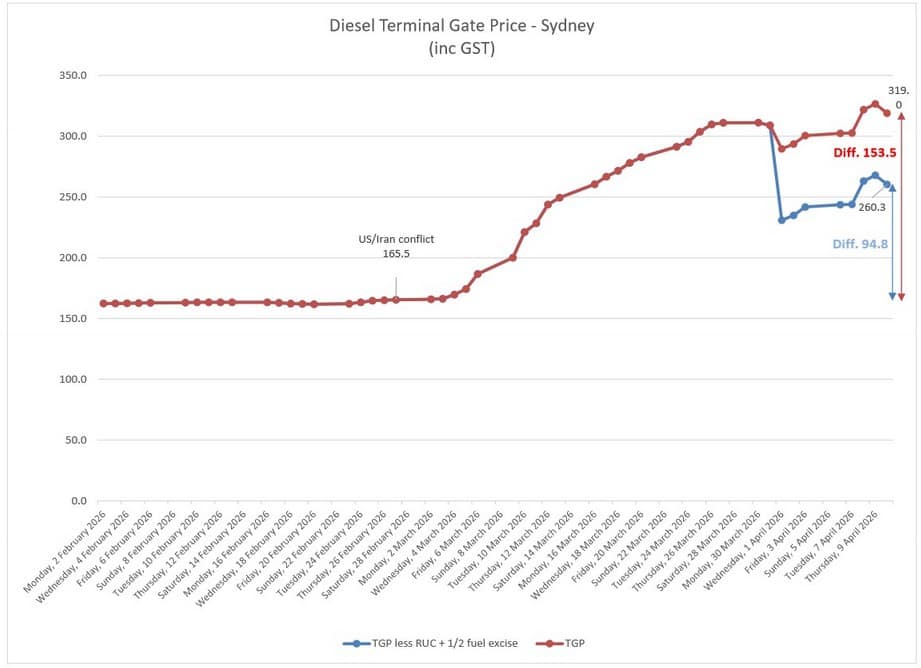
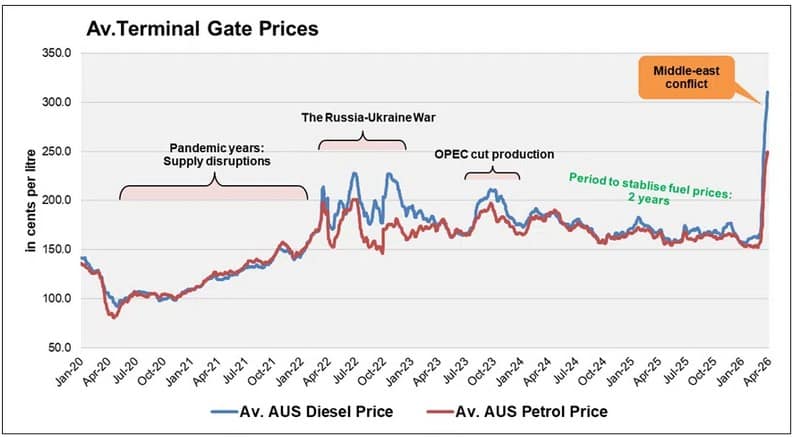
Whilst welcoming the Albanese Government’s decision to halve the fuel excise and scrap the Heavy Vehicle Road User Charge for three months, FWCA Chair Steve Dobbyns said the reality on the ground tells a very different story.
“Despite promised savings of 58.7c at the bowser, diesel users are seeing prices surge to highs of $3.39/l in regional areas,” Mr Dobbyns said.
“Even with the removal of the RUC and halving the fuel excise, the Terminal Gate Prices are still almost a dollar more than before the US-Iran conflict began. Operators need to find that from somewhere and they need to find it now, not just claim it back at BAS time. By then, it will be too late for some.”
FWCA said wholesale diesel prices, reflected in terminal gate pricing, have surged dramatically since the onset of the conflict, with some markets jumping from around $1.60/L to over $3.00/L in a matter of weeks.
“These are the real costs driving the system,” Mr Dobbyns said.
“Terminal gate prices set the baseline for everything that follows – freight rates, contractor pricing, machinery operation and ultimately the cost of getting timber, food and goods to market.”
FWCA reiterated concerns it has consistently raised throughout the fuel crisis – that focusing solely on pump price relief ignores the broader cost environment facing diesel-reliant industries.
“We’ve said from the outset this isn’t just about what you pay at the bowser. It’s about the full cost stack.”
Across forestry, farming and freight, businesses are now absorbing:
- Rising freight and haulage costs as contractors factor in fuel volatility
- Increased machinery operating expenses across harvesting and transport
- Higher parts, servicing and equipment costs linked to global supply pressures
- Escalating contractor rates as fuel risk is priced into every job
FWCA noted that even where tax relief is applied, these compounding pressures are quickly offset before any meaningful savings reach operators.
“There is a clear disconnect between policy announcements and what’s actually being experienced at the bowser in regional Australia,” Mr Dobbyns said.
“By the time relief filters through, it’s already been absorbed by higher wholesale pricing and flow-on costs across the supply chain.”
For regional industries operating on tight margins, FWCA warns the situation is becoming unsustainable.
“Forestry, farming and freight don’t have the ability to simply absorb these increases. These are essential industries — and they’re being squeezed from every direction.”
FWCA is calling on the Federal Government to expand its response beyond temporary tax relief and address the full economic impact of the diesel crisis.
“We need a response that reflects how these industries actually operate – where fuel is embedded across every part of the supply chain, not just the pump price.”