

Department of Agriculture, Fisheries and Forestry (DAFF), Media Release, 8 July 2025
An Asian hornet’s incredible compound eyes, the distinct ventral spine of a mottled shieldbug and the diamond-like bling of a polished green stink bug are among remarkable high-resolution images now bolstering Australia’s biosecurity system.
The Department of Agriculture, Fisheries and Forestry recently added high-tech digital stacking capabilities to its laboratory imaging set-ups, to photograph tiny pests with deeper depth of field than ever before, and without any loss of clarity.
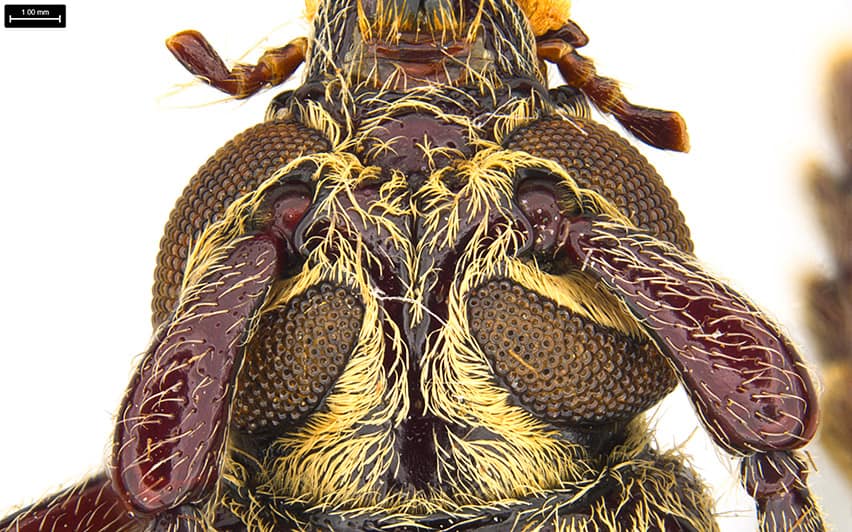
The improved imaging capability is a part of efforts to modernise the department’s diagnostic laboratories, known as the Modern Technologies and Diagnostic Tools (MTDT) program.
Exceptional high-resolution images of stink bugs, wasps, and other pests are generated by the sophisticated microscope and camera system and will be shared to a national reference Pest and Disease Image Library (PaDIL), in a major advance for diagnostic labs.
Entomologists and frontline biosecurity personnel use PaDIL to identify and distinguish pests and diseases of national agricultural and environmental concern from similar-looking innocuous species. The redevelopment of PaDIL by Plant Health Australia (PHA) was funded by the department.
Maintained and administered by PHA, the PaDIL system costs are shared by the Australian and state and territory governments.
In November 2021, the National Biosecurity Committee endorsed PaDIL as an asset or infrastructure of strategic national importance to biosecurity.
Deputy Secretary for Biosecurity, Operations and Compliance Group, Justine Saunders APM, said the improved imaging capabilities allow more images to be contributed to important national diagnostic tools like PaDIL.
“PaDIL is a valuable resource for diagnosticians across the country to access high-quality, diagnostic images of pests and diseases,” Ms Saunders said.
“It is used by a variety of stakeholders including biosecurity officers and our diagnosticians.
“Access to these images will significantly improve biosecurity outcomes by making it easier and faster to identify pests found at the border.
“We have been building an impressive collection of high-resolution images for the national reference database.
“The visuals are quite striking, and it demonstrates a tangible outcome of the MTDT funding in strengthening our national diagnostic resources.”