


La Trobe University, Media Release, 10 June 2025
Researchers from La Trobe University in Bendigo have developed an innovative recycling solution for synthetic bale twine, helping to address the growing problem of agricultural waste.
In a study published in the journal Recycling, the research team analysed the thermal, physical and mechanical properties of various plastic waste materials to determine the optimal temperature to process them using a groundbreaking, cost-efficient melting machine developed by partner company Ritchie Technology (Rtec™).
Bale twine – a strong plastic cord used to bind hay, straw and other crops – has long posed a recycling challenge due to contamination from soil, animal waste and other residues.
Until now, most twine has ended up in landfill or been burned on farms, contributing to environmental pollution.
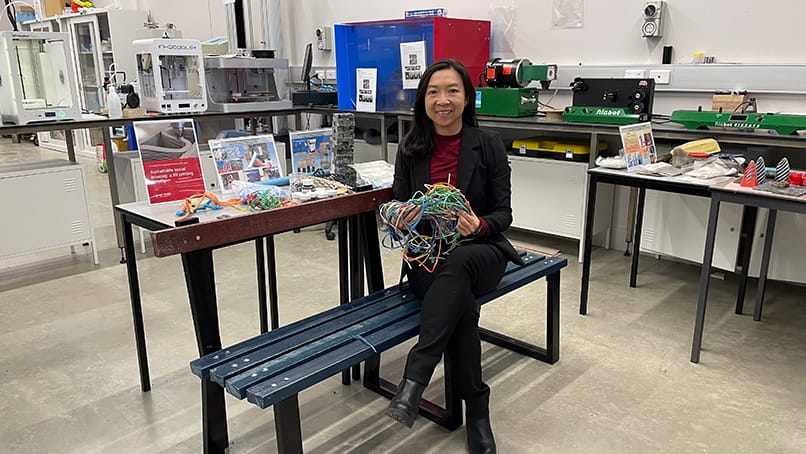
Lead researcher Associate Professor Ing Kong said the team had developed a closed-loop recycling system to give second life to plastic farm waste.
“We successfully demonstrated that bale twine can be efficiently melted and reformed into useful, durable products such as garden planters, outdoor furniture and construction materials like decking or fence posts,” Dr Kong said.
“Not only does this work provide an environmentally friendly solution for reducing agricultural plastic waste, but it highlights opportunities to build a sustainable circular economy in Victoria. Beyond its direct environmental impact, it could potentially influence industrial practices by providing scalable, low-cost recycling solutions.”
The Rtec melting machine is compact, affordable and designed for on-farm use, offering a local recycling solution that could help cut plastic waste disposal costs for farmers.
Richie Technology founder and Chief Executive Officer Dr William Richie said the product was a “triple win” for the agricultural sector, the environment and the economy.
“This new technology offers a cost-effective economic and environmental solution to tackle mounting piles of agricultural plastic waste,” Dr Richie said.
“It will give farmers the tools to reduce their ecological footprint, cut their waste disposal costs, while offering the added benefit of potentially selling recycled plastic material back to manufacturers.”
Globally, the agricultural industry uses millions of kilometres of bale twine annually.
The team hopes to scale up its initiative for a broad range of applications that could be adapted for other plastic waste streams like silage wrap or irrigation tubing, which could lead to greater long-term environmental and economic benefits.
The joint project between La Trobe University and Ritchie Technology was supported by a $145,000 grant from the Victorian Government’s Circular Economy Markets Fund delivered through Sustainability Victoria.
La Trobe is committed to sustainability, with Victoria’s largest urban solar farm in Bundoora, north of Melbourne, and an ambitious goal to be carbon neutral by 2029.

