

Brown & May Marine (BMM), Media Release, 24 July 2024
Australia’s fledgling offshore wind farm sector can learn from the successes and mistakes of the UK, says an expert with a quarter century of hands-on experience in fishing and the last dozen advising offshore oil, gas and renewables industries.
John Watt, Brown and May Marine’s Senior Fisheries Expert, was invited as a keynote speaker at this month’s Offshore Windtech Summit in Melbourne, the Asia Pacific’s largest wind energy gathering. Brown and May Marine, part of the global RSK Group, is based in the UK where offshore wind infrastructure has been steadily growing since 2000.
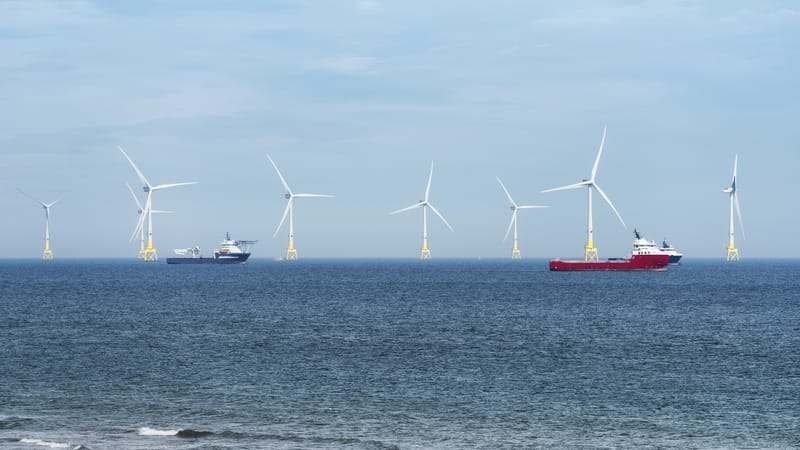
John said Australia can gain insights and tap into mitigation measures thanks to experience from the UK and European offshore wind industry, which in several areas is already showing positive signs of co-existence with commercial and recreational fishing activities.
“Many fishing activities are similar in Australia and the UK. Australia can take advantage of the experience and lessons learned from existing projects” John says. “Developers should consult with the fishing industry from the early stages so that fisheries concerns can be accounted for from the start. Understanding how the fishing industry operates, how important the area is to active fisheries, and what fishing gear is used is critical to facilitate co-existence. In addition, fishermen have a wealth of knowledge about seabed conditions and can provide useful feedback and input to projects – they are well aware of what is on the seabed before developers do survey work.”
Collaborating with the fishing industry can lead to better outcomes for both parties. For example, discussions can help work out the optimal burial depth for underwater cables and identify areas unsuitable for wind farms due to seabed conditions.
The type of wind farm design – floating or fixed – also plays a critical role. In the case of fixed bottom wind farms, there are good prospects for co-existence provided cables are buried and there is sufficient space between turbines. There is increasing evidence of fishing taking place within some UK fixed bottom projects both with static and mobile fishing gear. For floating projects, early fishing trials undertaken in one of the operational floating sites in Scotland, suggest that there is potential for some fishing methods to be able to operate within floating wind farms. The focus of these trials to date has been on static gear methods. Co-existence between floating wind farms and mobile fishing gear is expected to be more challenging. It will be important for each project to understand what fishing activity is in the area and how compatible it could be with the project design.”
“Engaging in early discussions is important to help identify potential mitigation options,” says Watt. “Small changes, like adjusting the wind farm’s boundaries or slightly moving turbine locations to accommodate fishing, can make a big difference for fishers.”
As for Australia, the Federal Government has set up a regulatory framework for offshore wind projects, recognising the nation’s abundant offshore wind resources. States and the Northern Territory manage coastal water activities to three nautical miles; beyond that the Commonwealth is responsible. There are three declared offshore wind areas and four more proposed in Australia, but no site has yet obtained a transmission and infrastructure licence.
Watt says: “Offshore wind generation is a new industry in Australia, but there is a wealth of knowledge and experience from existing projects elsewhere on how to address potential issues. Australia can learn from other projects and avoid those unexpected challenges.”
About Brown & May Marine
Brown & May Marine (BMM) is an RSK Group company specialising in the provision of commercial fisheries consultancy services to the offshore industry with a strong focus in offshore renewable projects. They are industry leaders in this field having provided services in connection with over 100 offshore wind farm projects across Europe and globally, BMM have an extensive track record in the development of successful strategies to minimise interactions and conflict between commercial fishing and offshore activities. They are experienced across all project phases, from early advisory services at the bidding stage to day-to-day management of fisheries issues during the operational phase of projects. The company aims to facilitate co-existence with the fishing industry whilst minimising risks to projects.
About RSK”¯
RSK (www.rskgroup.com) is a global leader in the delivery of sustainable solutions. Its family of”¯more than 200 environmental, engineering, and technical services businesses and 12,000 employees works together to provide practical solutions to some of the greatest challenges societies have ever faced.”¯”¯
”¯”¯
The company operates in most sectors of the economy, including many of those most critical to future global sustainability, such as water, energy, food and drink, infrastructure, urban development, mining, and waste. With its integrated offering across research and development, consultancy, and on-the-ground application, RSK can deliver a complete solution that is unrivalled in the market.”¯”¯
”¯”¯
The company is certified to the ISO 9001, ISO 14001 and ISO 45001 international standards for quality, environmental management and health and safety management.”¯”¯