

Buybacks have begun as the Federal Government seeks to add to the huge volumes of held environmental water. A deal last year with the Greens saw the Restoring the River Bill pass, removing social and economic protections for basin communities.
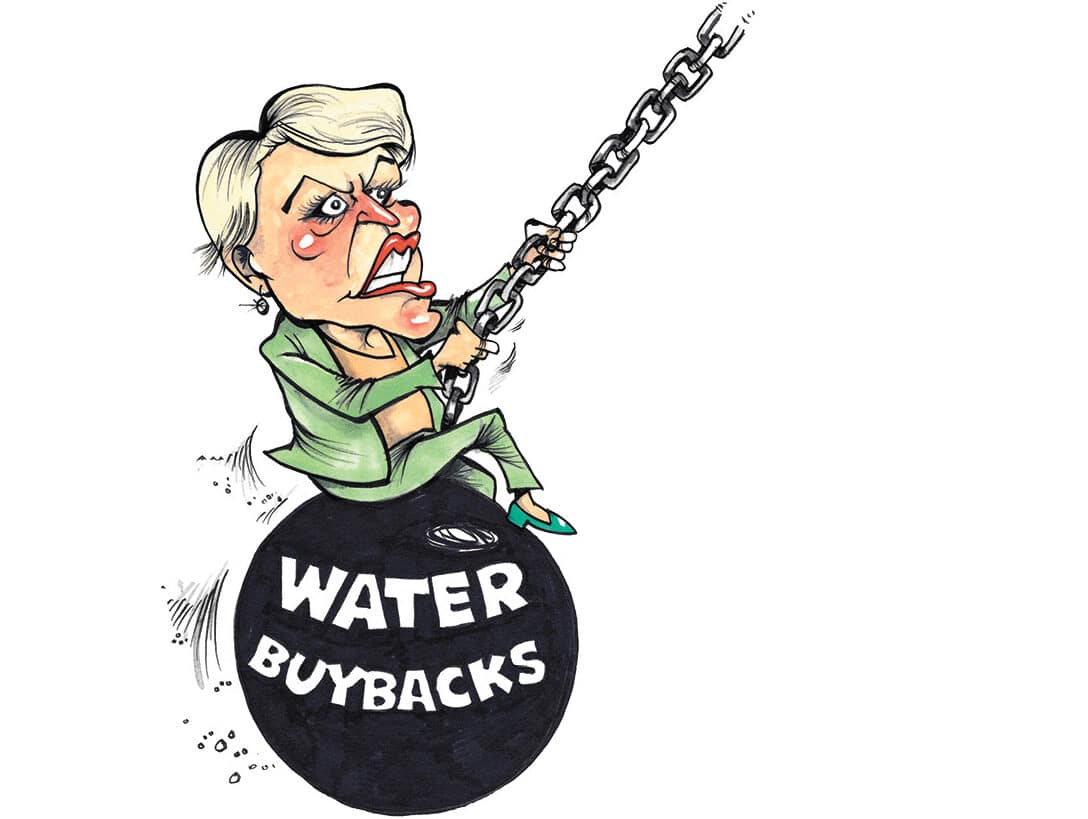
The plan appears to have moved past the noble intention of a balanced plan with a triple bottom line. Now fuelled by political motives, the political plan risks the viability of irrigation companies, food-producing industries, and locks many young Australians out of the chance to be an irrigation farmer.
Minister Plibersek seeks to remove another 750,000 megalitres (ML) from the productive pool. The productive pool is the 11,879,000ML of surface water that is legally allowed to be utilised from the Murray-Daring Basin 33,500,000ML inflows.
While the legally allowed take represents 35 per cent of basin inflows, not all of the water is used for agriculture. Environmental water holders at both state and federal levels have both purchased large volumes of the productive pool, 41 per cent to be exact.
The Commonwealth Environmental Water Holder in 2020 had 2,875,939ML, Victorian environmental water holdings on April 12, 2021 were 827,350ML, NSW had 929,993 at June 30, 2022, and SA 253,582ML, totalling 4,886,864. With an additional 750,000ML target, bringing the ambition to 5,636,864ML of held environmental water or 47 per cent of the productive pool water. Environmental water is a class of water not to be confused with all the other water in the environment like unregulated flows (floods), conveyance water, dilution flows, and even water transfers that flow down the same river.
Currently, the environmental water holder only uses about 70 per cent of their allocations, with carryover and water trading forming a big part of Australia’s largest irrigator’s operation.
Natural river constraints have been a thorn in the side of lofty political ambitions. Despite promises that the MDBA could use the full water recovery target within the constraints, the truth is that they desperately need the constraints relaxation project.
In a 2016 Hansard transcript, Russell James, then Executive Director, Policy and Planning Division at the MDBA, along with David Dreverman, Executive Director, River Management Division, MDBA and Colin Mues Executive Director, Environmental Management Division, MDBA all tried to reassure the Senate that constraints weren’t a problem to environmental objectives during a hearing on the social, economic and environmental impacts of the Murray-Darling Basin Plan on regional communities.
Mr James: Perhaps just to put it the other way: the Basin Plan was done on the basis that no particular additional constraints needed to be addressed. The 2,750 can be delivered without additional constraints being addressed. The constraints process does provide an opportunity to be more efficient and effective in the way that we do that, but we do not need that.
Chair: You do not need to flood anyone to meet your targets?
Mr Dreverman: Correct.
Mr James: We can use the existing rules to deliver the 2,750.
Senator Canavan: That is not quite what the chair asked. I have no debate that you could deliver 2,750 gigs of water—you would just do it in different ways. The plan, as I understand the plan, is not about delivering 2,750 gigs of water per se; it is about meeting certain environmental targets and protecting certain key environmental assets. I think that is the question the chair was getting to.
Can you meet those targets, those KPIs, without these easements?
Mr Mues: Once the Basin Plan was finalised, we developed the basin-wide environmental watering strategy, which went to quantifying the environmental outcomes that would be achieved under the plan, within the existing constraints as they stood at the time. We published that in terms of the outcomes—river connectivity, native birds, native fish and vegetation outcomes. Those outcomes were all achievable within the existing operating constraints at the time.
If these claims were true, why do we need NSW Reconnecting Rivers Program?
The sad reality is that everyday Australians are being dudded under a plan that enabled an almost $2 billion unregulated water trading industry to flourish while the governments work to further drive up the price of water and restrict its supply. A good water policy should achieve broad-scale environmental improvement, increased water availability and lower prices.
Even the advocacy of local governments fell on deaf political ears as mayors from the Murray River Group of Councils in northern Victoria spoke at Parliament House in Canberra to urge the Commonwealth to urgently rethink its approach to the Basin Plan.
Chair of the Murray River Group of Councils, Cr Ross Stanton warned that buying back water through one-on-one deals from anywhere across the southern Basin, without a strategic plan developed with communities, would be the worst outcome for all Australians.
“Open tender buybacks will have serious negative social impacts on our communities.
“They will have serious negative economic impacts on our businesses and our towns.
“Worst of all, they will not restore our region’s rivers or our valued floodplain ecosystems.
“When market forces alone determine how much and where water is recovered, it actually makes achieving environmental outcomes harder. This is because it concentrates environmental water in dams upstream and it’s more difficult to deliver to the ecosystems that need it,” Cr Stanton said.
Geoff Kendell of the Central Murray Environmental Floodplain Group said Minister Plibersek appears hell-bent on destroying family farmers.
“Today’s the day Minister Plibersek turned irrigated agriculture and its Victorian and NSW communities along the Murray into a ‘desert’ for food production and processing,” said Mr Kendell.
“No water, no farmers, no food, no you!
“Governments haven’t learned the lesson from Covid-19 showing Australia needs to be self-sufficient in food production and not rely on unregulated food imports from countries that don’t care about us.
“They have no vision.
“When will the penny drop and we start putting the Australian population’s needs first?”
National Irrigators Chair and Moulamein farmer Jeremy Morton was also bitterly disappointed with the government’s approach.
“It’s a bloody disgrace that we’ve ended up in this position and there’s a number of reasons why,” said Mr Morton.
“The Basin Plan is about the sustainable diversion limit, we’ve been at the sustainable diversion limit under the current regime and the previous one, so there’s no requirement to buy water other than the number they came up with in the Basin Plan process.
“It was all about getting us to the sustainable diversion limit, buying more water just means we are going to be using less water than the sustainable limit and has all the implications that it does, production and communities, it’s a bloody disgrace.
“The second bit is the minister has said all things are on the table, but they haven’t done anything else but announce a buyback; 70 per cent of the 100 gigs they announced they were going to put in the budget is in the first tender, and they also announced there’s going to be another couple.”
The government’s water targets have also been expanded to include indigenous water. While many believe the environmental water allocation would be a great place to achieve indigenous water priorities, the government seeks a traditional owners’ water bucket with plans to acquire 559,240ML. Will that be also purchased from the productive pool?
This article appeared in The Koondrook and Barham Bridge Newspaper, 18 July 2024.

